Property Management for Small Landlords in 2026
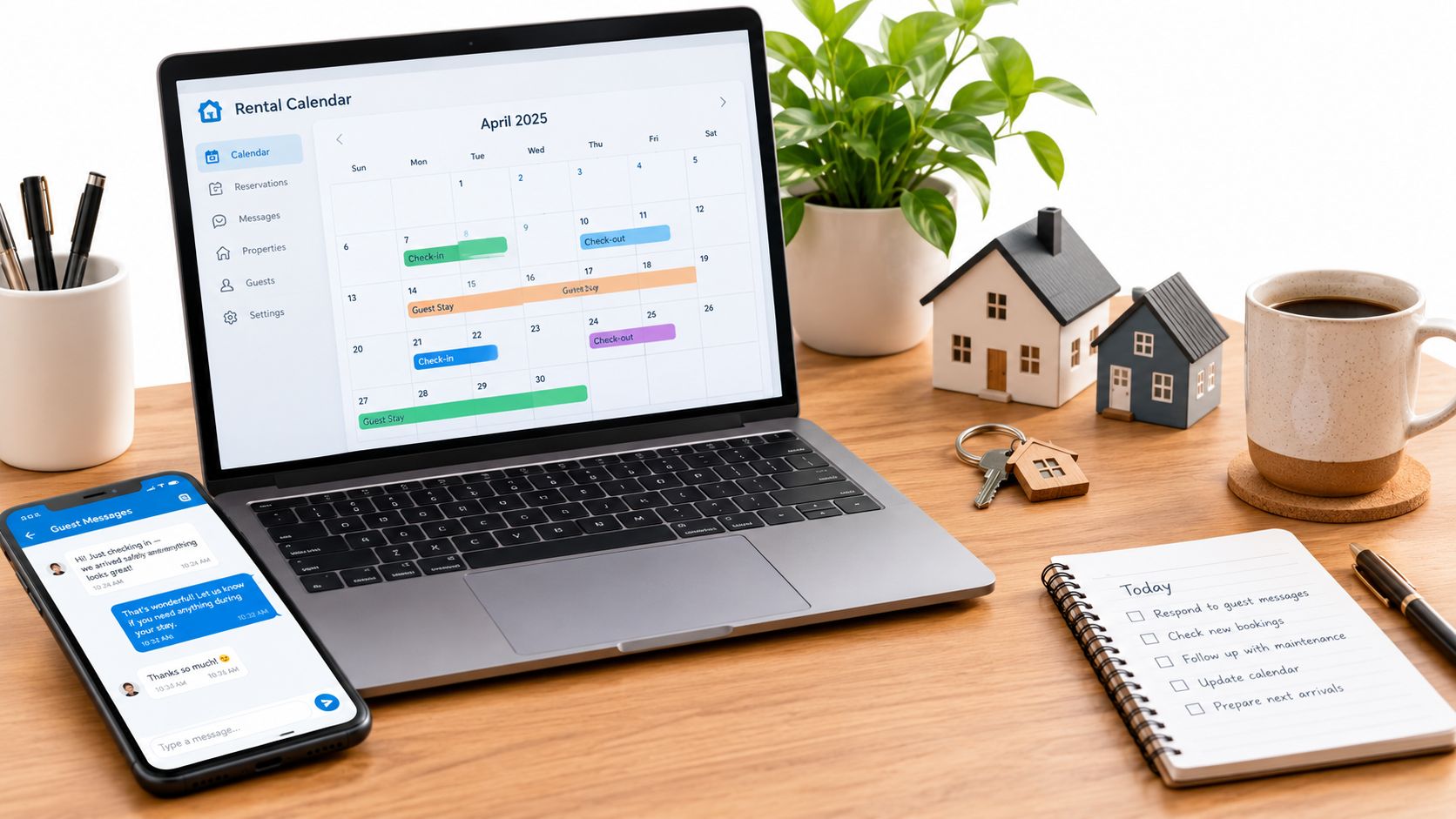
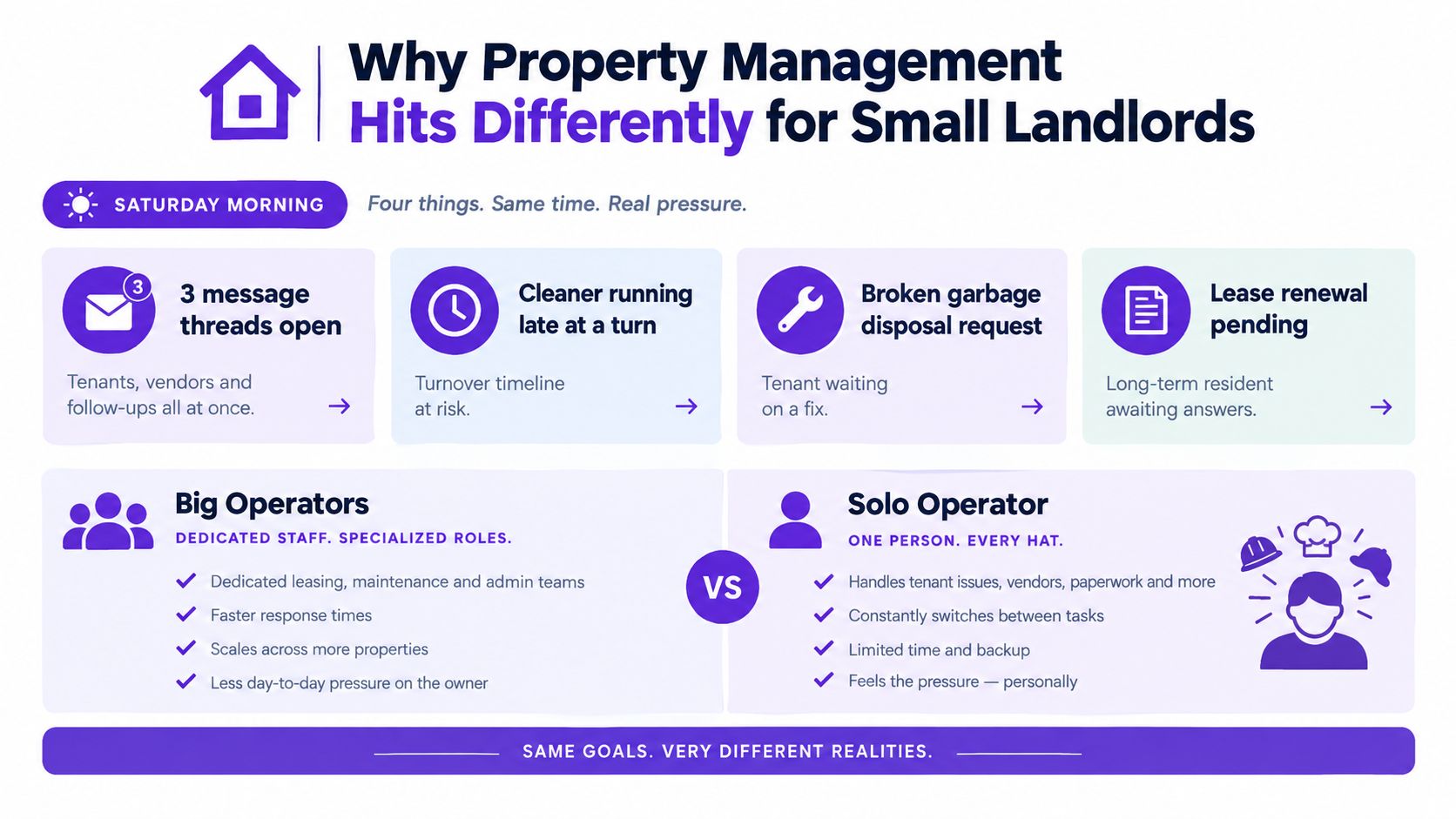
You know the feeling. It's Saturday morning, and the day is already splitting into four directions, one tenant wants to know when the garbage disposal gets fixed, the cleaner is running late at the turnover, a renewal is sitting in your drafts, and your inbox has three threads open before coffee. That's property management for small landlords in real life, not the tidy version people put in checklists.
The stress comes from the size of the portfolio, but also from the fact that small landlords are usually operating alone. An industry summary says 89.6% of investor-owned single-family rentals belong to landlords with 1 to 5 properties, and 80% of individually owned rental properties are managed by the owners themselves. It also says owners collectively manage 18.2 million rental units, averaging 1.89 units per landlord, which makes the job feel less like “owning a few rentals” and more like running a tiny operating business with no backup staff. Baselane's rental bookkeeping and accounting statistics show exactly why the load lands so hard.
The pressure usually shows up in three places. Turnovers leave you exposed when one clean or one lockbox handoff slips. Communication lag turns small issues into escalations. After-hours emergencies pull your attention away from your regular job, which is the part people forget when they talk about passive income.
That's why the right frame isn't “How do I stay organized?” It's “How do I build a system that stops every unit from demanding a fresh decision?” The rest of this guide treats the work like a capacity problem, because that's what it is.
Table of Contents
- Why Property Management Hits Differently for Small Landlords
- The Weekly and Monthly Workflow That Holds Everything Together
- Manual Tracking Versus Centralized Property Management Software
- Guest and Tenant Communication Templates That Save Hours
- Financial and Legal Basics Most Small Landlords Skip
- Building a Direct-Booking Channel That Beats the OTAs
- Scaling From One Unit to Six Without Burning Out
Why Property Management Hits Differently for Small Landlords
By the time a Saturday reaches 10 a.m., a big operator has a team spread across inboxes, vendors, and cleaning schedules. A small landlord often has the same volume of work, but every task lands on the same person. When one unit turns, one resident texts, and one lease renewal needs a decision, the whole portfolio feels like it's pressing from different sides at once.
That's why the pain isn't proportional to unit count. A four-unit owner isn't managing four separate businesses with shared infrastructure, they're juggling four separate timelines with one brain and one phone. Even simple delays, a late cleaner, a slow reply, a missed handoff, can ripple across occupancy, reputation, and cash flow.
Practical rule: if you're the one answering messages, coordinating vendors, and tracking rent, your portfolio is already an operations job, not just an ownership job.
The money side is just as unforgiving. When rent covers household expenses, a missed payment or a vacancy isn't a rounding error, it's a direct hit to the month. That's why small landlords tend to feel maintenance, renewals, and move-outs as urgent even when the issue looks minor on paper.
The shift is mental. Once you stop treating each message as an isolated interruption, you can build repeatable handling rules for it. That's what makes the next sections worth using, not just reading.
The Weekly and Monthly Workflow That Holds Everything Together
A small portfolio works when the calendar has a rhythm. Without one, every issue becomes a fire drill, and the portfolio starts living inside your inbox. The fix is to assign recurring tasks to recurring days, so you're not deciding from scratch every time.
Monday Review Block
Monday is for control, not action. Pull the week's rent roll, any open maintenance tickets, and the upcoming move dates, then scan for gaps before they turn into surprises. Confirm cleaners, vendors, and any key handoffs so you know where the week can break.
Keep the Monday pass short. If you spend the whole morning on admin, the rest of the week gets pushed into reactive mode.
Midweek Triage
By Wednesday, the focus shifts to messages and exceptions. Answer pre-arrival questions, late-payment notices, and maintenance updates in one sitting so conversations don't fragment across your day. A clean status note after each reply is more useful than a long thread you'll have to re-read later.
Friday Prep and the Monthly Close
Friday is the pre-arrival sweep. Check HVAC, confirm access instructions, and time welcome messages so they don't get buried. On the financial side, treat the first, the fifth, and month-end as fixed checkpoints, rent reconciliation first, vendor payouts second, expense categorization mid-month, and owner statements last.
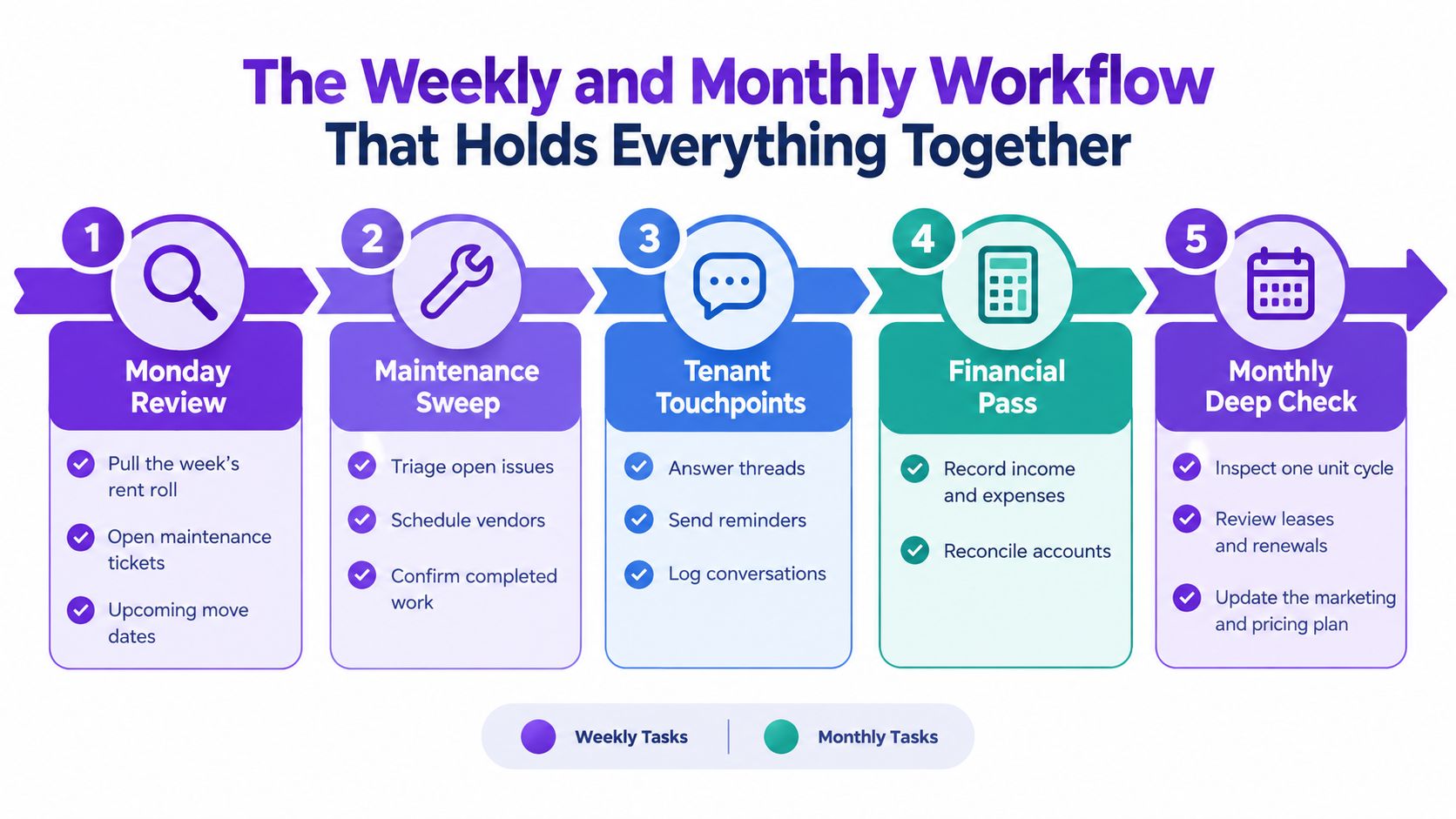
A good workflow leaves you with three things every week, a clean calendar, an updated ledger, and a short status note. If you can produce those under pressure, the portfolio stays manageable.
Manual Tracking Versus Centralized Property Management Software
A small landlord can get pretty far with a calendar, a spreadsheet, email, and a chat thread. I've run four units that way, and it works until one booking change, late rent note, or maintenance reply sits in the wrong place. Then you spend time stitching the whole picture back together.
The problem is not spreadsheets themselves. It is the constant reassembly of the same unit-by-unit picture across separate tools. Centralized property management software matters because it keeps calendar, payment, messaging, and maintenance in one place, which matters even more if you are also trying to build a direct-booking channel and keep availability synced without manual checks. The small-landlord software discussion is a useful place to compare that setup against a manual workflow.
| Metric | Manual Tracking (Spreadsheets + Email) | Centralized Software |
|---|---|---|
| Calendar control | Easy to miss overlaps when dates live in separate tools | One view for bookings, blocks, and availability |
| Communication | Threads scatter across inboxes and texts | Unified inbox keeps tenant and guest context together |
| Payment follow-up | Reminder timing depends on memory | Scheduled reminders reduce manual chasing |
| Maintenance tracking | Requests get buried in messages | Tickets and status updates stay attached to the unit |
| Financial review | Takes extra time to rebuild the month | Income and expense records stay in one place |
Landlord software surveys report that about 75% of small landlords see efficiency gains after adopting property-management software, with reported time savings of up to 15 hours per week and annual savings around $5,000. Those numbers are not the point by themselves. The point is that the time savings show up in fewer follow-ups, fewer duplicate checks, and less context lost between tools.
For a landlord with one or two simple units, manual tracking can still hold together. Once you start repeating the same coordination work every week, software usually costs less than the hours it takes to keep the system patched by hand.
Guest and Tenant Communication Templates That Save Hours
The fastest way to lose time is to write the same message from scratch every week. Most small landlords don't need more communication, they need better timing and less typing. A few templates cover the most repetitive touchpoints without turning the relationship robotic.
Pre-arrival instructions
Send this 48 hours before arrival.
Hi [Name], your check-in details are ready. Door code, [code]. Parking, [spot or instructions]. Wi-Fi, [network and password]. Trash day is [day]. Emergency contact, [contact]. Reply if anything looks off.
That message cuts back-and-forth because it bundles the basics in one place. The blanks should stay blank until you fill them with unit-specific details.
Check-in and Wi-Fi details
Send this the morning of arrival or when the unit becomes available.
- Access steps: remind the guest or tenant of the exact entry process.
- Connection details: list the network name and password in one scannable block.
- House rules: include the one or two items people miss most often, not a long policy dump.
Mid-stay nudge
Send this halfway through a stay or a few days after move-in for a mid-term tenant.
Hi [Name], checking in to make sure everything's working as expected. If anything needs attention, send it now so I can fix it before it turns into a bigger issue.
That one line catches problems early and buys goodwill without sounding scripted. It works best when it's short.
Renewal or review request
For renewals, send the note before the deadline. For reviews, send it after checkout plus a couple of hours, once the stay is still fresh. The request should be direct, polite, and tied to the next action you want.
If you want a structured confirmation flow for bookings, the setup in this reservation confirmation guide fits neatly next to these templates. The point is to automate the routine, not the human part of the relationship.
Financial and Legal Basics Most Small Landlords Skip
Small landlords usually know what a repair costs. They're less likely to know what weak bookkeeping, vague insurance coverage, or a missing registration can cost over time. That's the problem, because the expensive mistakes usually start as paperwork omissions, not dramatic failures.
Where margin leaks first
Separate operating and tax accounts from day one. That keeps rent, repairs, and owner draws from blending into one unreadable cash pile. If you're collecting rent in one account and paying vendors from another, the bookkeeping becomes faster and the tax season cleanup gets less painful.
Vacancy deserves the same discipline. Recent summaries cite a national U.S. rental vacancy rate of 6.9% to 7.3% in 2026 in the market at large, and one 2026 property-management summary says landlords lose up to $3,872 for each vacant rental unit, while another estimates vacancy at about $1,795 per month per empty unit and around $1,825 per vacancy event. RentPost's property management statistics make the pressure easy to see, vacancy is not an abstract operating ratio, it's a cash-flow event.
What gets overlooked legally
Short-term use often needs more than a standard long-term mindset. Landlord insurance, local licensing, occupancy tax registration, and lease language around unauthorized guests and pets all matter because they define what happens when a stay goes sideways. If the paperwork doesn't match the actual use of the unit, the risk sits with you.
| Skipped Item | Typical Risk | Estimated Annual Impact |
|---|---|---|
| Separate operating and tax accounts | Messy records and harder tax prep | Harder-to-measure admin loss |
| Vacancy planning | Lost rent during empty periods | Up to $3,872 per vacant unit, per the 2026 summary cited above |
| Guest and pet clauses | Unauthorized use and dispute risk | Legal and cleaning exposure |
| Insurance review for short-term use | Coverage gaps if use changes | Potential claim denial or premium shock |
| Local registration and taxes | Fines or delayed compliance | Varies by local rule |
A clean compliance pass can be done in an afternoon if you keep it practical. Check the account structure, insurance, local registration, tax setup, guest rules, pet rules, late-fee language, move-out procedures, deposit handling, and renewal notices. If those ten items are clean, you're already ahead of most small operators.
Building a Direct-Booking Channel That Beats the OTAs
For vacation rentals and mixed portfolios, a direct-booking site should sit inside the operating system, not beside it. The channel changes stay length, calendar control, and the guest data you keep. For a small landlord, that matters because every booking decision has to fit a finite amount of attention and turnover capacity.
Independent 2026 reporting says direct bookings for short-term rentals can produce 45.2% longer average stays and 51.3% longer booking windows than OTA bookings. Longer stays cut turnover frequency, and a longer booking window gives earlier visibility into demand. It also reduces the odds that your calendar gets managed on the edge of arrival day. Houfy's direct-booking statistics roundup is a useful reference point for the channel mix discussion.
What the channel needs to do
A practical setup has four parts. First, a hosted site with branded property pages and live availability. Second, payment handling for deposits and refunds. Third, a channel manager or calendar sync so Airbnb, Vrbo, and direct requests do not collide. Fourth, pricing rules that let you change rates without editing every listing by hand.
The value is control as much as sales. Direct channels let you collect guest details, send repeat offers, and set stay rules that OTAs do not prioritize for you. That is why many small operators use the site as the front door and the OTA as the fill-in channel. For a detailed comparison of channel economics, see the OTA vs. direct booking breakdown.
A rollout order that won't wreck your ranking
Publish the direct site before you cut back on OTA effort. Then connect synced calendars, then turn on pricing rules, then invite repeat guests to book direct next time. If you switch everything at once, you can create gaps you will not catch quickly.
A hosted option like Rentabble fits that model because it combines a branded rental site with availability, booking requests, and calendar sync in one place. That setup works when you want the direct channel without building a custom website from scratch.
The margin story is only part of it. Once the direct channel is live, every repeat guest is easier to rebook without paying marketplace fees on the same relationship.
Scaling From One Unit to Six Without Burning Out
The break point for small landlords is rarely a dramatic crisis. It's the moment repeated coordination starts crowding out everything else. Three or four units can still feel manageable if the turns are simple, but the weekend load gets ugly fast once check-ins, cleanings, and guest questions overlap.
Where help starts to pay for itself
A cleaner is usually the first hire because they remove the most visible bottleneck. A part-time coordinator makes sense when you're spending too much time on messages, handoffs, and vendor chasing. A channel manager becomes worth it once multiple listings create enough overlap risk that manual updates feel brittle.
Rule of thumb: when one missed update creates two or three follow-up tasks, you've already outgrown the manual process.
The better question isn't “Can I still do this myself?” It's “What task needs a human, and what task needs a system?” Humans should handle judgment, tone, and exceptions. Software should handle calendar sync, reminders, and recurring records.
A 90-day path from solo management to a sturdier setup
Days 1 to 30. Standardize cleaning checklists, create one inbox for all tenant and guest communication, and decide where every document lives. Don't expand the tool stack yet. Make the current mess visible first.
Days 31 to 60. Move into centralized software and connect direct-booking calendars so blocks and reservations stay aligned. Set up the workflows that keep rent, maintenance, and messages in the same place.
Days 61 to 90. Test pricing rules, decide whether the first part-time hire is justified, and document each repeatable process so the next unit doesn't create a new system from scratch.
The trap is over-investing too early. Fancy tooling can eat the margin that should fund better help later. A small landlord wins by tightening the workflow first, then adding software and labor only where the recurring friction justifies it.
If you're running a small portfolio and want the booking side, calendar sync, and request flow in one place, Rentabble gives you a hosted direct-booking website built for self-managing owners. It's a practical fit when you want to reduce OTA dependence without adding custom development work, and you can see how it maps to your own setup at Rentabble.