Property Rental Website Guide: Build Direct Bookings Fast
The popular advice is to build a property rental website, add attractive photos, and wait for direct bookings. That approach leaves out the difficult part. A website doesn't create demand by itself, and it won't persuade guests to leave Airbnb or Booking.com unless it makes the direct option clearer, safer, and easier.
The practical objective is narrower and more valuable: turn existing interest into owned reservations. That means live availability, transparent pricing, persuasive property pages, reliable calendar synchronization, search visibility, and a booking flow that removes uncertainty before the guest has to contact you.
Table of Contents
- Why Property Owners Are Leaving Marketplaces
- Core Components of a High-Converting Website
- Building Property Pages That Sell
- Direct Booking vs Marketplace Comparison
- Technical SEO and Multilingual Support
- Overcoming Guest Awareness Barriers
- Conversion Optimization and Quick Tips
- Future-Proofing Your Rental Business
Why Property Owners Are Leaving Marketplaces
Marketplaces solve discovery, but they also rent owners access to their own demand. Built-in search, payments, reviews, and guest messaging help a property attract its first reservations. They do not create a lasting customer relationship. The risk begins when borrowed visibility becomes the entire booking strategy.
A guest who books through an OTA may remember the platform more clearly than the apartment. On a future trip, the marketplace controls the search results, pricing context, and much of the communication. The owner still delivers the stay, but has less influence over how the next reservation is made.
Direct channels now provide a meaningful alternative. In a 2024 U.S. dataset cited in later industry reporting, direct-booking websites accounted for nearly 34% of bookings, behind Airbnb's 46% share, according to recent vacation-rental channel data. That figure points to a practical opportunity: owners do not need to replace marketplace demand overnight. They need a website and follow-up process that convert guests who already know the property, discover it through search, or arrive through referrals.
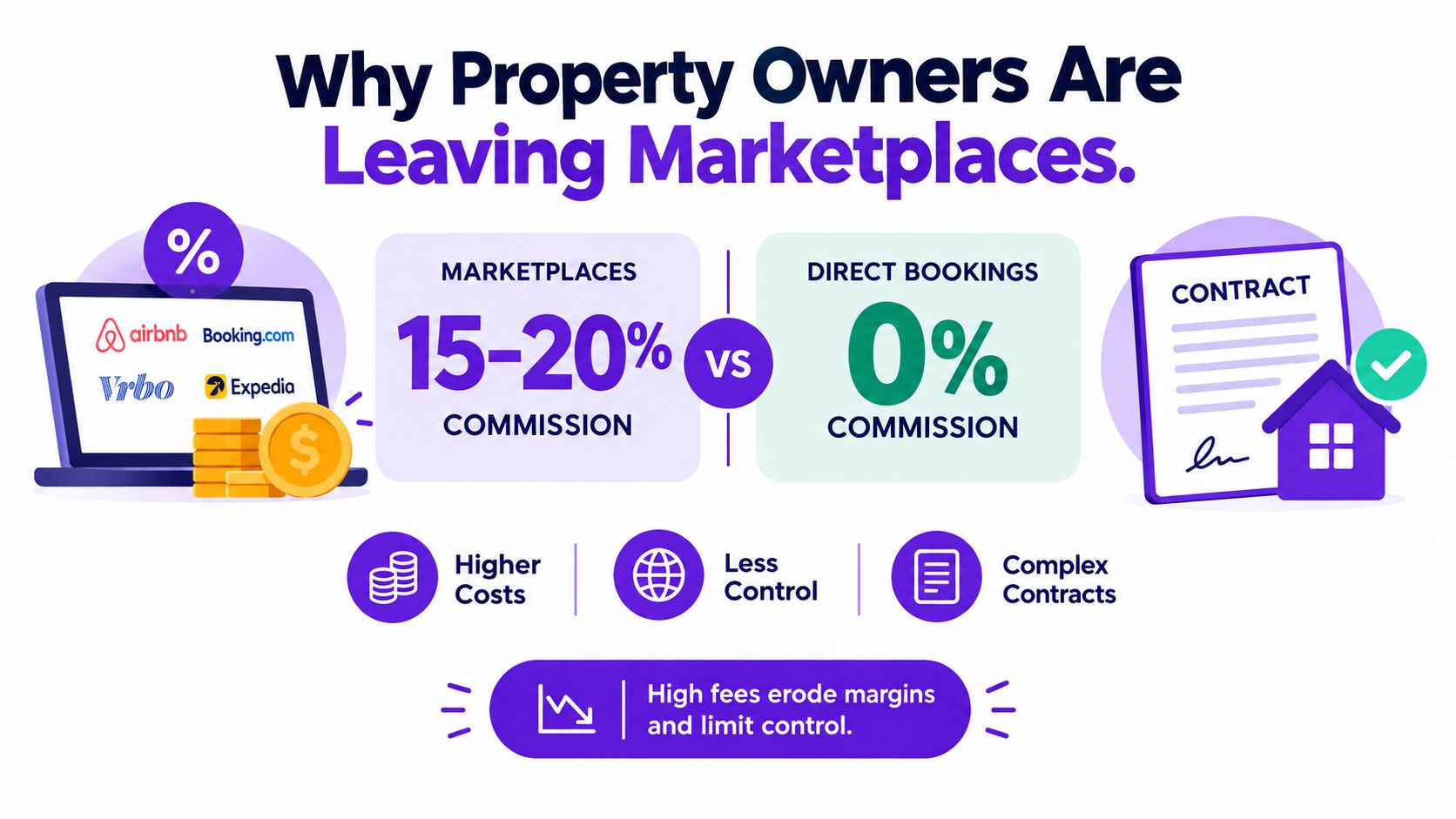
The strongest model uses both channels for different jobs. Marketplaces provide reach, while the property rental website gives repeat guests, social followers, local search visitors, and referral traffic a clear place to book. The site must earn that choice with transparent terms, credible property information, and a booking path that feels easier than sending another platform message.
The ownership problem
Manual availability checks waste leads. An owner may open Airbnb, check Booking.com, review a spreadsheet, calculate a rate, and reply after the guest has contacted other properties. Each handoff adds delay and creates another opportunity for an incorrect quote.
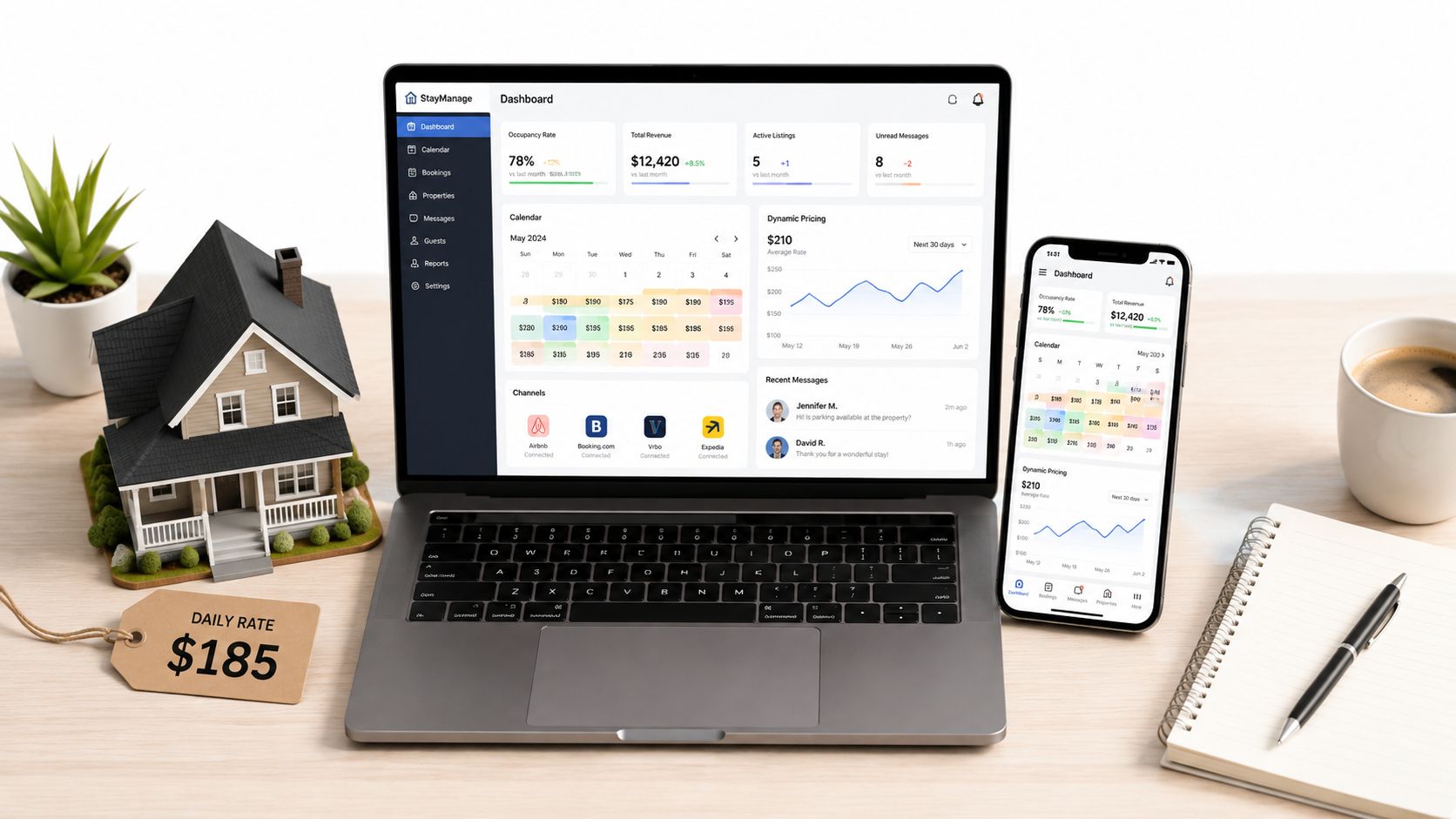
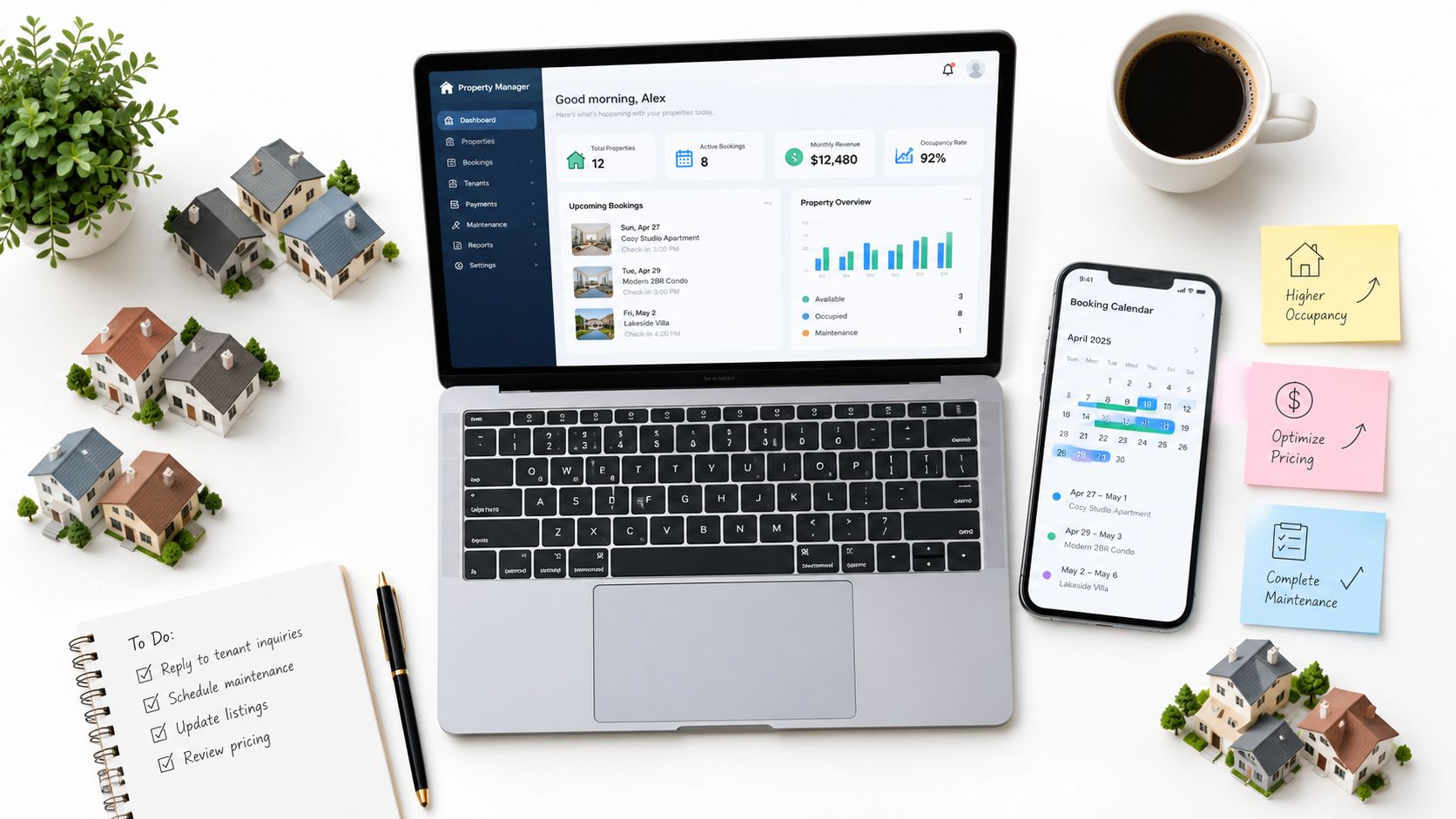
A direct website can centralize calendars, display current availability, and calculate the reservation total before a guest submits a request. Two-way iCal synchronization keeps external calendars aligned while the owner gradually moves qualified demand to an owned channel.
Practical rule: Keep marketplaces for discovery, but make your website the clearest destination for guests who already know the property or want to return.
Core Components of a High-Converting Website
A property rental website does not convert because it looks polished. It converts when guests can verify the stay, see an accurate price, trust the operator, and complete a booking without unnecessary messages. The core system combines presentation, availability, pricing, trust, and search structure. Remove one, and the visitor must resolve that uncertainty alone.
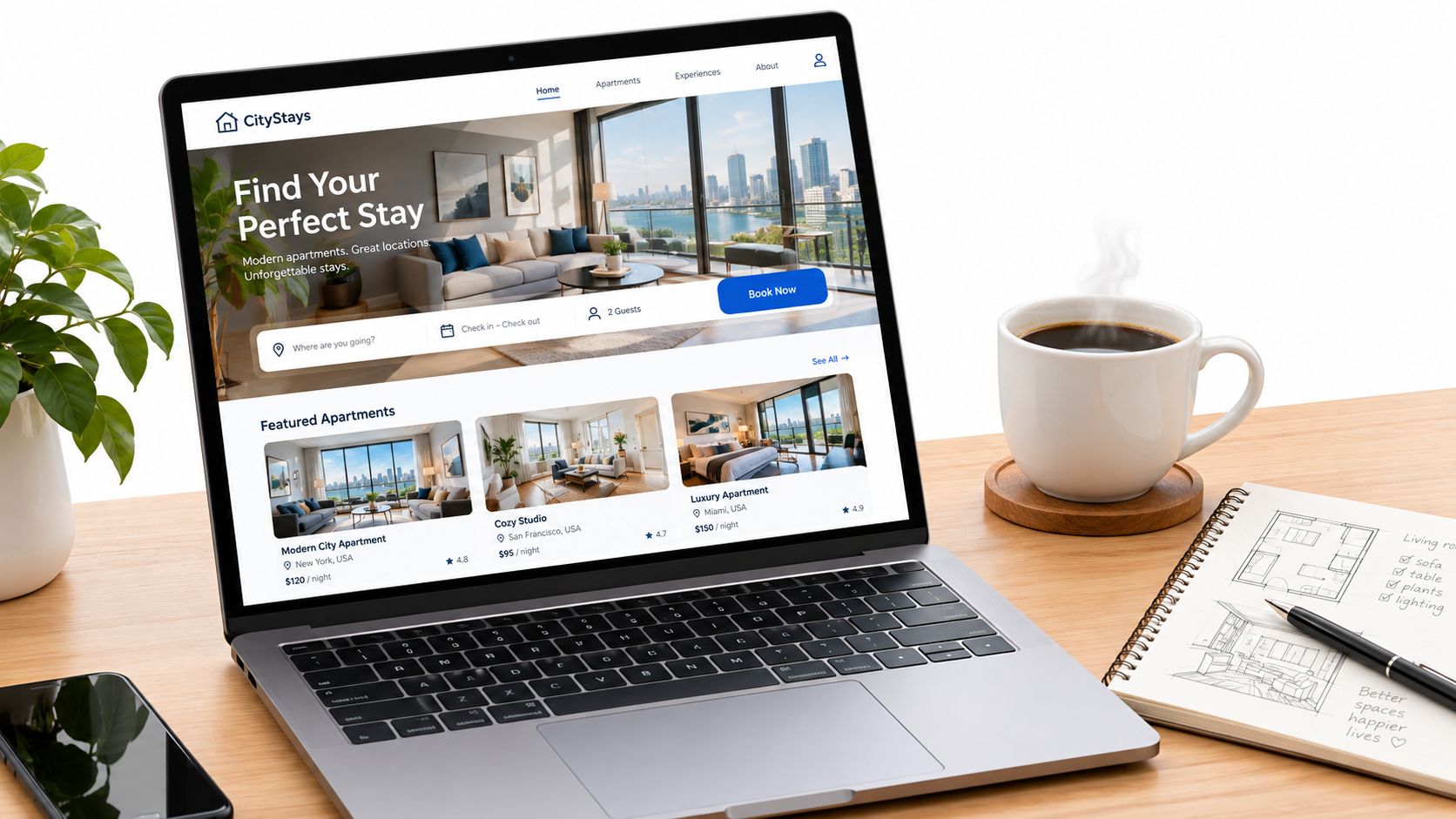
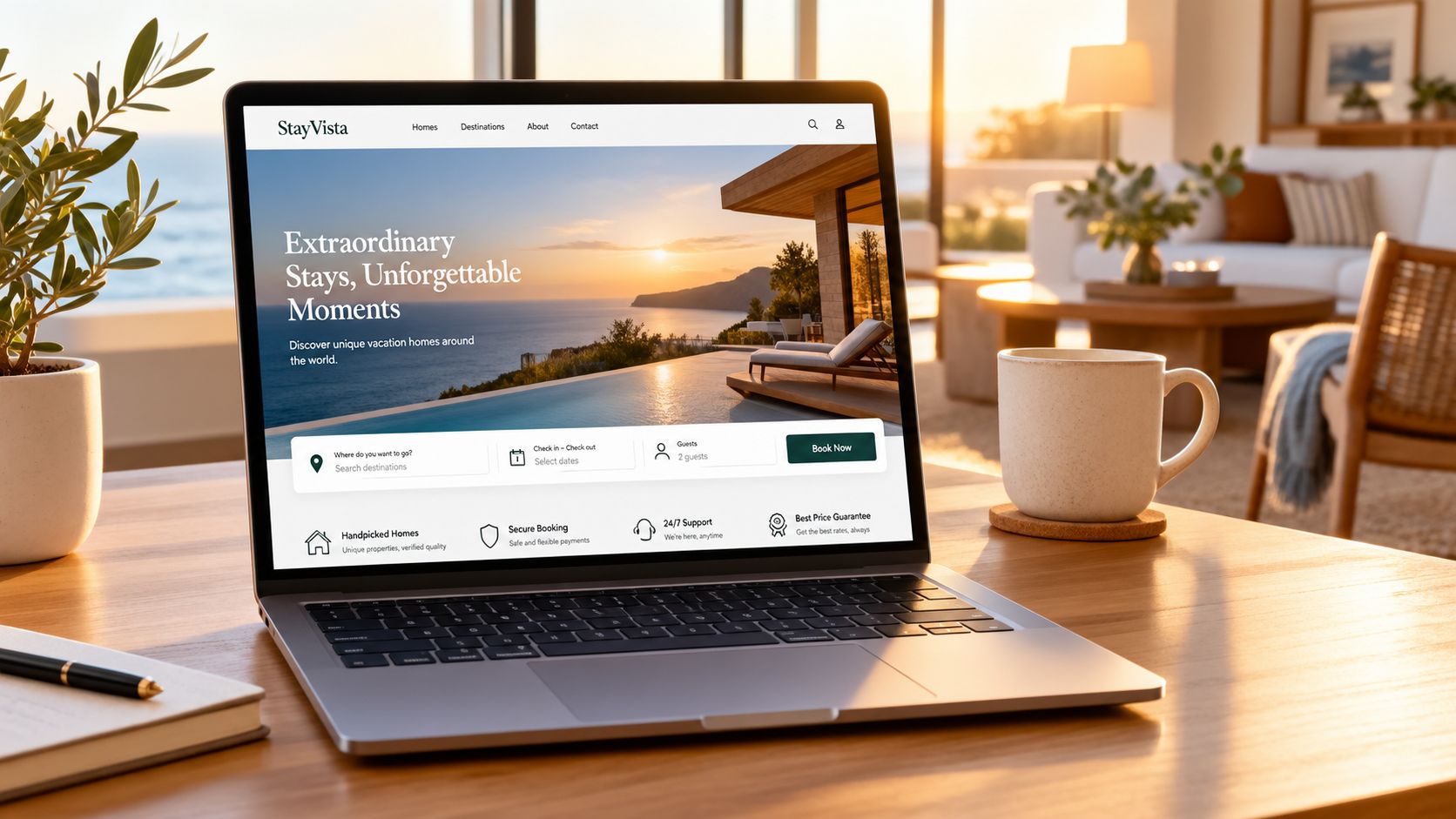
Give every apartment or home its own page. The homepage can establish the location and brand, while property pages answer practical questions about photos, sleeping arrangements, amenities, house rules, and location. Put date search and a clear booking action beside that information. A gallery without availability behaves like a brochure. Availability without context asks guests to trust a form before they understand the stay.
Conversion work should follow actual booking behavior, not design preference. Direct guests may plan differently from marketplace guests, so review booking windows, stay length, cancellation patterns, and completed bookings by channel. Those measures show whether the site attracts valuable demand, even when direct booking volume remains smaller. They also reveal which questions your content must answer before a guest contacts you.
The operating layer
Connect the website to the tools that remove avoidable work:
- Availability: Show booked and blocked dates from one central calendar.
- Pricing: Apply seasonal rates, minimum stays, check-in rules, and discounts consistently.
- Requests: Let guests see an automatically calculated total before asking for a quote.
- Protection: Prevent overlapping reservations when a request is confirmed.
- Trust: Display reviews, contact details, policies, and clear payment or request expectations.
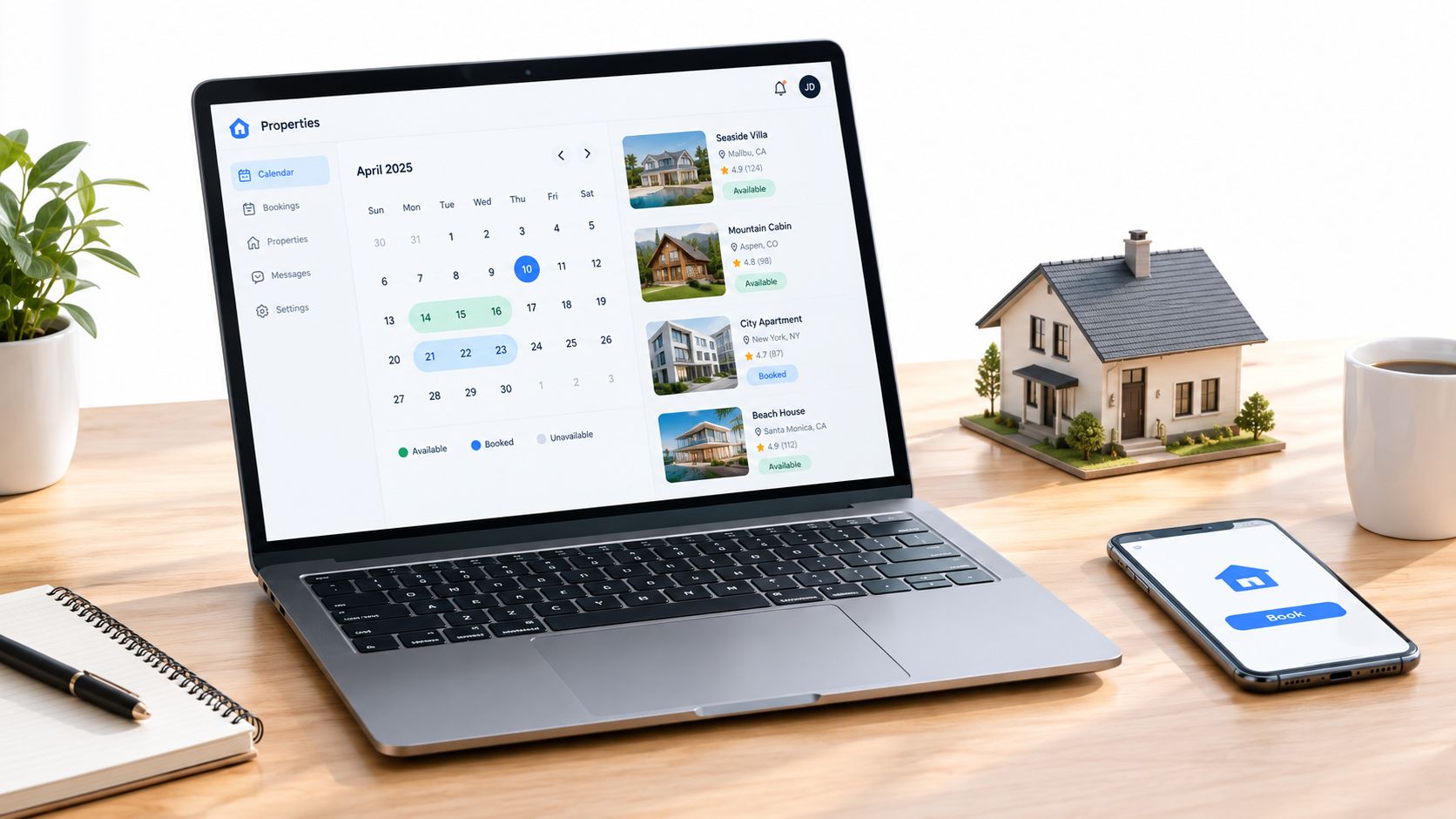
A rental availability calendar helps only when it matches the same operational truth as marketplace calendars. Manual updates create false confidence, especially when a guest sees open dates that are no longer bookable.
Your content should reflect the questions that block conversion. Add clear explanations for arrival, payment, cancellation, occupancy, and availability rules instead of forcing guests to send a message for basic answers. Review search queries and on-site behavior to decide which property details deserve more prominence.
The video below works as an implementation prompt. Compare each feature with the steps guests currently take on your website.
Building Property Pages That Sell
A property page should answer the guest's main questions before the booking request begins. Start with a clear title that identifies the accommodation and its strongest practical benefit. “Two-bedroom apartment near the old town with balcony” gives a visitor more direction than “Beautiful holiday home.”
Build the page in booking order
Lead with evidence. Use bright, accurate photos of the exterior, living areas, bedrooms, bathrooms, kitchen, outdoor space, and views. Show the layout accurately rather than relying on heavily edited images.
Explain the stay. Describe who the property suits, how the space is arranged, what guests can use, and what they should know before arrival. Replace empty language such as “luxurious” with observable details.
List decisions, not decoration. Include beds, bathrooms, air conditioning, Wi-Fi, parking, laundry, outdoor areas, accessibility information, pet rules, and relevant restrictions. Add distances to recognizable places, transport, beaches, restaurants, or business areas.
Put the date search near the decision point. Guests shouldn't have to return to the homepage to check availability. Show the calendar, minimum-stay rules, and complete total as close to the property details as possible.
Make policies visible. Cancellation terms, check-in arrangements, deposit requirements, and response expectations should appear before the guest submits a request.
The page also needs a clean technical identity. Give every property one canonical URL, keep that path stable, and avoid creating separate indexable versions for every filter, tracking parameter, or calendar state. Structured data can then reinforce the page's meaning through LodgingBusiness or VacationRental, a property-level Accommodation, and BreadcrumbList markup.
Write for people and crawlers
Structured data doesn't compensate for thin content or inaccurate details. Search engines need consistent names, locations, amenities, and page relationships, while guests need confidence that the advertised property matches the stay they'll receive.
Use internal links from destination pages, local guides, and relevant blog posts to the property page. Keep the booking action persistent on mobile, where cramped layouts and hidden totals often cause visitors to abandon the process before they understand the offer.
Direct Booking vs Marketplace Comparison
The right channel depends on what you need the channel to do. A marketplace supplies built-in demand and familiar trust mechanisms, but it controls the presentation and the customer journey. A direct website gives you more control, but you must bring visitors through search, referrals, repeat guests, social content, email, or marketplace follow-up that complies with applicable platform rules.
| Feature | Direct Booking Website | Marketplace, Airbnb or Booking |
|---|---|---|
| Revenue model | No commission on direct booking requests when the platform uses a subscription model | Commission and marketplace-specific commercial terms |
| Demand | Requires your own promotion, search visibility, and repeat-guest strategy | Built-in marketplace discovery |
| Branding | Control over logo, copy, photos, domain, and page structure | Listing format and presentation follow platform rules |
| Guest relationship | Direct communication and a clearer path for future rebooking | Relationship is mediated by the marketplace |
| Calendar integrity | Can use two-way iCal synchronization and central availability management | Marketplace calendar is native to the platform, with external synchronization needs |
| Pricing display | You control the page and can show the exact total before a request | Platform controls much of the pricing presentation |
| Setup | Hosted tools can go live in hours, depending on content readiness | Listing setup can also be fast, but depends on platform verification and content requirements |
| SEO | Your pages can be optimized for relevant searches | Marketplace pages benefit from platform demand, but you don't control their SEO structure |
| Operational burden | You manage traffic generation and direct guest communication | The platform provides more built-in distribution and standardized workflows |
The trade-off is not just commission versus subscription. It's control versus immediate reach. A direct channel works poorly if the owner never updates dates, hides fees, or answers requests promptly. A marketplace works poorly as a sole strategy if repeat guests can't find a clear owned channel for future stays.
For small operators, the sensible arrangement is often additive. Keep the channels that produce qualified demand, synchronize their calendars, and use the property rental website to own the brand, the content, and the repeat-booking path.
Technical SEO and Multilingual Support
Technical SEO and guest experience reinforce each other when they describe the same inventory accurately. A sitemap helps search engines discover pages, but it doesn't help much if those pages lead to unavailable dates or unclear prices. Secure hosting protects trust, while regular backups and email notifications protect the owner from operational surprises.

A multilingual site should translate the booking experience, not only the homepage. If English and Croatian visitors can read the property description but encounter untranslated policies, amenities, or confirmation messages, the language switch creates a partial experience rather than confidence.
Build the system around one source of truth
Keep property names, amenities, prices, restrictions, and availability consistent across language versions and channels. Use clear language selectors, indexable language pages where appropriate, and localized titles that reflect how guests search in each market. Don't machine-translate important safety, cancellation, or arrival instructions without reviewing the result.
A vacation-rental SEO checklist should sit alongside operational checks. Review canonical URLs, sitemap output, mobile rendering, structured data, internal links, image descriptions, and broken booking paths. Then test the actual guest journey from search result to date selection to request confirmation.
Calendar synchronization completes the loop. When the site, Airbnb, Booking.com, and other connected channels share updated availability, search visibility doesn't send visitors toward dates that are no longer open. Email notifications alert the owner to requests and changes, while backups preserve the site's content and settings if something goes wrong.
This is why a hosted system can suit owners without development teams. The owner still needs to provide accurate content and make commercial decisions, but hosting, maintenance, security, and core synchronization don't have to become separate technical projects.
Overcoming Guest Awareness Barriers
A property rental website doesn't win just because it exists. Guests need a reason to change a familiar behavior, and the owner has to explain that reason without sounding defensive or vague.
In a 2026 owner survey, 60.2% identified guest awareness of the benefits of booking direct as their biggest barrier, while 61.3% said most bookings came through direct channels or repeat guests, according to the owner survey coverage. That contrast matters. Owners may already have direct demand, but many still fail to make the direct path obvious to the people most likely to use it.
Give visitors a concrete reason
“Book direct” is not a benefit by itself. Explain what the guest receives or avoids, and make the explanation match your actual policies.
- Show the complete price: Display the accommodation price, required fees, discounts, and total before the request is sent. Avoid forcing a guest to start a conversation to learn the cost.
- Make availability credible: Use a live calendar connected to the channels you operate. A guest who sees a date request rejected after submitting it loses confidence quickly.
- Prove who operates the property: Include a real contact method, business information where relevant, guest reviews, arrival details, and photographs that answer practical questions.
- Capture repeat demand: Give past guests a memorable domain, a simple rebooking route, and permission-based follow-up that helps them return without searching a marketplace again.
- Answer objections on the page: Address cancellation, payment timing, check-in, cleaning, parking, accessibility, and support before the guest has to ask.
Content strategy should follow these objections. A blog post about how to build a website may attract owners, but a page explaining direct-booking value, transparent pricing, local expertise, and repeat-stay convenience helps persuade guests.
The site should also make the marketplace comparison fair. Don't promise unavailable discounts or hide terms. State what direct booking changes, then deliver that experience consistently.
Conversion Optimization and Quick Tips
Direct-booking rental sites usually convert a small share of visits. One industry benchmark places booking conversion around 1.5% to 4%, while another direct-booking benchmark reports a 1.9% median for a single-property vacation-rental site, according to the rental conversion-rate benchmark. Treat those figures as directional, not as a target that every property should automatically reach.
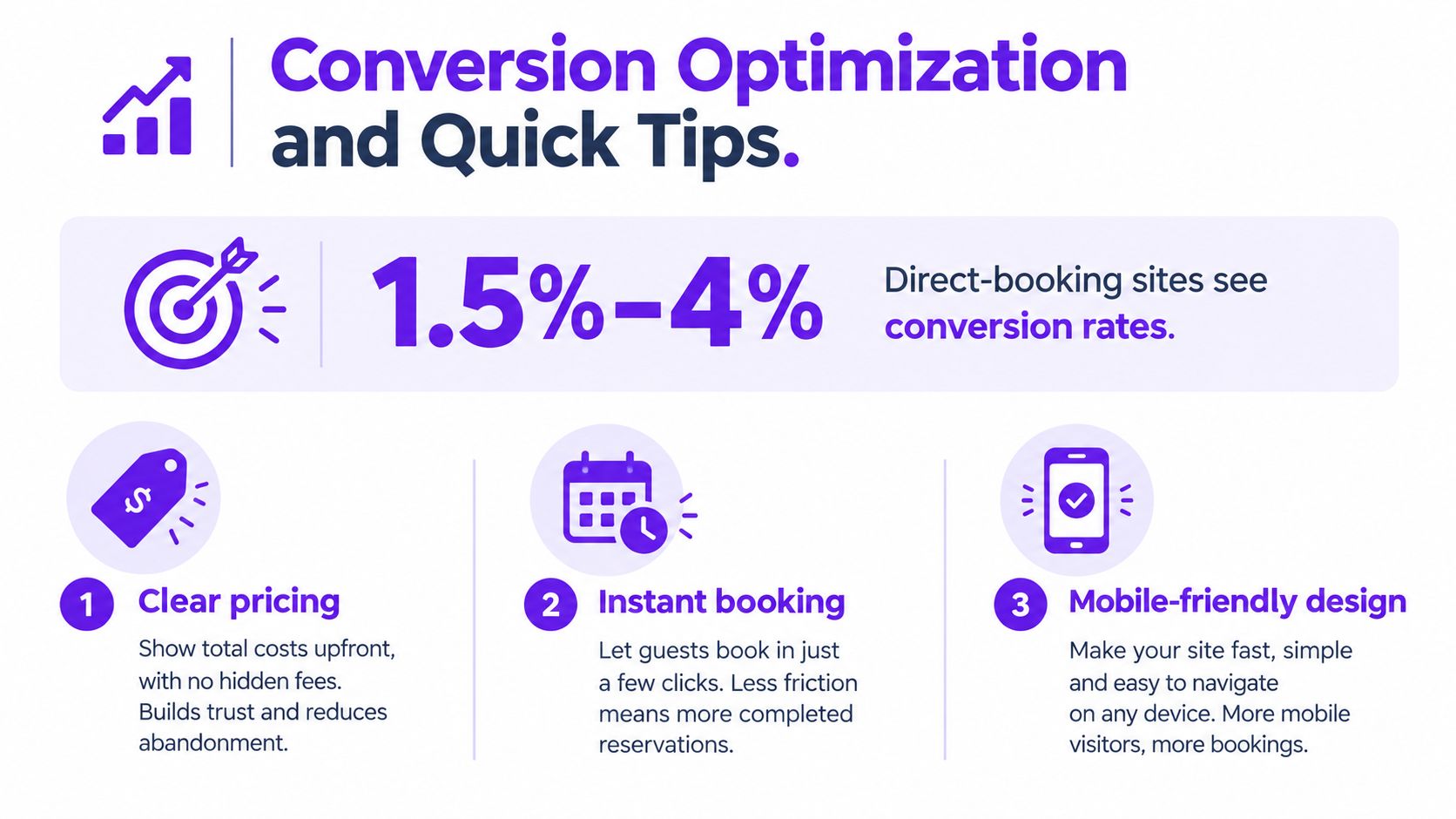
Start with the first screen on mobile. The visitor should understand the property, location, availability action, and basic price context without waiting for a heavy image carousel or hunting through menus.
Remove friction in order
Speed up the decision. Compress images, remove unnecessary scripts, and make the date picker responsive. Slow pages make every later improvement less effective.
Show the price early. Let guests select dates and see an automatically calculated total, including applicable fees and discounts. A request form that promises a later quote creates work for both sides.
Strengthen trust at the booking point. Place reviews, contact details, policies, secure hosting signals, and clear next steps close to the request action. Trust information buried in the footer arrives too late.
Use pricing rules deliberately. Seasonal rate periods, minimum stays, allowed check-in days, and configurable discounts should reflect how you sell nights. Don't create a complicated price grid that guests can't understand.
Confirm the request clearly. A reservation confirmation process should tell the guest what was requested, the dates, the total, and what happens next. Send the owner a matching notification so no request sits unanswered.
Measure the funnel by stage: property-page visits, date searches, price views, request starts, completed requests, and confirmed bookings. If visitors view dates but don't start a request, examine price clarity and trust. If they start but abandon, inspect form length, mobile usability, payment expectations, and error messages before changing the headline.
Future-Proofing Your Rental Business
Owning a booking channel doesn't mean rejecting every marketplace. It means refusing to let a third party remain the only place where guests can discover your availability, understand your property, and return to you.
The channel mix is changing, but OTAs still matter. A 2026 industry outlook forecasts that direct-booking websites will grow at an 8.5% compound annual growth rate through 2031, even though OTAs held 81.4% of the U.S. short-term-rental market in 2025, according to the U.S. short-term vacation-rental market outlook. Because that growth is a projection, owners shouldn't treat it as permission to stop acquiring marketplace demand. They should use it as a reason to build a second channel before they urgently need one.
Make the website an operating asset
The durable setup connects four pieces:
- Distribution: Keep suitable marketplaces, metasearch, referrals, and repeat-guest paths working together.
- Operations: Synchronize calendars, block unavailable dates, apply pricing rules, and notify the owner when requests arrive.
- Discovery: Give every property a stable page, useful local content, clear internal links, a sitemap, and appropriate structured data.
- Conversion: Show accurate prices, live availability, credible reviews, clear policies, and a short booking-request flow.
Audit your current process from the guest's perspective. Search for the property name, open the site on a phone, check dates, calculate the total, submit a request, and read the confirmation. Then test the owner's side: does the calendar update, does the notification arrive, and can the request be accepted without retyping information?
Fix the biggest failure first. If the site has no traffic, improve distribution and search content. If it has traffic but few requests, improve price transparency and trust. If requests create manual work or calendar risk, fix synchronization and automation. A phased migration works better than a dramatic marketplace exit because each improvement can be tested against real operations.
Rentabble provides a hosted property rental website with branded property pages, live availability, exact price calculation, booking requests, seasonal pricing, and two-way iCal synchronization with channels such as Airbnb and Booking.com. Visit Rentabble to review the platform and create a direct-booking setup that supports your current marketplace strategy while building an owned path for future guests.