Vacation Rental SEO How to Rank and Get Direct Bookings
You've polished the photos, connected your calendars, and added a booking form. Then a traveler searches for an apartment in your destination, clicks an online marketplace, and never sees your website. You still pay for the booking, while the guest relationship stays with someone else.
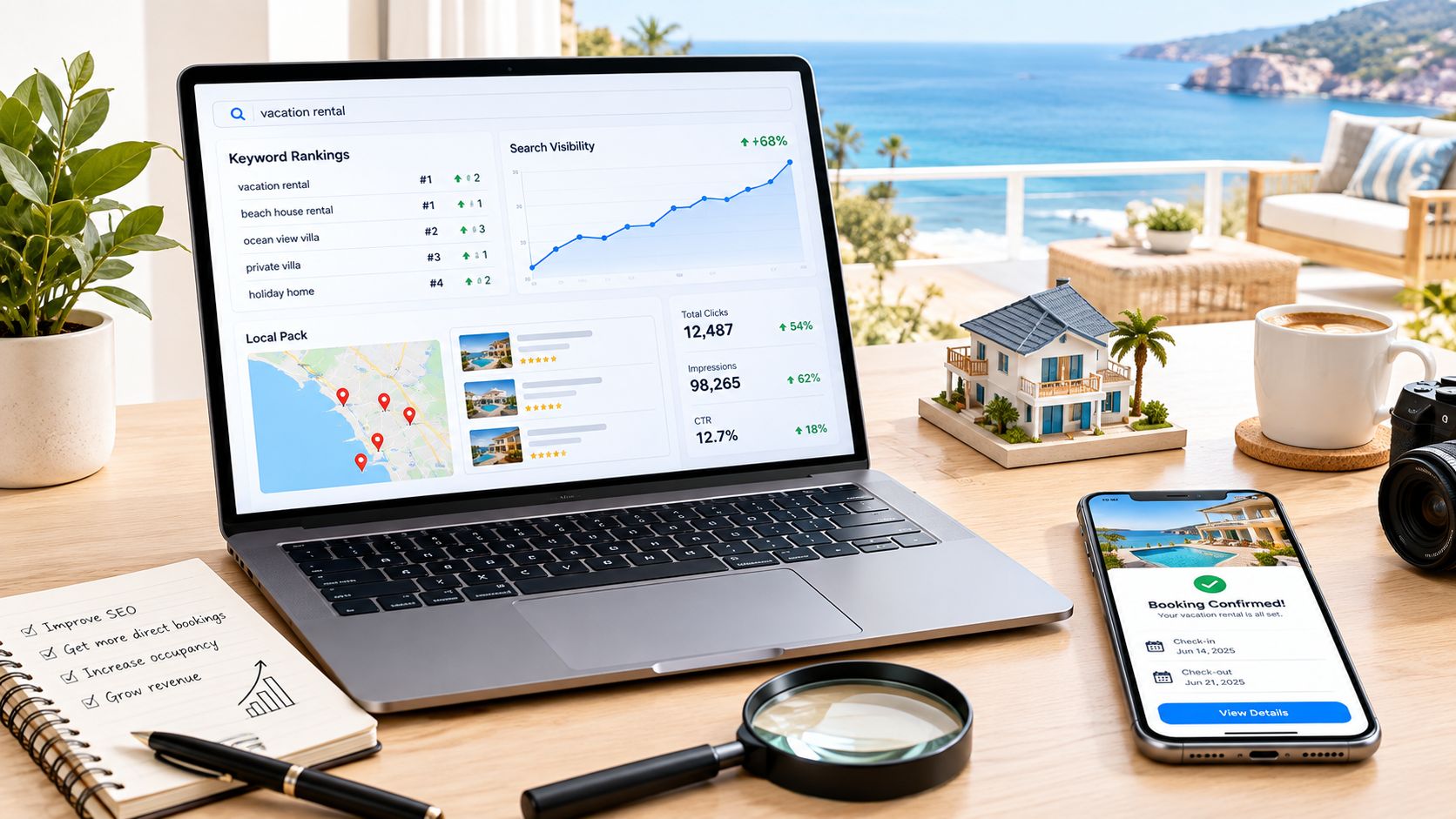
Vacation rental SEO gives small operators another route. It puts your property pages, local knowledge, and direct-booking path in front of travelers before they reach a marketplace. The work isn't a quick switch, and rankings aren't guaranteed, but a focused site can build an owned discovery channel instead of relying entirely on rented visibility.
Table of Contents
- Why Vacation Rental SEO Is Your Direct Booking Engine
- Finding Keywords Guests Actually Search For
- Optimizing Property Pages That Rank and Convert
- Winning Local SEO and Map Visibility
- Building Multilingual Content That Gets Cited by AI and Google
- Your Next Moves to Turn Rankings Into Bookings
Why Vacation Rental SEO Is Your Direct Booking Engine
Marketplace listings can generate demand quickly, but they also place your business inside someone else's search experience. The platform controls the brand presentation, the guest journey, and the relationship after checkout. Your own website gives you control over the property story, local recommendations, repeat-guest path, and direct inquiry process.
Organic search remains central to that channel. A 2026 marketing benchmark found that organic search represented 38% of global vacation-rental traffic, ahead of direct traffic at 32% and paid search at 16%. In the same benchmark, 68.5% of traffic was mobile, which makes readable mobile pages, compressed images, and fast booking flows essential. See the vacation rental SEO benchmark for the market breakdown.
Those figures don't mean every owner should publish endlessly or chase broad destination terms. A one-property website won't compete with a major marketplace for every generic query. It can, however, become highly relevant for searches that combine a real location, a property type, and a specific need.
Practical rule: Treat SEO as a long-term booking asset, not as a replacement for immediate distribution.
Why rankings matter more than impressions
Visibility only matters when travelers choose your result. A 2026 Search Console study of 223 vacation rental websites recorded a 7.90% click-through rate for positions 1 to 3, compared with 1.57% for positions 4 to 10 and 0.51% for positions 11 to 20. The study's vacation rental SEO statistics indicate that top-three pages captured roughly five times more clicks than positions 4 to 10 and about fifteen times more than pages on page two.
That's why small operators should prioritize attainable first-page queries instead of collecting a huge list of vaguely related phrases. One useful property page that earns clicks can support direct inquiries for a long time. Ten thin pages built from the same template usually create maintenance work without giving travelers a better answer.
What an owned channel needs
A direct-booking site needs more than a keyword in a title. It needs stable property pages, trustworthy availability, transparent pricing, clear contact options, local relevance, and a mobile experience that doesn't make guests work to understand the offer.
A hosted platform such as Rentabble's vacation rental website setup can provide the public branded site, property content, availability, pricing, booking requests, and calendar synchronization without requiring a custom development project. The platform is only one implementation choice. The strategic requirement is the same either way, make the site easy for search engines to understand and easy for guests to trust.
Finding Keywords Guests Actually Search For
Keyword research becomes useful when it reflects the way guests make decisions. Travelers don't search with one consistent pattern. Someone ready to book may search for “two-bedroom apartment in Split,” while someone earlier in the journey may ask “best area to stay in Split with children.” Those queries deserve different pages and different calls to action.
Start by separating search intent into three groups.
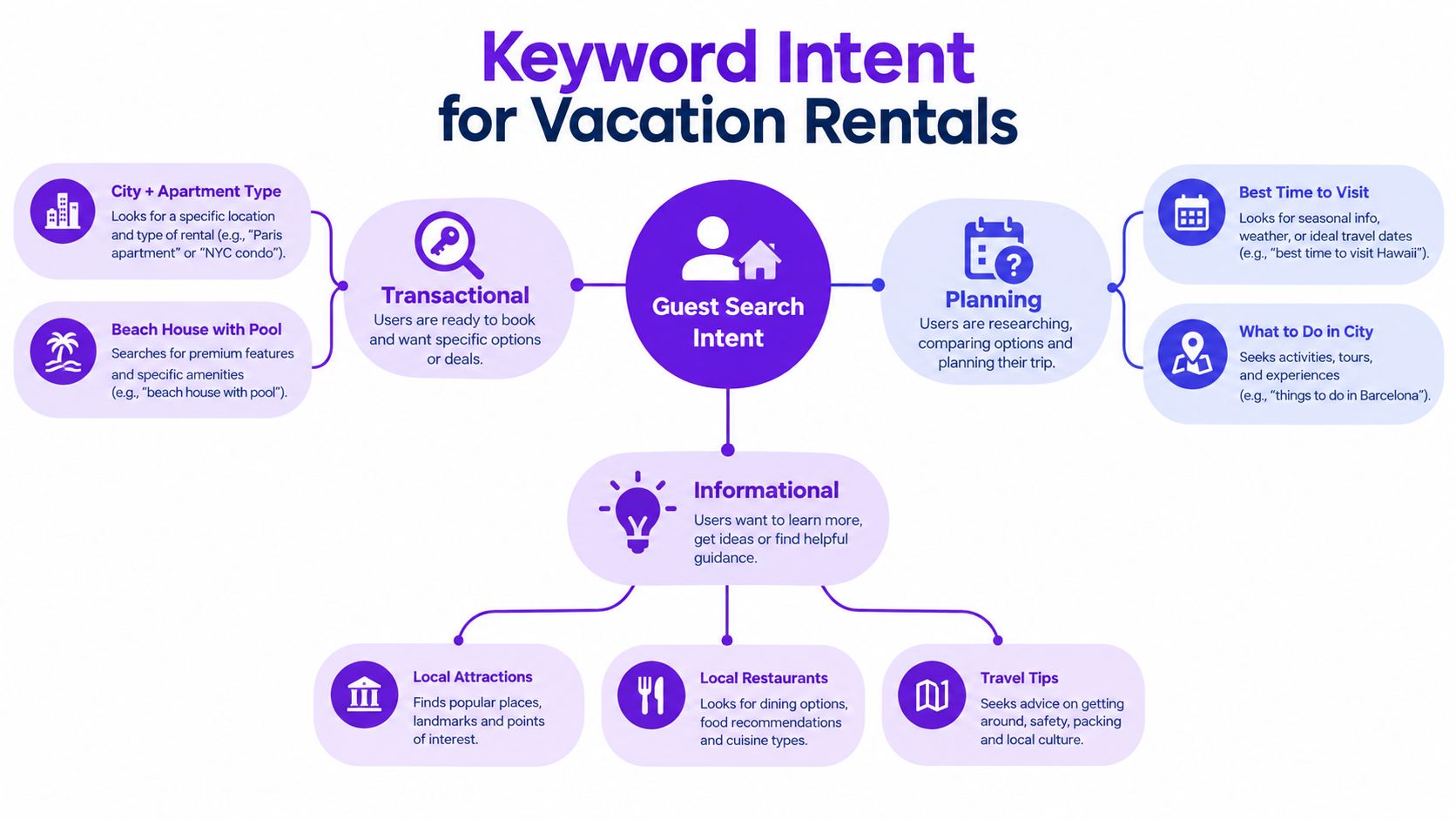
Transactional searches
These searches signal that the traveler is comparing places to stay or preparing to reserve. Examples include:
- “Split two-bedroom apartment near the old town”. Map this to a specific property page if one unit matches.
- “Beach house with pool in Istria”. Use a property or collection page, depending on whether you offer one suitable house or several.
- “Family apartment in Split with parking”. Build the page around the complete need, not just the word “apartment.”
The page should answer the booking question quickly. Show the property type, location, sleeping arrangement, amenities, photos, availability path, and a clear request or booking action.
Planning searches
Planning queries often appear before the traveler has selected a property. “Best area to stay in Split,” “how far is the old town from the beach,” and “family-friendly things to do in Istria” belong on location guides or helpful destination pages.
These pages can introduce your local expertise without pretending every reader is ready to book. Link naturally to the relevant property page when the accommodation fits the context. A guide about beaches near an apartment with beach access has a stronger connection than an unrelated article stuffed with booking language.
Informational searches
Informational queries answer narrower questions, such as “local attractions near Rovinj,” “where to park in Split,” or “what to pack for an Istrian holiday.” These pages can earn visibility earlier in the journey, but they should still offer a useful next step, such as a map, a neighborhood guide, or a relevant accommodation link.
The page should match the question, not merely contain the phrase.
Map one intent to one useful URL
A two-apartment owner in Split might use this structure:
| Search intent | Suitable page | Primary focus |
|---|---|---|
| Ready to book | Individual apartment page | Apartment type, area, amenities, direct request |
| Comparing neighborhoods | Split area guide | Location differences, transport, beaches, local context |
| Solving a practical question | FAQ or travel guide | Parking, check-in, luggage, local attractions |
Avoid creating separate pages for tiny wording variations when they answer the same need. If “Split apartment near the old town” and “old town apartment in Split” lead to the same experience, one strong page is usually clearer than two competing URLs.
Validate ideas without expensive software
Begin with the language guests already use. Review booking questions, messages, guest reviews, and questions asked before arrival. Search your destination manually and note autocomplete suggestions, related questions, map results, and the wording used by pages that rank.
Then inspect your own Search Console data once the site has impressions. Queries that already generate visibility can reveal better page titles, supporting questions, and content gaps. Don't force every phrase into the copy. Use the primary intent in the title and headings, then cover related needs naturally through useful details.
For owners with similar units, differentiate by genuine facts. One page may target a balcony and sea view, another may focus on a family layout and parking. Don't duplicate the same description and change only the apartment name.
Optimizing Property Pages That Rank and Convert
A property page has two jobs. It must help a search engine identify the accommodation and help a traveler decide whether the accommodation fits. Pages that focus only on keywords often feel generic, while pages that focus only on visual design can leave search engines and guests without enough context.
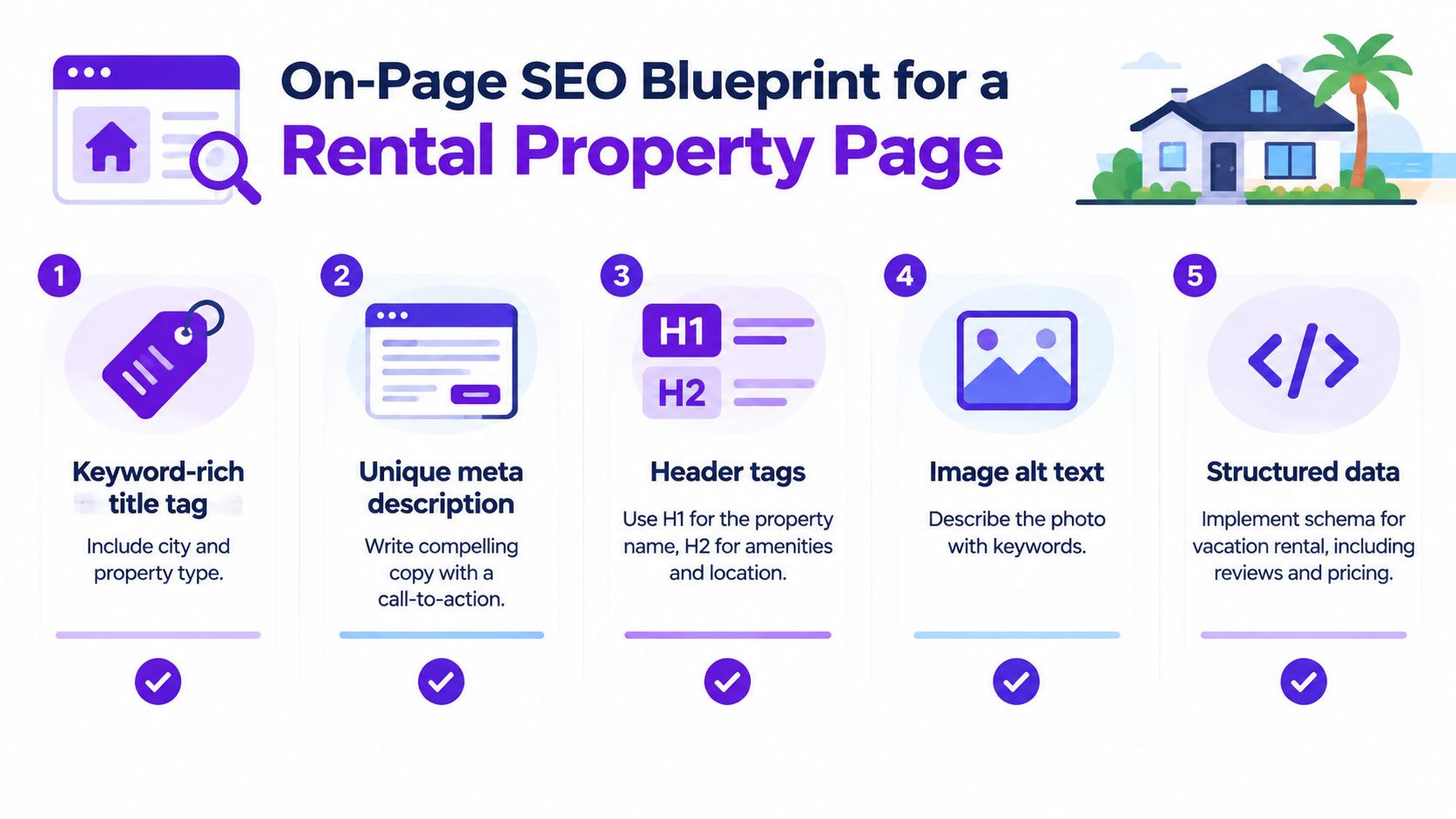
Build each important URL with a clear information hierarchy.
Start with the search result
The title tag should identify the property type, location, and meaningful differentiator. “Old Town Split Two-Bedroom Apartment with Parking” communicates more than a branded name alone. The meta description should add the strongest reasons to consider the property and make the next action obvious.
Use one descriptive H1 for the page's main subject. H2 headings can organize amenities, sleeping arrangements, location, house rules, reviews, and booking information. H3 headings are useful when a topic needs smaller divisions, such as separating beach access, restaurants, and transport under a location heading.
Keep the URL readable and stable. A path such as /apartments/split-old-town-two-bedroom is easier to interpret than a string of internal identifiers. Don't change the URL every time a seasonal offer changes. A stable address can accumulate relevance and links while the content modules around it evolve.
Make the page genuinely specific
A useful property page should explain details that marketplace templates often compress:
- Sleeping layout: State where guests sleep and whether beds suit adults, children, or flexible groups.
- Location reality: Describe walking access, nearby transport, stairs, parking, noise, and distance to meaningful landmarks.
- Amenities in context: Explain whether Wi-Fi supports remote work, whether the kitchen is equipped for full meals, and whether outdoor space is private.
- Guest evidence: Display authentic reviews and respond to concerns rather than presenting empty promotional language.
- Visual accessibility: Write alt text that describes the image accurately, such as “balcony view toward the Split harbor,” rather than repeating a keyword unnaturally.
Compress large images, use responsive formats, and test the page on a phone. A beautiful gallery that loads slowly can undermine the booking experience before the guest reaches the availability module.
Keep volatile data out of the page's identity
Rates, minimum stays, allowed check-in days, discounts, and availability can change frequently. That doesn't mean the property URL should become unstable or thin. Treat the property page as an evergreen asset, then isolate changing information in clearly labeled, crawl-friendly modules.
The permanent section should explain the property, location, amenities, guest fit, and practical limitations. The live section should expose current availability, calculated pricing, minimum-stay rules, and the booking request action. This arrangement lets search engines find durable value while guests still see accurate operational information.
Structured data can reinforce that distinction. Lodging-related schema can describe the accommodation, location, offers, and relevant reviews when the visible page supports those details. FAQ schema is appropriate only for real, visible questions and answers. Markup isn't a shortcut to rankings, and incorrect or hidden data can create trust problems.
Protect crawlability as inventory changes
Review the XML sitemap whenever properties are added, removed, or redirected. Include canonical, indexable pages that deserve search visibility, and avoid flooding the sitemap with expired offer URLs, duplicate filters, or empty availability combinations. Check important URLs in Search Console's URL Inspection tool rather than relying only on a rough site search.
A vacation rental website builder from Rentabble includes SEO-ready pages and an automatically generated sitemap, alongside property, price, availability, and booking-request functions. Whatever system you use, confirm that the public page remains accessible, the canonical version is clear, and the booking module doesn't replace the property description with an empty template.
Winning Local SEO and Map Visibility
A traveler searching for “apartment near the old town” has a location problem as much as an accommodation problem. Local SEO helps your business appear where that decision happens, especially in map results, destination searches, and location-led queries.
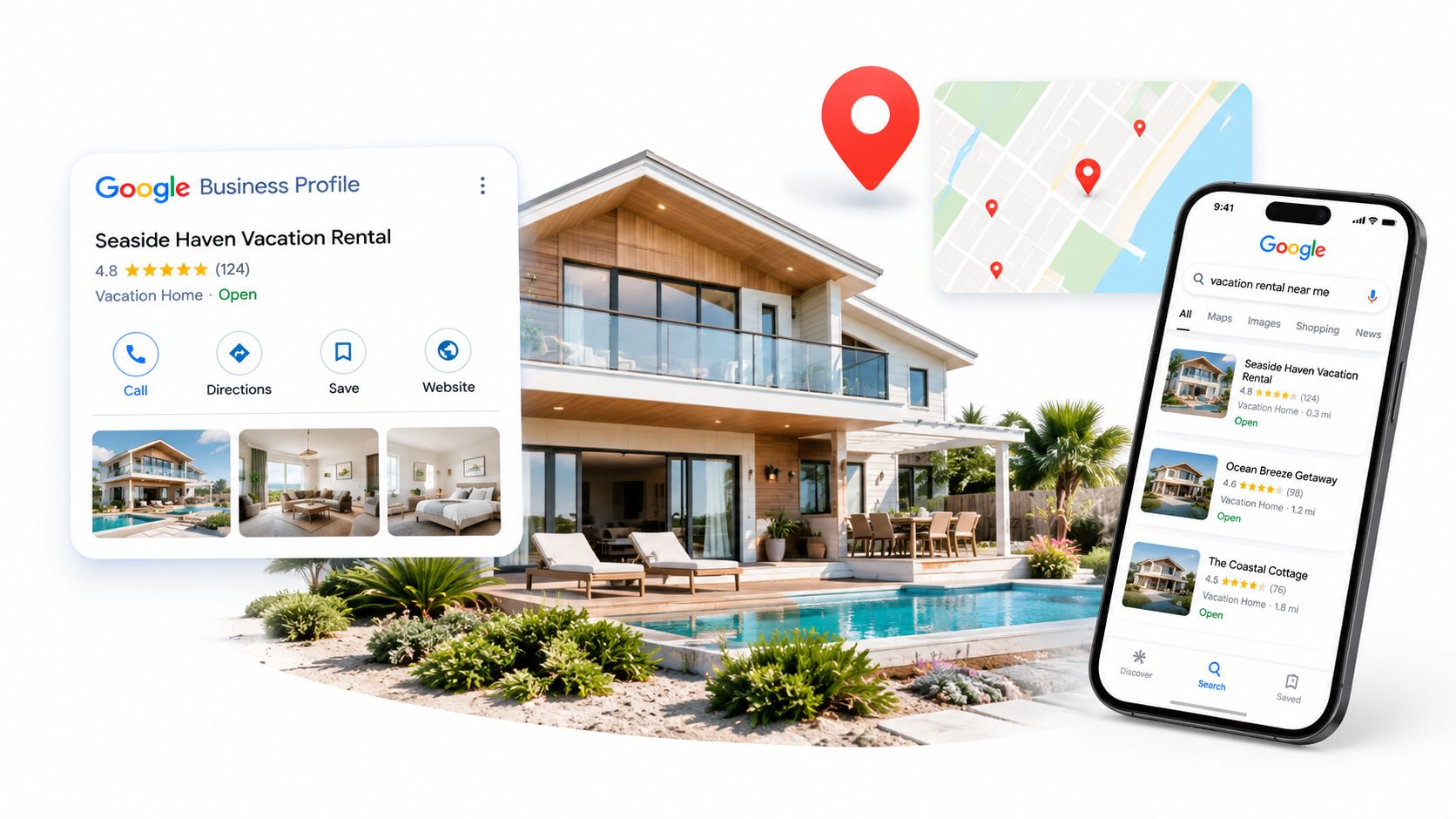
Build a credible local profile
Complete your Google Business Profile with accurate business information, useful photos, service details, and a link to the relevant owned page. Use the business name and location. Don't create a separate profile for every unit at one address if doing so would misrepresent separate businesses or confuse guests.
Reviews strengthen both trust and local relevance when they're genuine. Ask guests for feedback after their stay, make the request easy, and respond to reviews with specific references to the experience. A response that mentions parking, late arrival, or the nearby beach gives future readers more information than a generic thank-you.
Keep your name, address, phone details, and website relationship consistent across legitimate local directories and tourism organizations. Consistency reduces confusion, but don't pursue low-quality directories to collect listings. A relevant regional tourism site or local business association can be more useful than a large number of unrelated pages.
Use proximity honestly
Distance claims should help guests make decisions. “A short walk from the old town” is useful only when it reflects the actual route. Include nearby landmarks, transport stops, parking conditions, beach access, noise considerations, and accessibility details on the property page and location guide.
For several apartments in one destination, create one strong location page that explains the area, then link to each distinct property. Avoid near-identical neighborhood pages that swap only the street name. Search engines and travelers both benefit from one authoritative explanation supported by specific unit pages.
A repeatable local routine can be simple:
- Update photos: Add seasonal images that show the property and surroundings accurately.
- Review questions: Answer recurring guest questions in the profile and on the site.
- Request feedback: Invite real guests to describe their stay without scripting the wording.
- Check references: Confirm that external listings point to the right brand and destination page.
- Connect pages: Link the profile and local guides to the property URL that can handle the inquiry.
The following walkthrough adds context to the profile and map-visibility process.
Local visibility won't compensate for an inaccurate listing or a slow booking page. The map result earns the click, but the property page earns the request by confirming that the location and accommodation match the traveler's needs.
Building Multilingual Content That Gets Cited by AI and Google
Travelers increasingly ask complete questions instead of typing only a destination and property type. They may ask an AI assistant where to stay near a beach, whether an apartment suits a family, or how to reach a neighborhood from the airport. Your content has to answer those questions clearly enough for a search engine or answer engine to understand and reuse.
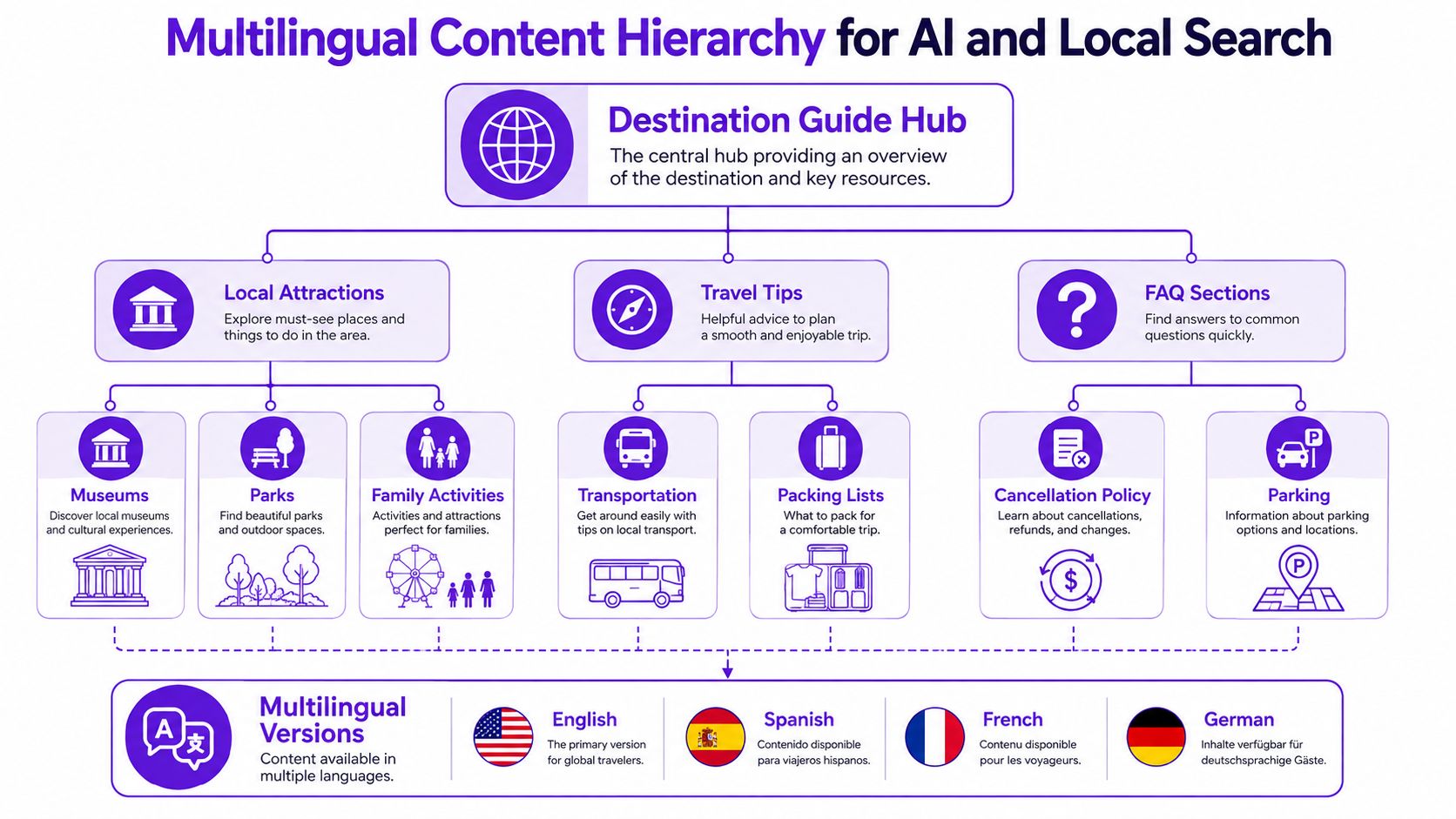
A practical content system starts with a destination hub. Under it, publish useful local pages, travel advice, and focused FAQs. Property pages should remain the commercial destination, but they can earn stronger context when the surrounding content answers the planning questions guests ask before booking.
Write for citation, not decoration
Answer the main question early. If a page is about parking near an apartment, state the parking situation near the top, then explain restrictions, alternatives, and walking implications. If a guide compares areas, give the comparison before the long background section.
Question-and-answer formatting helps readers scan and gives automated systems clear passages to interpret. Use descriptive headings, short paragraphs, concrete local facts, and visible evidence. Schema can clarify what a page represents, but it shouldn't substitute for an answer that a guest can read.
The 2026 guidance on vacation-rental websites reflects this broader shift toward optimizing for both traditional search and AI-generated answers. The practical lesson isn't to write robotic copy for machines. It's to make every important page direct, structured, and useful.
Build language versions with care
Create an English version when English-speaking travelers are a meaningful audience, and create a Croatian version when Croatian-language discovery and guest communication matter. Each version should read naturally for its audience, not like a machine-translated copy with awkward place names and inconsistent amenity terms.
Use separate, clearly connected language URLs and appropriate hreflang implementation. Keep the same core facts aligned across versions, including property features, policies, location descriptions, and booking conditions. Translation should preserve meaning, but it can adapt examples and phrasing to how travelers in that language search.
Don't translate every weak page just to increase the URL count. A small set of strong property pages, destination guides, and FAQs is more useful than a large collection of thin duplicates. A multilingual website platform can reduce publishing overhead, but a human still needs to review local wording, policies, and guest expectations.
Measure journeys that don't start with a click
Search Console can show queries, impressions, clicks, and page performance from traditional results. Analytics and booking records can connect organic visits with inquiries and completed direct requests. AI answer engines are harder to measure because a traveler may see your brand in an answer, remember it, and visit later through a direct or branded search.
Track branded searches, direct inquiries, referral traffic, assisted conversions, and guest questions that mention an AI assistant or travel recommendation. Review which pages earn links, citations, or repeated references in guest conversations. Measurement won't be perfect, but it can reveal whether your content is helping travelers before they reach the booking page.
Your Next Moves to Turn Rankings Into Bookings
SEO gets easier to manage when you stop treating every task as equally urgent. A slow mobile property page, an unindexed URL, and a missing destination guide don't have the same remedy or the same potential value.
Fix the high-impact basics first
This week, inspect the pages closest to a booking:
- Verify indexability: Use Search Console's URL Inspection tool for the homepage, each active property page, and the main location page.
- Improve the result preview: Rewrite titles and descriptions so they identify the destination, property type, and strongest guest benefit.
- Test mobile behavior: Open the pages on a phone and check image loading, text readability, navigation, and the booking request flow.
- Correct property facts: Confirm that rates, availability, minimum stays, policies, and location details agree across the page and live booking module.
- Strengthen internal links: Connect destination guides and FAQs to the property pages they support.
Then choose one commercial page and one local guide as your first focused publishing cycle. A single carefully improved property page can teach you more than a broad redesign because you can compare impressions, queries, clicks, inquiries, and guest behavior over time.
Plan the deeper work for the quarter
Once the core pages are sound, review duplicate unit descriptions, empty filter URLs, old offers, sitemap entries, redirects, image sizes, and structured data. Build relationships with relevant local organizations and tourism publishers rather than buying questionable links. Keep a record of which pages answer which intent so new content doesn't compete with existing URLs.
The most important trade-off is consistency. SEO won't help if a guest clicks through and finds unavailable dates, unclear pricing, or a calendar that hasn't synchronized with another channel. Direct-booking tools need accurate operations behind the marketing promise, including calendar sync, overlap prevention, and a fast response to booking requests.
For practical guidance on turning owned visibility into reservations, use this direct-booking bookings guide alongside your Search Console checks. Publish the improved property page, publish the helpful local guide, and record what changes. That's a manageable starting point for an owned channel that can keep working after the initial effort.
Rentabble gives small rental operators a hosted branded website with property pages, live availability, pricing, booking requests, calendar synchronization, multilingual support, and an automatically generated sitemap. Visit Rentabble to create a direct-booking site that gives your vacation rental SEO work a stable home.