How to Get Bookings Without Paying OTA Commissions
You've probably watched the same pattern repeat: a guest discovers your property on Airbnb or Booking.com, asks a few questions, pays through the marketplace, and leaves you with less revenue after the commission. Then you build a direct-booking website, wait for reservations to arrive, and discover that a website alone doesn't create demand.
The practical answer to how to get bookings is broader than publishing attractive photos. You need an offer guests can understand, pricing that reflects demand, pages that answer objections, traffic from people already planning a trip, and a booking flow that doesn't make them work to pay you. You also need dependable calendar and communication systems behind the scenes.
Table of Contents
- The Economics of Direct Vacation Rental Bookings
- Configuring Seasonal Pricing and Stay Requirements
- Optimizing Property Pages for Search and Conversion
- Driving Targeted Traffic to Your Direct Channel
- Reducing Friction in the Booking Request Flow
- Managing Calendar Integrity and Guest Communications
The Economics of Direct Vacation Rental Bookings
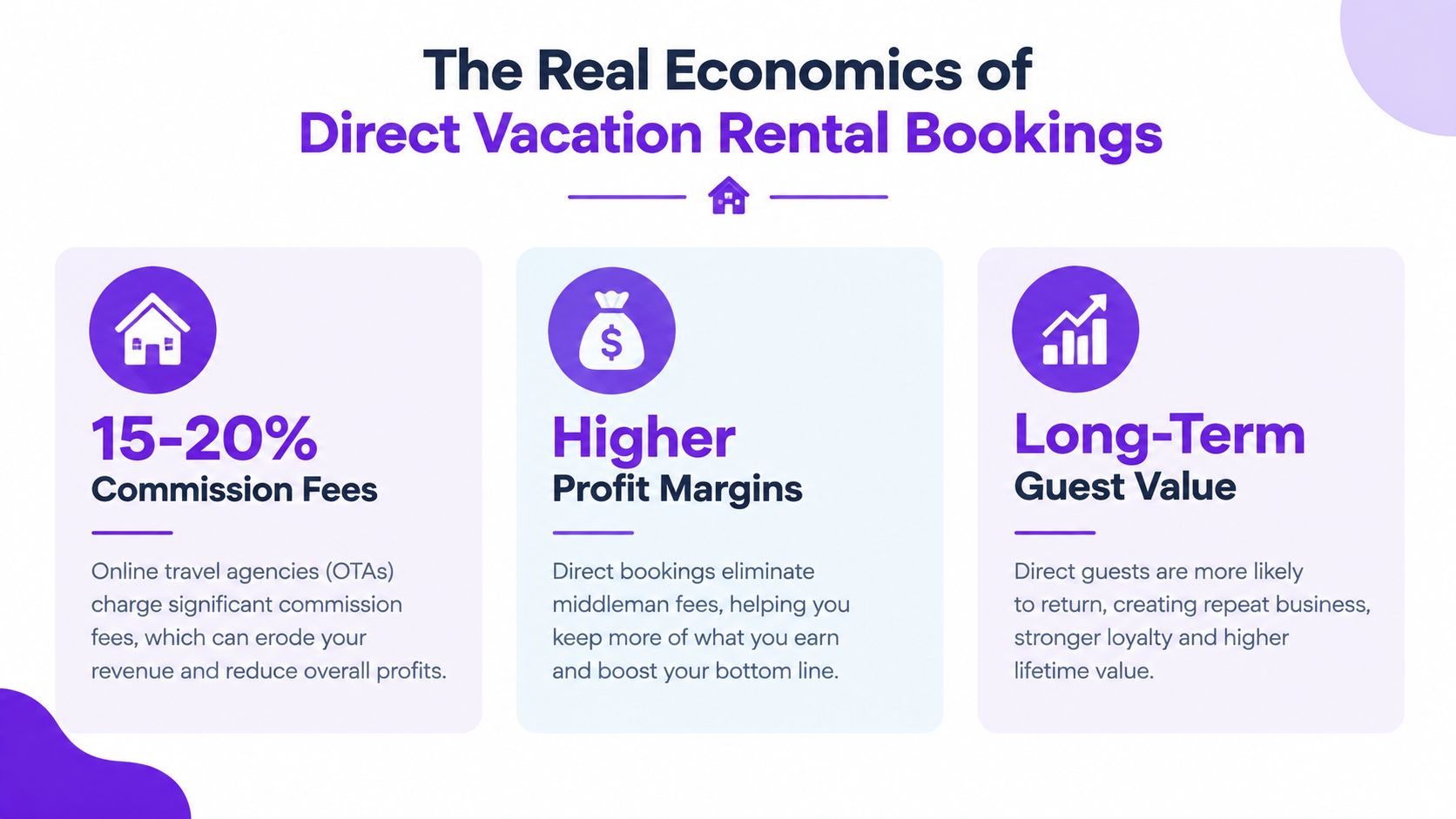
A guest finds your property on an online travel agency, completes the familiar checkout, and leaves you with the reservation minus the marketplace's share. The OTA supplied discovery and transaction infrastructure, but it also controls much of the presentation and guest relationship. That trade-off can make full dependence on one channel costly, even when the calendar stays busy.
A direct channel changes the operating model by giving you distribution you control. Your website can present the property without neighboring listings competing for attention, collect first-party guest details with appropriate consent, explain policies clearly, and support repeat stays. It is not merely a digital brochure. The practical foundations are covered in this guide to vacation rental websites.
Why guest quality matters
Direct demand is valuable for more than avoiding marketplace commissions. A 2026 industry roundup reports that, among hosts using direct-booking software, 31.6% of bookings came from direct sites, compared with 47.2% from Airbnb and 21.2% from other channels in the cited dataset, according to BuildUp Bookings' vacation-rental statistics roundup. The same roundup places direct shares at about 10% for many smaller operators and 40%–50% for strong operators. The range shows that direct bookings can become a meaningful channel when traffic, messaging, and checkout work together.
The cited analysis found that direct reservations produced 45.2% longer average stays and higher average daily rates than third-party bookings. Lodgify's 2026 U.S. report also found 45.2% longer stays and 51.3% longer booking windows for direct bookings than OTA bookings, as reported in the survey release. Guests who reach your own site may already have stronger intent or a specific reason to choose your property, which can improve conversion and booking value.
Practical rule: Keep OTAs for discovery and incremental reach, then build direct demand to improve control over margin, guest communication, and repeat business.
Online demand supports both channels. A 2026 travel-statistics summary reports that 65% of travel bookings happen online, while 72% of worldwide travel reservations were made online in the first quarter of 2025, as detailed by Houfy's direct-booking statistics guide. The operational question is whether every online guest must complete the reservation through another company's marketplace. A website only earns its keep when it attracts qualified visitors and removes enough friction to convert them.
Configuring Seasonal Pricing and Stay Requirements
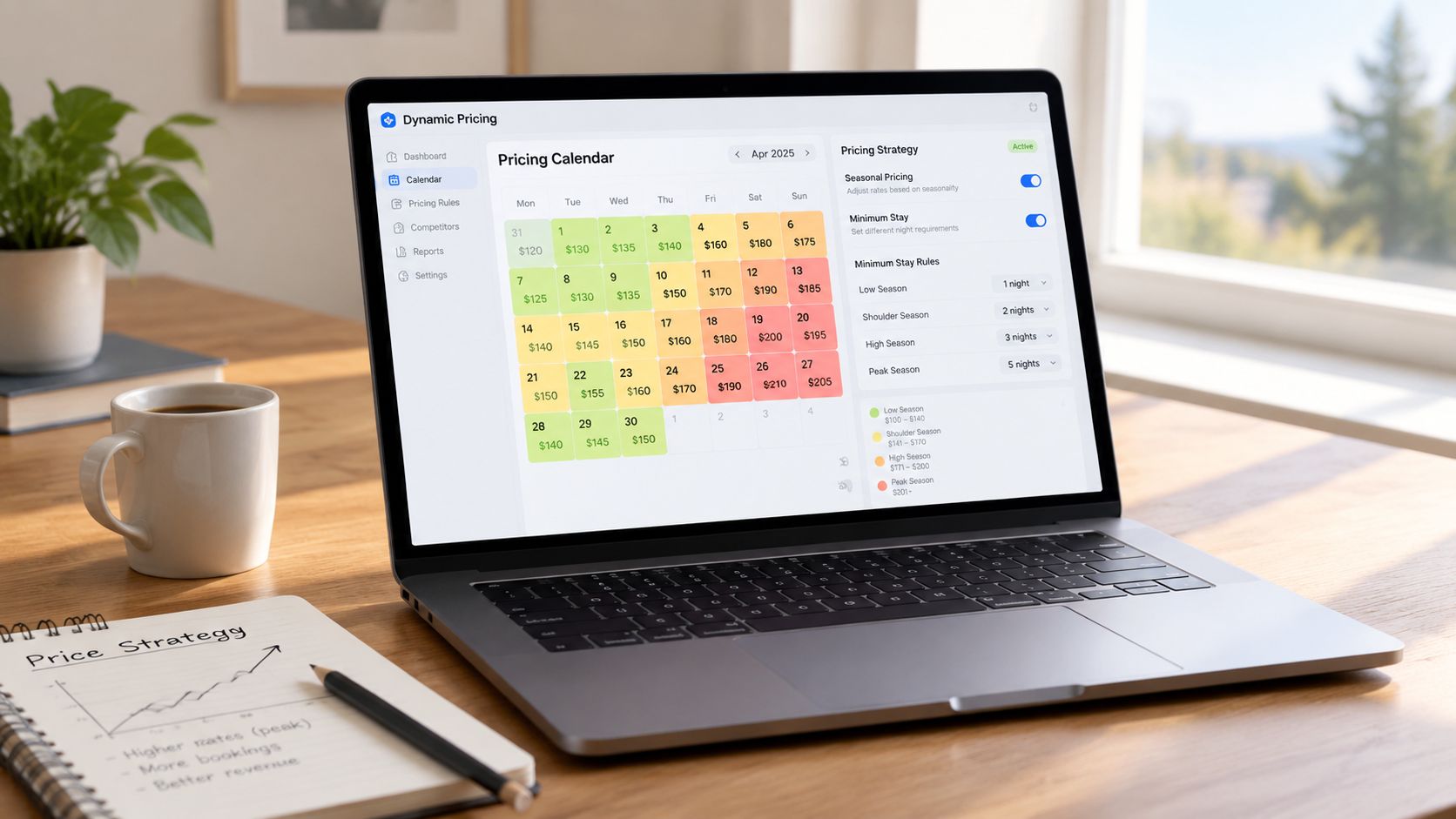
A direct channel gives you room to design pricing around your actual calendar instead of copying a marketplace competitor. The wrong approach is to set one nightly rate, add a generic discount, and hope volume makes up for weak margins. The better approach separates demand periods, protects valuable dates, and shows guests the complete cost before they submit a request.
Build rate periods around demand
Start by dividing the calendar into recognizable periods, such as quieter dates, shoulder demand, holidays, and local event windows. You don't need a complicated revenue-management model to begin. You do need rates that reflect the cost of turning over a property, the likelihood of gaps, and the value of dates guests are competing to secure.
Review each period with four questions:
- What rate protects the night? Account for cleaning, utilities, taxes, platform costs where relevant, and the time required to operate the stay.
- What stay length fits the calendar? A short reservation may be attractive on an open week but damaging when it leaves isolated nights between longer stays.
- Which arrival days help operations? Assign allowed check-in days that match your cleaning schedule and local travel patterns.
- Which dates deserve stricter rules? Peak weekends and event periods often need stronger minimum-stay requirements than ordinary weekdays.
Use minimum stays without blocking demand
Minimum stays should solve a calendar problem, not punish guests. A longer requirement can protect a high-demand weekend, while a shorter requirement may help fill an awkward gap close to arrival. Configure rules by period and adjust them as the date approaches.
Longer-stay discounts can encourage guests to extend without forcing you into across-the-board price cuts. The discount should reward behavior that helps your operation, such as fewer turnovers and more predictable occupancy. Keep the standard rate visible so guests understand what they're receiving, and avoid stacking promotions that make the final price difficult to interpret.
| Configuration | Operational purpose | Guest-facing effect |
|---|---|---|
| Seasonal rate periods | Match price to demand conditions | A clearer reason for rate changes |
| Minimum stays | Protect valuable dates and reduce gaps | Fewer unsuitable date combinations |
| Allowed arrival days | Align bookings with cleaning capacity | More predictable check-in planning |
| Longer-stay discounts | Encourage useful extensions | Better value without permanent discounting |
| Live total calculation | Remove quote delays | Immediate understanding of the trip cost |
Show the total early
Guests abandon unclear pricing. Your booking engine should calculate accommodation, cleaning, taxes, discounts, and any other applicable charge before the request or payment step. Transparent totals reduce repetitive messages and prevent the guest from discovering a materially different amount at checkout.
Don't hide fees until the final screen. Don't use a form that requires you to manually confirm every basic quote. Direct bookings compete partly on trust, and an exact total is one of the simplest ways to demonstrate it.
Optimizing Property Pages for Search and Conversion
A property page has two jobs. It must help search engines understand where the accommodation is and help a human decide whether it fits the trip. A gallery alone can't do either job well. Search visibility depends on useful, specific language, while conversion depends on removing uncertainty before the guest reaches the booking form.
Write for destination intent
Lead with the facts a guest uses to make a decision. Name the neighborhood, property type, sleeping arrangement, distinctive amenities, and nearby reasons to visit. “Beautiful apartment in a great location” says little. “One-bedroom apartment near the old town with a private balcony, dedicated parking, and workspace” gives both the reader and the search engine a clearer subject.
Organize the description around real planning questions:
- Arrival: Explain parking, access, stairs, elevators, public transport, and distance from major arrival points.
- Sleeping: State bed types, room separation, blackout options, and the number of guests the layout suits comfortably.
- Working and connecting: Describe Wi-Fi, workspace, heating, cooling, and mobile signal when relevant.
- Living: Mention the kitchen equipment, outdoor space, washing facilities, and dining setup.
- Rules: State pet policies, smoking rules, parties, quiet hours, and cancellation terms plainly.
Use specific distances only when you can verify them, and explain how the distance is measured. A short walk, a drive, and a public-transport journey mean different things to different guests.
Make every photo answer a question
Place the strongest exterior or living-area image first, then create a sequence that follows the guest experience. Show the entrance, sleeping areas, bathroom, kitchen, work area, outdoor space, parking, and any limitation that could affect the stay. Don't use wide-angle photography to make a small room appear misleadingly large.
Captions can add useful context, particularly for features that aren't obvious from an image. A caption such as “dedicated parking space beside the building” does more work than a decorative adjective.
Add proof and technical structure
Display genuine guest reviews close to the booking action. Reviews work best when they reinforce the concerns your page already addresses, such as cleanliness, location, communication, or the accuracy of the photos. Don't fabricate testimonials or edit them into claims guests didn't make.
A strong vacation-rental website builder should support structured property pages, multilingual content where needed, an automatically generated sitemap, and clear internal links between your home, accommodation, location, and contact pages. Each language version should read naturally rather than functioning as a rough machine translation.
The page also needs a direct path to availability. Put a visible booking action near the opening details and repeat it after the key information. Guests shouldn't have to return to the top, open a separate menu, or send an email just to check dates.
Conversion principle: The page should answer the guest's objection before the guest has to ask it.
Driving Targeted Traffic to Your Direct Channel
Publishing a website does not generate reservations by itself. It gives qualified demand somewhere to go. The operational mistake is treating publication as promotion, then judging direct bookings after the site receives little relevant traffic.
Once the booking path works, acquisition becomes the priority. Choose channels based on the guests you want, the trips they are planning, and the amount of effort you can maintain. Broad visibility may create visits, but targeted traffic is more useful when it arrives with a clear reason to book.
Capture specific search intent
Generic destination pages rarely answer a guest's decision. Build pages around combinations that match real trip planning, such as:
- A neighborhood and accommodation type
- A local attraction and family-friendly lodging
- A beach, trail, venue, or business district and parking availability
- A seasonal activity and a relevant stay requirement
- An airport, ferry terminal, or train station and arrival convenience
Each page should provide practical local information, explain why the property suits that trip, and link directly to relevant availability. A festival guide has limited value if readers cannot see suitable dates or reach a clear booking path. Track which pages and search terms bring visits, then improve the pages that attract the right guests rather than producing more generic articles.
Turn past guests into future demand
Previous guests already know the property, so they can become a more efficient audience for repeat stays and referrals. With permission and sensible frequency, send useful pre-season or return-visit messages instead of constant discount promotions. Mention new amenities, updated local guides, quieter periods, or dates that fit the type of stay they previously booked.
A post-stay message can request an honest review, provide a direct rebooking route, and invite the guest to share the property with someone planning a similar trip. Include the URL and simple instructions. Do not assume guests remember where they booked.
Create local referral loops
Independent operators can attract qualified visitors through relationships that large marketplaces cannot easily reproduce. Approach wedding venues, tour guides, relocation specialists, activity providers, employers, and local event organizers. Offer each partner a dedicated landing page or referral code, then review the resulting visits, inquiries, and bookings.
A website without an acquisition plan is a catalog, not a channel.
Use OTAs as one source of discovery, not as the entire demand engine. They can introduce the property to new travelers, while the direct site can serve repeat guests and people searching for a particular location or experience. Keep core rates and policies consistent where required. Give direct guests legitimate value through clearer communication, useful extras, or a stronger ongoing relationship, not misleading undercutting. The goal is a repeatable flow of relevant visitors, followed by a booking path that answers their questions quickly.
Reducing Friction in the Booking Request Flow
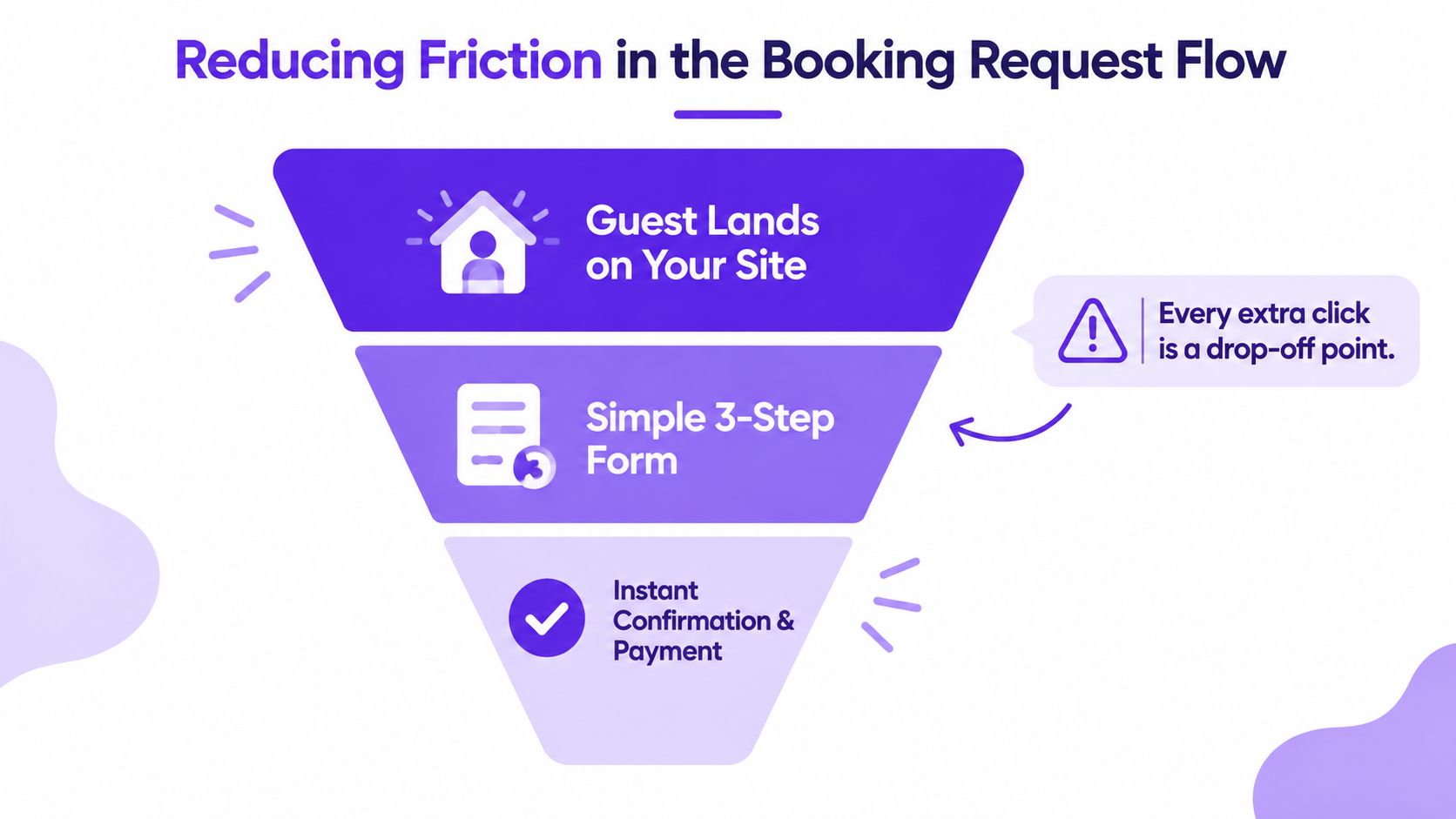
A visitor can arrive ready to book, then leave after encountering unclear availability, a slow page, or an unexpected fee. The request flow must answer practical questions quickly and make the next action obvious. Vacation-rental sites often convert about 1%–3% of visitors, while optimized funnels can reach 4%–6%, according to ConnectYourPMS guidance on converting website visitors. Use those figures as benchmarks, not promises. Review your own funnel to find where qualified visitors stop.
Make the first screen useful
On mobile, show the property identity, location, capacity, starting information, availability action, and next step without forcing guests through animation or oversized media. Keep the page fast and test it on an ordinary mobile connection, not only a quick office network.
Show live availability before requesting personal details. If the dates are unavailable, let the guest change them immediately or view another property. A dead end sends interested visitors back to an OTA.
Reduce the form to decisions you need
Collect what you need to evaluate and confirm the request: guest name, contact details, dates, party size, and any necessary message. Defer information that belongs later in the process, and never make guests enter dates twice.
A practical flow includes:
- Select dates and guests: Display available dates and apply stay rules automatically.
- Review the complete total: Show nightly charges, cleaning, taxes, discounts, and policies before payment or submission.
- Confirm contact and payment details: Add a progress indicator, familiar payment options, and a clear confirmation screen.
Transparent pricing and visible progress reduce uncertainty. Guests should know how many steps remain and what the final charge includes before they submit payment.
Treat objections as interface content
Place cancellation terms, parking, Wi-Fi, pet rules, check-in arrangements, and security information near the booking decision. A structured FAQ can answer questions that might otherwise require a long message exchange, giving the guest a reason to stay on your site.
Run the flow yourself on a phone. Check every total, test unavailable dates, submit a test request, and read the confirmation email as someone unfamiliar with the property. A broken button or surprise fee can erase the value of traffic you worked to acquire.
Managing Calendar Integrity and Guest Communications
A direct channel earns trust only when its availability is accurate. One double booking can trigger compensation, emergency relocation, poor reviews, and lost confidence. Calendar control therefore belongs in the booking operation from day one, not after the website goes live.
Synchronize every source
Choose one central availability calendar as the operational source of truth. Connect Airbnb, Booking.com, Expedia, VRBO, and other channels through two-way iCal synchronization. Confirm that each external calendar imports blocked dates correctly and that confirmed direct reservations export to every channel.
Syncing is not always immediate, so set a routine for checking new reservations and blocked periods. Add manual blocks for owner stays, maintenance, deep cleaning, and private holds. Once a direct request is confirmed, the central system must block those dates and prevent overlapping confirmations.
A vacation-rental channel manager can centralize these connections. It does not replace configuration work. Define which system controls availability, reservation status, cancellations, and blocked dates before activating the connections.
Automate the predictable messages
Guests should receive basic information without waiting for a manual reply. Create automated emails for request receipt, confirmation, payment instructions where applicable, arrival details, house rules, checkout, and post-stay follow-up. Keep the wording calm and useful. Include the property address, access instructions, emergency contact process, and travel-day links in the messages guests are most likely to need.
Automation handles repetition. Operators still need a manual review for unusual party sizes, special requests, rule exceptions, payment concerns, and maintenance issues. The goal is a timely response that still feels considered.
Review the operation every week
Inspect occupancy, revenue, open requests, unavailable periods, pending payments, and review activity in the owner dashboard. Look for recurring operational signals, such as repeated parking questions, check-in confusion, early-arrival requests, or booking gaps created by a particular minimum-stay rule.
Maintenance and cleanliness deserve close attention because operators frequently identify property upkeep as a major challenge, while industry feedback also connects guest complaints with property condition and cleanliness. Those problems affect reviews, repeat intent, and the credibility of every promise on the property page.
Run a test reservation regularly. Verify the total, confirmation, calendar block, external sync, and automated messages. A direct channel becomes dependable when marketing, checkout, and operations show the same information.
Rentabble provides a hosted direct-booking website with branded property pages, live availability, calculated totals, seasonal pricing, booking requests, reviews, email notifications, and two-way iCal synchronization. If you want to reduce OTA dependence without custom development or a complex PMS, visit Rentabble to review the platform's booking-channel features.