OTA vs Direct Booking: The Owner's Strategy Guide
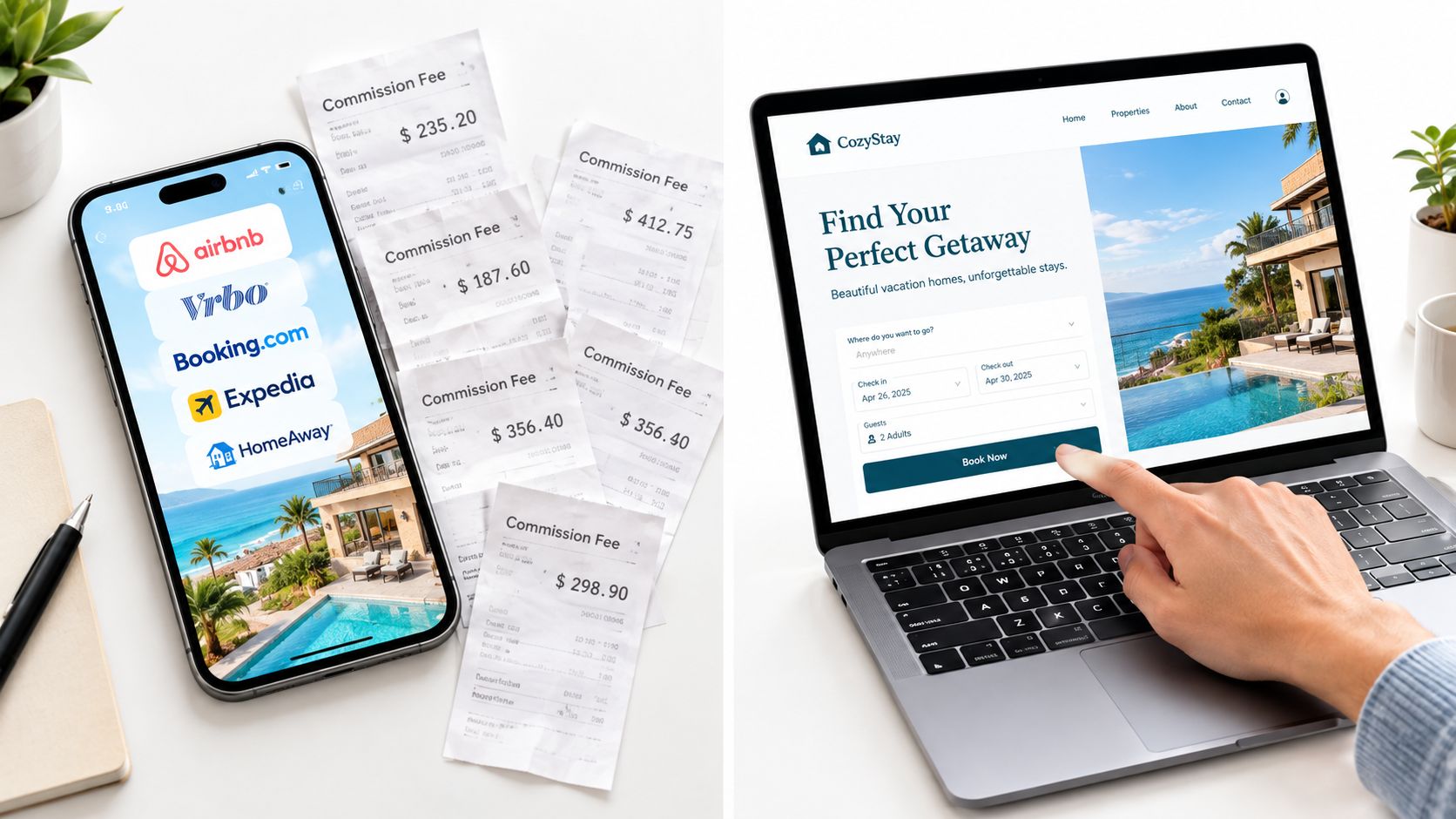
Direct booking sites accounted for nearly 34% of vacation-rental bookings in 2024, compared with 46% for Airbnb, according to the 2025/2026 vacation-rental industry summary. That changes the usual OTA versus direct-booking debate. Direct reservations aren't a niche bonus reserved for large resorts. They already represent a meaningful distribution channel, while OTAs still provide the reach, trust, and last-minute demand many owners need.
The practical question isn't whether OTAs are good or bad. It's which job each channel should perform, what each reservation really costs, and whether your property is suited to the booking behavior each channel attracts. A profitable setup usually uses OTAs for discovery and demand smoothing, then builds direct booking into the business as an owned path for repeat guests, longer stays, and stronger margins.
Table of Contents
- How Vacation Rental Distribution Is Fragmentating
- Evaluating the True Cost of Customer Acquisition
- Understanding Guest Behavior and Booking Windows
- Owning the Storefront and Guest Experience
- Maintaining Calendar Integrity Across Channels
- Matching Distribution Channels to Property Types
- Building a Profitable Hybrid Booking Strategy
How Vacation Rental Distribution Is Fragmentating
The distribution market is more fragmented than many owners realize. Only 5.82% of rentals were listed on all major OTAs, while 28.8% appeared on more than one platform, according to the industry distribution data. A guest may discover a property on one marketplace, compare it on another, then search the property name before booking.
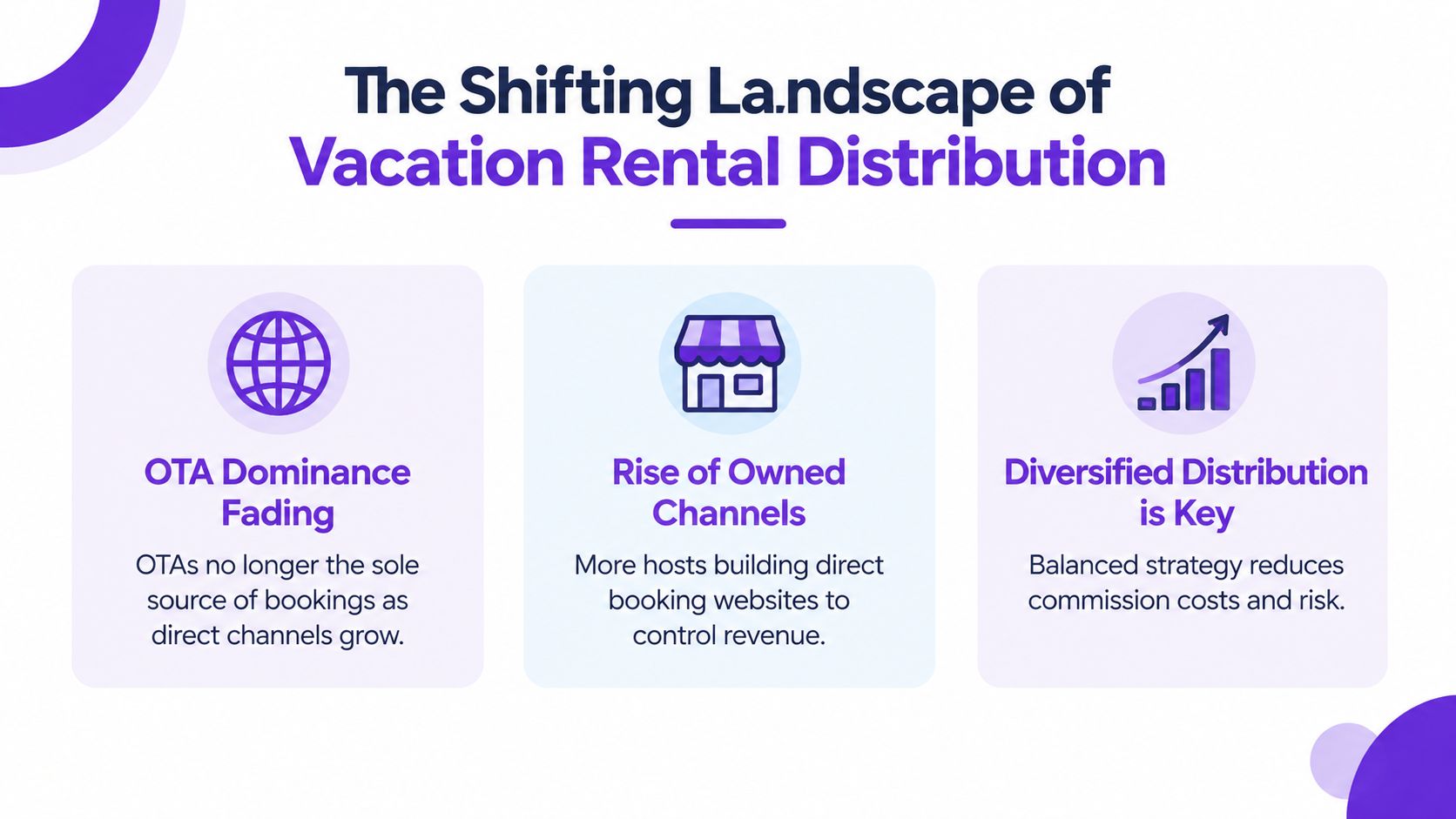
Fragmentation creates reach, but it also spreads the operator's exposure across systems they do not control. An OTA can introduce a new apartment to guests who have never heard of the owner. The listing then depends on search ranking, platform policies, fee structures, cancellation rules, and visibility incentives that may change without meaningful input from the operator.
A direct website follows a different operating model. It does not supply marketplace traffic automatically, but it gives the owner control over presentation, policies, pricing communication, and the relationship after the reservation. It also requires ongoing work: accurate availability, reliable payment handling, guest support, and a credible way to bring visitors to the site.
The role OTAs still play
OTAs remain useful when a property needs immediate exposure, enters a new market, or faces weak demand. Guests already know the search and checkout process, while platform reviews and payment flows reduce hesitation. For a solo operator, that convenience can justify the fee when generating every visitor independently would consume more time and money.
The risk begins when marketplace access becomes the entire business. The operator pays acquisition costs on every reservation, receives limited guest data, and remains exposed to algorithm changes. Guests who might book again may continue using the OTA because the owner never provides a trustworthy direct option.
Practical rule: Use the OTA to earn attention when necessary, but do not let it become the only place where your business exists.
Assign each channel a specific job. OTAs can handle broad discovery and short-notice occupancy. Direct booking can serve repeat demand, planned trips, longer stays, local partnerships, and guests who search for the property by name. The right mix depends on location, property type, operating capacity, and the owner's ability to maintain a dependable booking experience.
Evaluating the True Cost of Customer Acquisition
The visible OTA commission is only the starting point. A direct booking avoids the marketplace fee, yet it still needs a working website, payment processing, booking software, guest support, and a reliable way to generate demand. Calling direct reservations “free” usually means the owner has not counted advertising, content, maintenance, or the time spent managing the channel.
Reported OTA commission or fee rates range from 13% to 20% per booking. Some analyses estimate that a $2,000 reservation can cost roughly $340 to $380 in combined host and guest fees on a marketplace channel, as outlined in this direct-booking cost comparison. Direct booking changes the cost structure rather than removing it. Payment processing and website operations replace part of the marketplace fee, while the owner takes responsibility for attracting and converting the guest.
| Cost Factor | OTA Marketplaces | Direct Booking Channel |
|---|---|---|
| Reservation fee | Typically a percentage of the booking, with reported rates of 13% to 20% | No marketplace commission, but payment processing still applies |
| Demand generation | The platform supplies search traffic, brand familiarity, and marketplace exposure | The owner funds SEO, partnerships, email, social activity, or paid advertising |
| Website and booking tools | Included within the marketplace experience | Website, booking engine, hosting, maintenance, and support create operating costs |
| Guest relationship | The platform mediates communication and limits ownership of the relationship | The owner controls the booking journey and can build consent-based repeat marketing |
| Pricing control | Platform rules and fee presentation influence the guest's final price | The owner controls the displayed total and the value proposition |
| Operational workload | Familiar platform workflows reduce setup effort, but policy disputes remain outside the owner's control | The owner manages payment, policies, support, refunds, and technical reliability |
| Net margin | Lower retained revenue per reservation because fees are attached to the transaction | Potentially stronger retained revenue, provided acquisition and maintenance costs stay under control |
Calculate net revenue per reservation, not just gross booking value. Record nightly revenue, cleaning revenue, marketplace fees or payment costs, marketing expense, support time, refund exposure, and the software cost assigned to that booking. Direct reservations also need to be separated by acquisition source. A repeat guest arriving through unpaid email or word of mouth has different economics from a guest acquired through paid advertising.
The difference can be meaningful. One comparison based on a $60,000 annual gross revenue base estimated that shifting from a fully OTA-based model to a direct model could save about $1,800 in host fees alone, with further savings connected to guest-side service fees, according to the OTA and direct-booking analysis. That result is not a forecast for every property. It is a reason to calculate channel economics using the property's actual booking value, traffic sources, and operating workload.
The cost direct booking hides
Direct acquisition commonly includes:
- Website operations: Hosting, booking software, payment tools, maintenance, and technical support.
- Traffic generation: Search-engine content, local partnerships, email campaigns, social media, and paid ads.
- Conversion work: Better photography, clearer policies, mobile improvements, trust signals, and abandoned-booking follow-up.
- Owner time: Responding to inquiries, checking payments, managing exceptions, and keeping content accurate.
Industry benchmarks place OTA commissions around 15% to 25%, while all-in direct acquisition costs are often estimated at roughly 5% to 12%. The gap narrows when an owner needs sustained SEO, paid advertising, automation, and website maintenance, as described in this 2026 hospitality distribution review.
Direct usually produces stronger margins when the owner can attract qualified guests efficiently and keep the booking process reliable. It does not become more profitable because the reservation occurs on the owner's domain. The practical comparison is OTA acquisition cost versus the full cost of generating, converting, supporting, and retaining a direct reservation.
Understanding Guest Behavior and Booking Windows
Channel choice often reflects the guest's decision process. OTA shoppers can compare several properties, check availability, and book with limited research. Direct guests are more likely to have found a specific property through a previous stay, referral, local search, company relationship, or deliberate brand search.
Booking timing and stay length show the clearest operational difference. One benchmark found that direct bookings produced 45.2% longer average stays and 51.3% longer booking windows than OTA bookings. A separate STR report found that nearly 72% of bookings in 2025 were for one-to-three-night trips, while 32% were made within seven days of check-in, according to this Lodgify market summary.
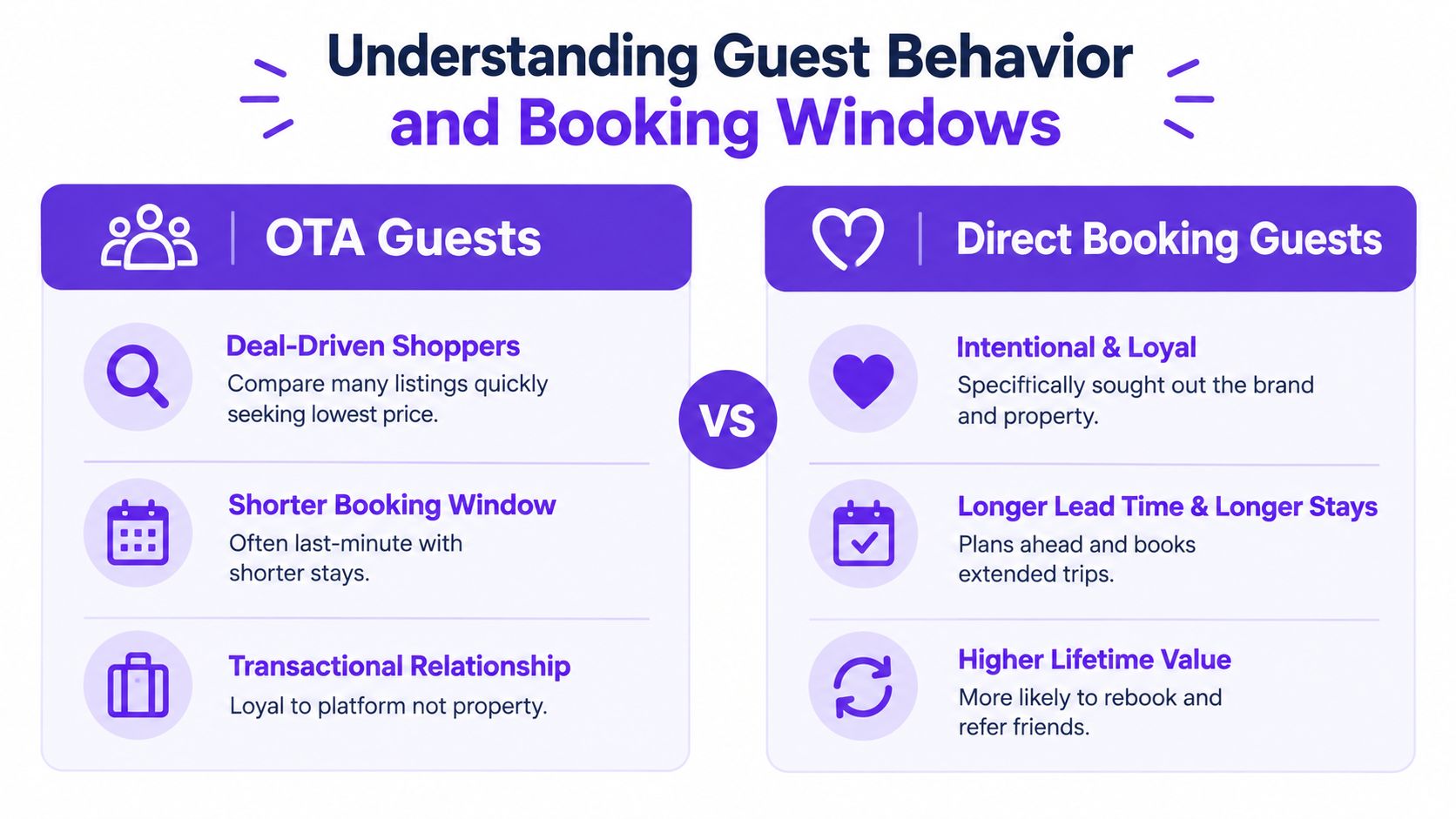
These patterns do not make one channel universally superior. They show why owners should match distribution to the inventory and demand they need. An OTA can fill a short-notice weekend gap. A direct site may suit a family planning a longer holiday, a returning guest who already trusts the property, or a traveler searching for a known villa well ahead of arrival.
Match the message to the trip
For OTA demand, emphasize availability, accurate amenities, flexible search dates, and a fast reservation path. Marketplace guests need enough detail to compare your listing without leaving the platform. Calendar accuracy and competitive positioning matter because the guest may be reviewing several similar homes at once.
For direct demand, sell confidence and specificity. Show the neighborhood, explain who the property suits, publish the full price before the guest submits a request, and make the booking terms easy to understand. Someone who intentionally sought your apartment does not need another generic marketplace listing. They need evidence that booking directly will be straightforward and well supported.
The best channel is not the one with the highest booking count. It is the one that attracts reservations your property can serve profitably.
Review booking history by channel. Compare short stays, late bookings, repeat guests, extended visits, and inquiries that converted after a personal conversation. Allocate inventory and marketing according to those patterns. A city apartment with frequent unsold gaps may need strong OTA exposure. A coastal home with returning families may gain more from a direct website and a thoughtful rebooking process.
Owning the Storefront and Guest Experience
An OTA controls the page where the guest compares your property, the surrounding alternatives, and often the final fee presentation. Your photos and description matter, but they appear inside a standardized interface designed to keep the guest shopping within the platform. A direct site lets you control the order of information and tell the property story in a way that fits the actual experience.
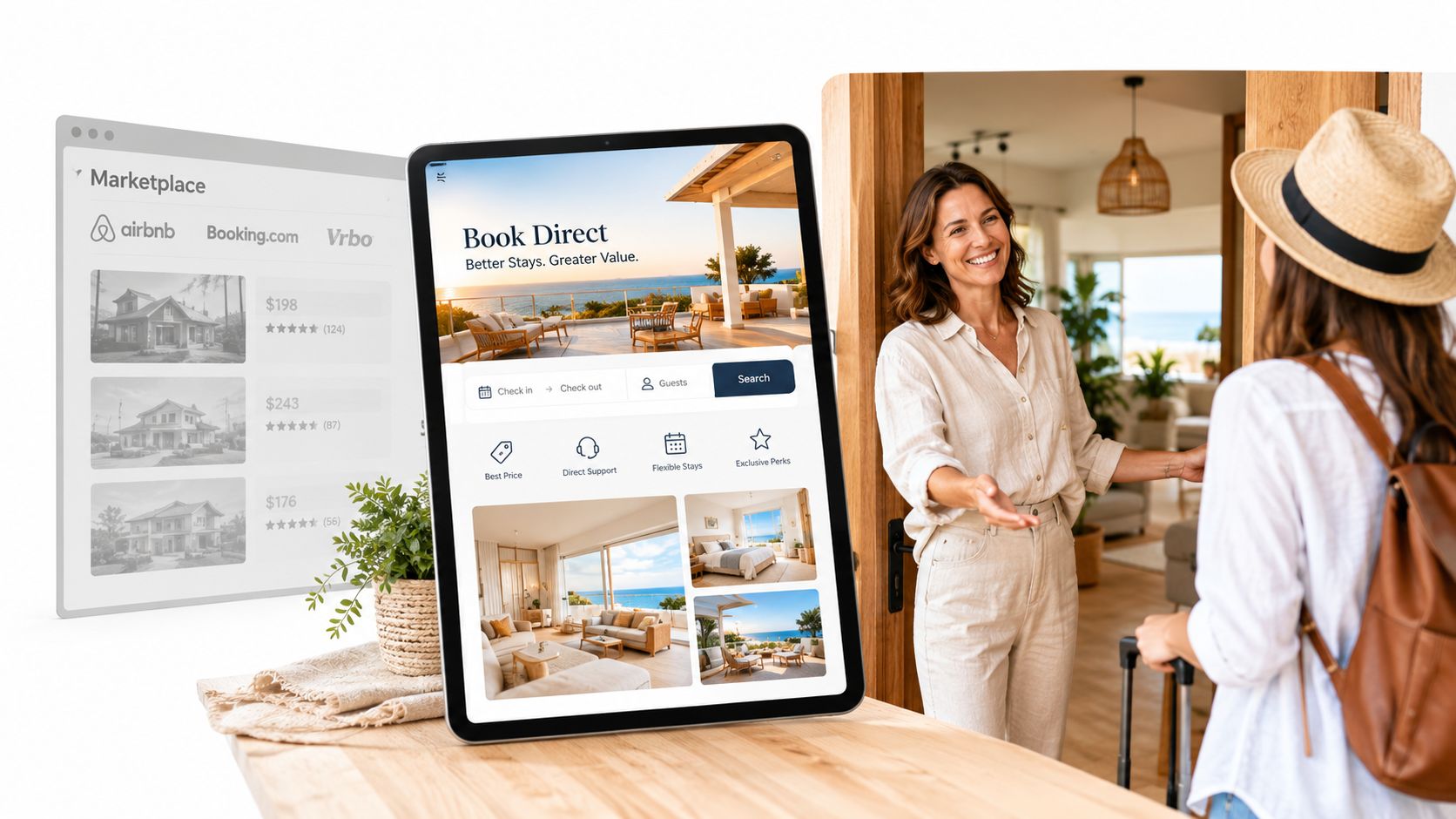
That ownership has practical value. You can explain access, parking, sleeping arrangements, local distances, house rules, and cancellation terms without competing for attention with another listing. You can present a transparent total price, collect the guest's details with appropriate consent, and follow up after the stay to encourage a future reservation or referral.
Direct booking does carry a conversion challenge. Independent guidance places typical vacation-rental direct-site conversion at about 3% to 5% of visitors, with desktop converting around 3.9% and mobile around 1.9%, according to this direct-booking strategy guide. Those figures make mobile usability more than a design preference. A slow page, confusing calendar, unclear fee, or lengthy form can send a motivated visitor back to an OTA.
Turn a brochure into a booking path
A credible direct site should answer the guest's main questions before asking for commitment:
- What exactly am I booking? Use current photos, floor plans or room details where useful, amenity lists, and honest descriptions of limitations.
- What will I pay? Show the calculated total and explain deposits, cleaning charges, taxes, and cancellation terms clearly.
- Can I trust this operator? Add reviews, a real contact route, business information, secure payment handling, and prompt confirmation.
- What happens next? Tell the guest how the request or reservation is confirmed, when payment is collected, and how arrival instructions are delivered.
Mobile visitors deserve the shortest path. The booking calendar should be easy to use with a thumb, the total should remain visible, and the form should ask only for information needed to process the request. Don't force a guest to email for availability if the site can show live dates.
Content can also attract people before they know your property name. A useful resource on vacation-rental SEO can support searches related to the destination, property type, travel season, or local activities. SEO won't replace the reach of an OTA overnight, but it can build an asset that continues working outside marketplace ranking systems.
Give the site a human support layer. A clear phone number, responsive email address, and concise answers to common questions reduce the perceived risk of booking outside a familiar platform.
Maintaining Calendar Integrity Across Channels
Multi-channel distribution fails operationally when availability isn't synchronized. A guest can book through an OTA while another guest is submitting a direct request for the same dates, especially when the owner relies on manual updates or checks several dashboards at different times.
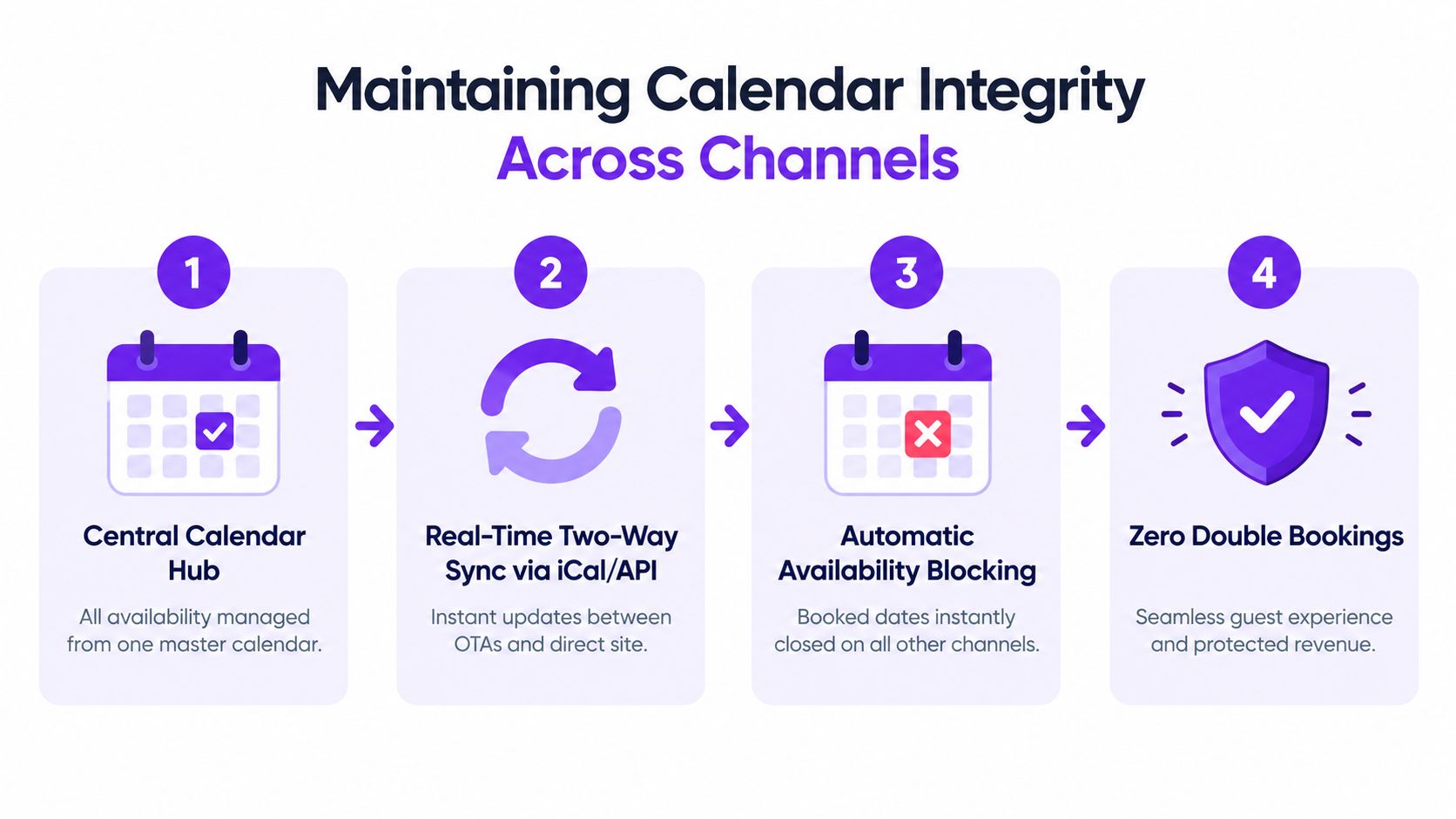
Two-way iCal synchronization provides the basic connection between calendars. When a reservation blocks dates in one system, the exported calendar can communicate that closure to another system. The receiving platform imports the blocked dates, reducing the chance that another guest sees the same inventory as available.
That connection isn't the same as a fully integrated property-management system or API. iCal feeds can have delays, and different platforms may refresh at different intervals. Owners should understand exactly when a booking becomes confirmed, when a block is exported, and whether a direct request remains pending until manually approved.
Build a single operating routine
Start with one calendar as the operational reference point. Then connect every active OTA and the direct booking site, verify that imported reservations appear correctly, and test a blocked date before accepting live bookings. Don't assume a connection works because a URL was added. Confirm that both inbound and outbound updates behave as expected.
Rates and restrictions need the same discipline. Keep a documented process for:
- Seasonal rates: Apply rate periods consistently across the channels you use.
- Minimum stays: Check that a direct booking doesn't bypass a restriction applied on an OTA, or vice versa.
- Check-in rules: Align allowed arrival days before promoting a date range.
- Manual blocks: Record owner stays, maintenance, and holds in the central calendar immediately.
- Pending requests: Decide whether dates are temporarily held or remain open until confirmation.
For a deeper operational reference, see this guide to a rental availability calendar. The goal isn't to remove every manual decision. It's to make sure one decision updates the inventory everywhere it needs to appear.
Calendar rule: Never promise a guest that dates are available until the system has checked the current master calendar and the booking status is clear.
Review synchronization after rate changes, platform updates, and software migrations. A small calendar discrepancy can become a relocation, refund, poor review, and preventable loss of trust.
Matching Distribution Channels to Property Types
A single urban apartment, a portfolio of rural homes, and a repeat-guest beach villa shouldn't use identical distribution plans. The right channel mix depends on how guests discover the property, how much lead time owners need, and whether the operator has enough brand recognition to attract direct demand.
Consider a solo host with one apartment in a competitive city. The property has no established guest list and needs visibility among travelers comparing neighborhoods and prices. An OTA should probably carry much of the discovery workload at first. The host can use the marketplace to learn which amenities guests ask about, identify strong booking periods, and collect operational feedback. A direct site still matters, but its initial role may be credibility, repeat reservations, and referrals rather than replacing marketplace demand immediately.
A property with frequent short gaps
A compact city unit often benefits from OTA reach when weekends open unexpectedly or a cancellation creates a near-term vacancy. Guests searching for immediate availability are already active on marketplaces, so the platform's search behavior can be useful. The owner should protect the calendar with minimum-stay rules and pricing logic, then direct longer-lead or repeat demand toward the owned site where appropriate.
The trade-off is margin. If most bookings are short and last-minute, the owner may find that direct marketing costs more than the commission saved, particularly before the site has organic traffic. In that case, abandoning OTAs would be a strategic error.
A rural portfolio with longer planning cycles
A small operator managing several rural homes has a different opportunity. Guests may plan family gatherings, seasonal holidays, or nature trips around availability, amenities, and driving distance. A branded direct website can present the portfolio together, explain differences between homes, and capture inquiries that don't fit a simple marketplace search.
This operator should still use OTAs for discovery, particularly for newer properties. But the direct channel can become more valuable as the business builds a recognizable name and receives referrals. A central calendar and consistent rate rules become essential because the owner is managing multiple units rather than one listing.
A repeat-heavy coastal rental
A coastal property with returning families has a natural direct-booking advantage. The guest already knows the location, the home, and the owner's service standards. The website can make rebooking simple, display familiar dates, and answer practical questions without forcing the guest to search through unrelated properties.
That doesn't mean the owner should remove the listing from OTAs. Marketplace exposure can bring first-time guests during weaker periods. The sensible division is acquisition through the marketplace and retention through the direct channel, with policies and pricing communicated clearly so returning guests understand the value of booking direct.
Match channel choice to capacity
A technically confident operator may manage several channels, content updates, and direct marketing. A host with limited time may need fewer listings and more automation. Distribution only helps when the owner can respond promptly, maintain accurate availability, and deliver the same standard after every booking.
Ask three questions before adding another channel:
- Does it reach a guest segment you don't already reach?
- Can you keep rates, availability, and policies accurate there?
- Will the added reservations produce enough net value to justify the support work?
If the answer to the second question is no, more exposure will only create more ways to make an expensive mistake.
Building a Profitable Hybrid Booking Strategy
A hybrid strategy is profitable only when each channel has a defined job. OTAs create discovery and help fill weaker periods. Direct booking serves known demand, repeat guests, referrals, and reservations where the owner can retain more revenue. Treating both channels as separate side projects creates duplicated work and inconsistent guest communication.
Start with recent reservation data. Export bookings by channel and calculate net revenue after commissions, payment costs, discounts, support time, and refunds. Separate first-time from repeat guests, then compare booking windows, stay lengths, and periods that still depend heavily on marketplace exposure. Those patterns show where an OTA adds incremental demand and where direct booking can reduce acquisition cost.
A practical launch sequence
First, establish the direct foundation. Build a branded property page with accurate photos, amenities, location details, policies, contact information, and a booking flow showing live availability and the full calculated price. Guests should not need a manual quote before deciding whether the property fits.
Next, connect calendars before promoting the site. Use two-way iCal synchronization or a suitable channel manager, test reservation blocks, and document how pending direct requests are handled. Rentabble provides a hosted branded rental website with live availability, calculated booking-request totals, seasonal pricing tools, and two-way iCal synchronization alongside major external platforms.
Then, make the direct URL visible wherever you control the communication. Add it to the business profile, email signature, social profiles, printed arrival materials, and post-stay messages where platform rules allow. A website does not generate repeat demand by itself. Past guests need a clear reason to remember and use it.
Improve conversion before buying traffic. Test the mobile booking journey, remove unnecessary fields, explain cancellation and payment terms, and place reviews and contact details where guests can find them. Paid traffic cannot compensate for a confusing checkout.
Review performance on a fixed schedule. Track net revenue, booking window, stay length, cancellations, repeat demand, support time, and calendar errors. Keep OTAs that produce useful incremental reservations. Put more effort into direct booking when the site attracts guests at a sustainable cost, while accounting for the work required to maintain content, payments, support, and marketing.
Operators with multiple listings can use a vacation-rental channel manager to centralize availability and reduce repetitive updates. The tool should remove avoidable work, not create another dashboard that nobody checks.
Guest trust determines whether the hybrid model lasts. Keep total pricing clear, avoid misleading direct discounts, honor published policies, and respond quickly to questions. Direct booking earns a larger role when it feels as reliable as an OTA while giving the owner more control over the relationship.