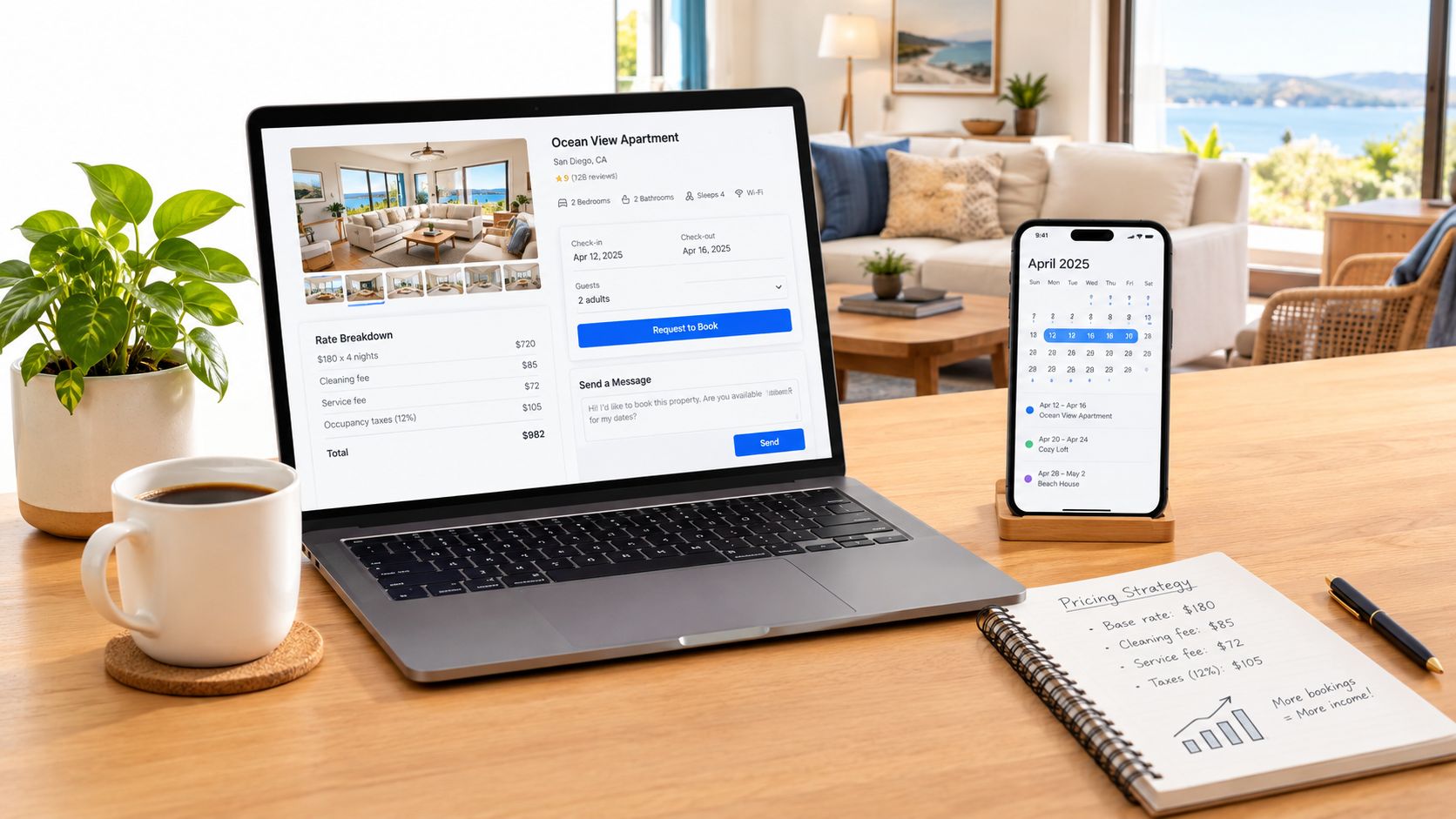
Business Plan for Property Management Company That Works
You've got a dozen vacation rentals, three calendars open, and an owner asking why last month's revenue didn't match the forecast. Airbnb brings volume, Vrbo fills some gaps, and direct inquiries arrive in a messy stream of emails and messages. You're busy every day, but you're not always sure which properties are profitable, which fees cover the work, or when another owner would push the operation past its limits.
A practical business plan for a property management company turns that activity into decisions. It defines the market, chooses the right owners, packages services, sets pricing, assigns channel roles, builds a lean operating stack, and connects every assumption to cash flow. The U.S. property management industry reached about $134.2 billion in 2025, with roughly 304,000 businesses operating nationwide, so the opportunity is substantial, but the market is fragmented and competitive (IBISWorld's property management industry data).
This guide is built for a small operator, especially one managing vacation rentals or owners with a handful of units. It focuses on the decisions that change break-even math, including direct-booking economics, calendar synchronization, transparent pricing, and repeatable workflows.
Table of Contents
- Why a Written Plan Matters for a Small Property Management Company
- Defining Your Market and Ideal Client Profile
- Services Menu and Pricing Model That Fits a Boutique Operator
- Channel Strategy and the Direct Booking Versus OTA Trade-Off
- Operations Stack, Tech Tools, and Day-to-Day Workflow
- Financial Projections, Break-Even, and KPIs to Track
- Final Checklist and Common Pitfalls Before You Launch
Why a Written Plan Matters for a Small Property Management Company
A solo manager with 12 units often starts by accepting whatever work arrives. One owner wants full-service guest communication, another wants only cleaning coordination, and a third expects emergency availability without paying for it. The manager responds to the latest message, adjusts prices when Airbnb changes visibility, and postpones direct-booking infrastructure because the immediate workload always feels more urgent.
That approach can produce revenue, but it rarely produces a stable company. A written plan forces you to decide which units belong in the portfolio, which owners fit your service model, and which work deserves a separate fee. It also gives you a reference point when an owner requests an exception or a platform fee changes your assumptions.
Put the decisions in operating order
A useful plan should answer these questions in sequence:
- Market: Which locations, property types, and owner profiles can you serve well?
- Services: What does full service include, and what remains an add-on?
- Pricing: Will you charge a percentage, a flat fee, or a hybrid?
- Channel mix: Which reservations should come from OTAs, and which should move to owned channels?
- Operations: Which tasks require a person, a software workflow, or a documented standard operating procedure?
- Financials: How many units do you need, what does each unit contribute, and how much cash can the business absorb before break-even?
The plan becomes more useful when each section connects to the next. Your target owner determines your service menu. Your service menu determines staffing and software needs. Your channel strategy affects both revenue quality and the amount of guest communication your team handles.
Practical rule: If a decision affects owner expectations, labor, or cash flow, write it down before you sell the service.
Use the plan outside your spreadsheet
The document also has practical uses beyond forecasting. A bank may need a clear explanation of your business model before opening an account. A prospective landlord may want to understand how you protect the property and communicate with guests. An owner who questions a pricing increase is more likely to engage with a documented cost structure than with an improvised explanation.
Industry guidance places common management fees around 8% to 12% of collected monthly rent, with break-even often requiring roughly 50 to 80 properties and net profit frequently modeled at about $50 to $150 per property per month (ZenBusiness guidance on starting a property management business). Those are broad reference points, not a substitute for your own unit economics. Your plan should show exactly why your portfolio can support its overhead.
Defining Your Market and Ideal Client Profile
A boutique manager shouldn't define the market as “all property owners in the city.” That description is too broad to guide sales, staffing, or pricing. Start with the kinds of properties you can operate profitably and the owner problems you can solve repeatedly.
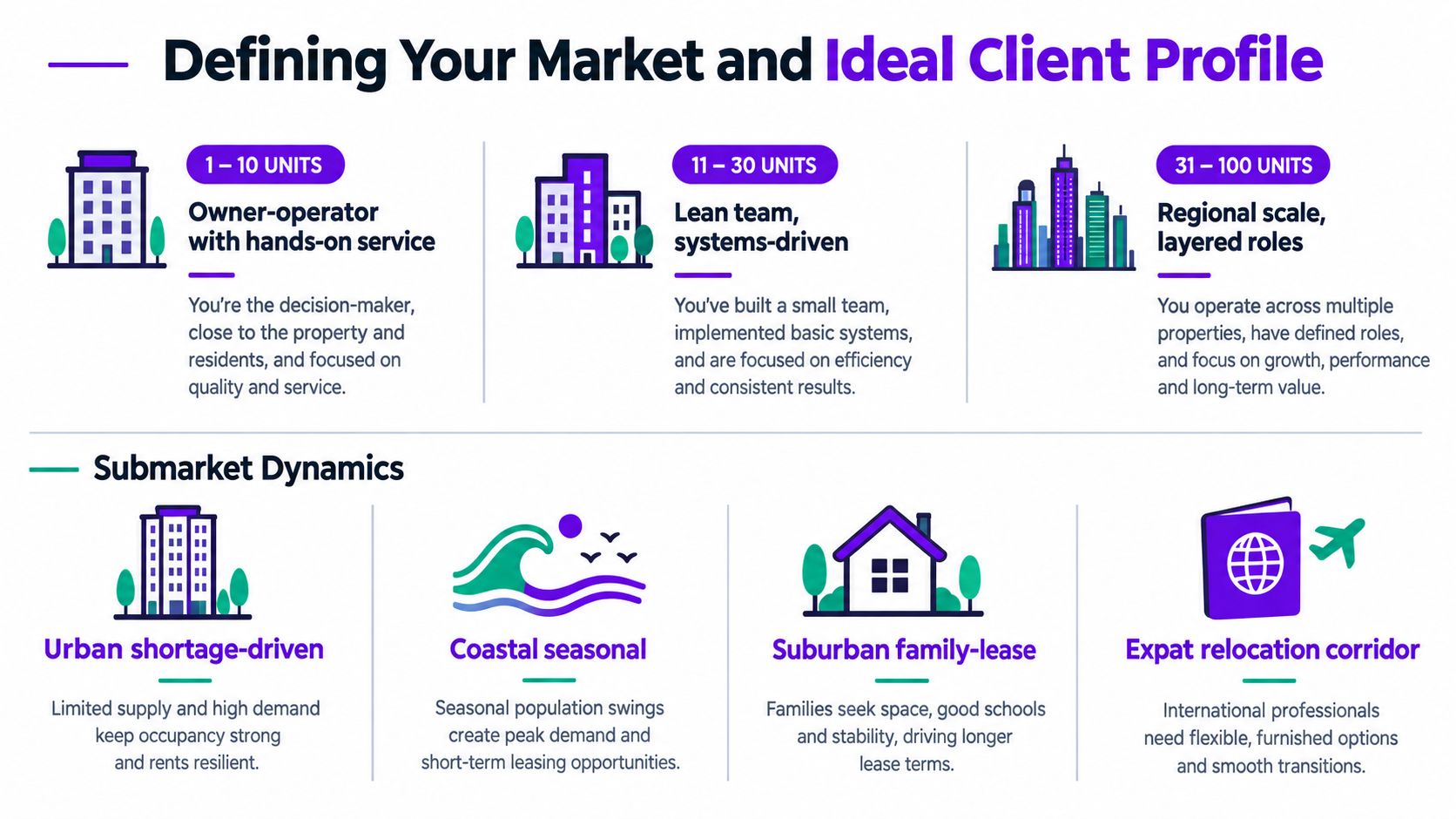
Segment the opportunity by unit count, submarket dynamics, and owner behavior. A local accidental landlord may need reassurance and basic reporting. An absentee investor may value remote oversight, fast maintenance decisions, and predictable communication. A second-home owner may care more about personal-use blocks, inspections, and keeping the property in excellent condition between stays.
Build segments you can actually sell to
Use unit count as an operational filter:
- 1 to 10 units: Owners usually buy responsiveness, hands-on care, and relief from guest issues. A concise onboarding package and clear personal-use policy may matter more than a complex owner portal.
- 11 to 30 units: These owners need consistent systems. Lead with calendar control, pricing discipline, vendor coordination, and reporting that reduces daily questions.
- 31 to 100 units: This segment expects layered roles, formal service levels, and dependable reporting. Only pursue it if your staffing and quality controls can expand with the portfolio.
Then add the local demand pattern. An urban, shortage-driven submarket may support steady weekday demand. A vacation market may produce strong peaks and difficult shoulder periods. A hybrid area may require separate pricing rules for business travel, events, and leisure stays.
Research before choosing a niche
Use three inputs rather than relying on intuition:
- Demand reports: Review short-term-rental and city occupancy reports to identify seasonality and booking patterns.
- Competitor listings: Compare amenities, property presentation, minimum stays, cancellation policies, and visible rate positioning.
- Owner conversations: Ask what currently causes stress. “I don't know whether the property is earning enough” points to reporting and pricing. “I live too far away” points to inspections, maintenance, and local oversight.
Your one-page Ideal Client Profile should state:
- Property type and typical unit count
- Location and demand pattern
- Owner's primary goal
- Services the owner expects
- Fee tolerance and preferred pricing structure
- OTA dependence and openness to direct bookings
- Communication preference and decision-making speed
The strongest niche isn't necessarily the largest one. It's the segment where your offer, operations, and economics fit together without constant exceptions.
Services Menu and Pricing Model That Fits a Boutique Operator
A boutique manager needs a service menu that protects margin without making the offer confusing. Three structures cover most starting models: a percentage of collected revenue, a flat monthly fee per unit, or a hybrid with core management plus paid add-ons.
Percentage pricing aligns your income with property performance, but it can leave you underpaid during low-demand periods. A flat fee makes revenue easier to forecast, although owners may question the charge when a unit has little activity. A hybrid model usually gives a small operator the clearest boundaries.
The worked example below follows the assumptions supplied for a 15-unit portfolio. At 65% occupancy and a $180 ADR, the portfolio generates roughly $641,000 in annual bookings. An 18% management fee produces about $115,000 in gross management fees, while a $600 monthly flat fee produces $108,000 annually. The arithmetic is useful for comparison, but your plan should replace it with property-level forecasts.
| Pricing Model | How It Works | Worked Annual Revenue, 15 units | Best Use Case |
|---|---|---|---|
| Percentage of revenue | Charge a percentage of collected booking revenue | About $115,000 at an 18% fee | Full-service management where effort follows booking volume |
| Flat monthly fee | Charge a fixed amount per unit each month | $108,000 at $600 per unit monthly | Predictable portfolios with consistent service requirements |
| Hybrid with add-ons | Combine a core fee with separately priced services | Varies by portfolio and add-on adoption | Boutique operators balancing clarity and margin |
The percentage and dollar figures in this example come from the supplied industry brief, which also summarizes common percentage-based structures and planning considerations in this vacation-rental pricing strategy guide.
Define the base service before adding extras
Your standard menu might include:
- Onboarding: Property setup, photography coordination, listing preparation, and house-rule collection.
- Revenue management: Seasonal pricing, minimum-stay rules, and periodic rate reviews.
- Distribution: OTA listing maintenance, calendar management, and direct-channel availability.
- Guest care: Pre-arrival messages, during-stay support, checkout instructions, and review requests.
- Turnovers: Cleaning coordination, linen checks, and readiness confirmation.
- Maintenance: Triage, vendor dispatch, owner approval thresholds, and completion follow-up.
- Reporting: Owner statements, booking summaries, expense records, and tax preparation packets.
Add-ons can improve contribution margin when you price them accurately. Consider linen programs, restocking, owner-block administration, mid-stay inspections, emergency callouts, and direct-booking site administration. Don't hide labor inside a vague “full service” promise if the work occurs irregularly or requires special coordination.
Publish the rate card on your direct-booking site and include it in the owner proposal. Transparent pricing reduces negotiation cycles and gives owners a clear explanation for charges before onboarding.
Channel Strategy and the Direct Booking Versus OTA Trade-Off
A small property management company can fill its first units through OTAs, then discover that every repeat stay still depends on a platform. Use marketplaces for reach, while building a direct channel that improves margin and keeps the guest relationship under your control. The direct booking versus OTA trade-off belongs in the financial model, not only the marketing plan.
Direct booking sites accounted for nearly 34% of vacation-rental bookings in 2024, compared with 46% for Airbnb, according to the supplied industry data (Lodgify's direct-booking survey release). In a separate 2025 dataset of hosts already using direct-booking software, direct sites represented 31.6% of bookings, while Airbnb represented 47.2% and other channels 21.2%.
Commission is only one part of the calculation. That dataset reported direct bookings with 45.2% longer average stays, 51.3% longer booking windows, and a slightly higher ADR of $351.31 versus $348.47 for OTA bookings. Results vary by portfolio. A 2026 channel-mix report found direct bookings at 21% of reservations and 29% of revenue in one professionally managed sample, so use your own results rather than promising a standard channel mix.
| Channel | Effective Commission | Average Lead Time | Repeat Guest Share | Best For |
|---|---|---|---|---|
| OTAs | Higher commission exposure | Often useful for discovery and demand gaps | Relationship remains platform-mediated | New-market reach and shoulder-season fill |
| Direct booking | Lower commission exposure, with software and payment costs | Often stronger for planned and repeat stays | Owner-controlled relationship | Repeat guests, referrals, and selected mid-week demand |
Model actual OTA fees, payment costs, direct-booking software, cancellation exposure, and labor per reservation. Compare net contribution per booking, not the headline nightly rate. A direct reservation with a small software and payment cost may still produce more contribution, while an OTA reservation may justify its cost when it fills an otherwise empty night.
Assign each channel a job
Use OTAs to introduce unfamiliar inventory and cover weak periods. Use direct channels for repeat visitors, referrals, selected corporate stays, and guests who already know the property. Collect rebooking consent at checkout with a simple email opt-in, and keep direct offers to past guests off the OTA messaging thread, since Airbnb and Vrbo both prohibit off-platform solicitation inside their inboxes.
Review channels weekly:
- Occupancy and ADR by channel
- Lead time and cancellation behavior
- Net revenue after channel and payment costs
- Guest-service workload
- Repeat and referral opportunities
Stage direct-booking growth. Set an initial target, test the economics on a subset of units, improve the booking experience, and expand once the numbers hold. The supplied market research identifies direct-booking websites as a fast-growing channel and notes that nearly two-thirds of hosts and property managers ranked direct bookings among their top goals (StayFi's vacation-rental statistics overview). Rentabble can reduce development work through a hosted direct-booking option, but pricing discipline, channel review, and follow-up remain the manager's responsibility.
Operations Stack, Tech Tools, and Day-to-Day Workflow
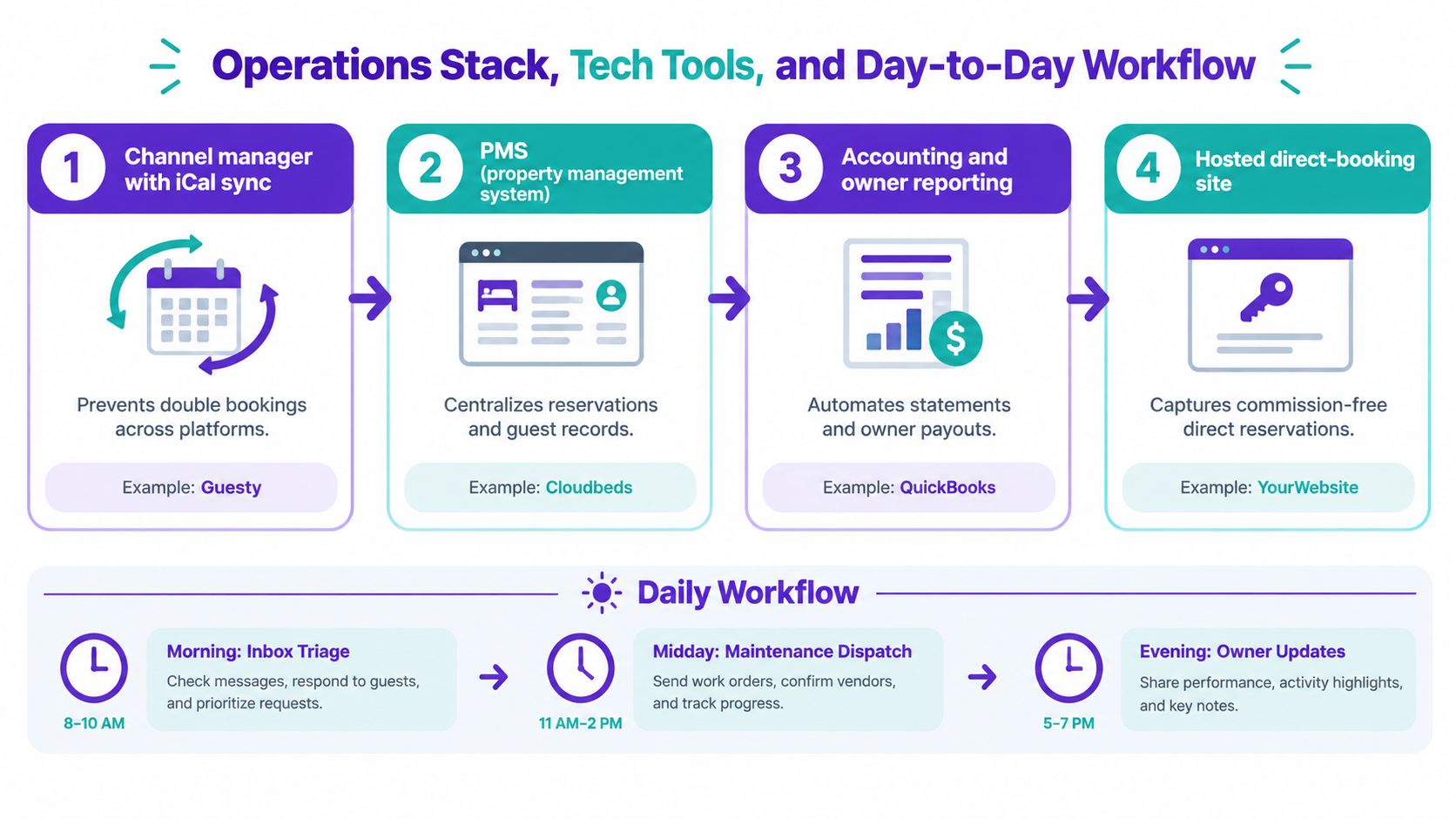
A lean operator doesn't need every feature on day one. The stack should follow operational risk. Start with calendar integrity, then centralize reservations, connect financial reporting, and add the owned booking channel once the core workflow is reliable.
Build in the order that prevents expensive mistakes
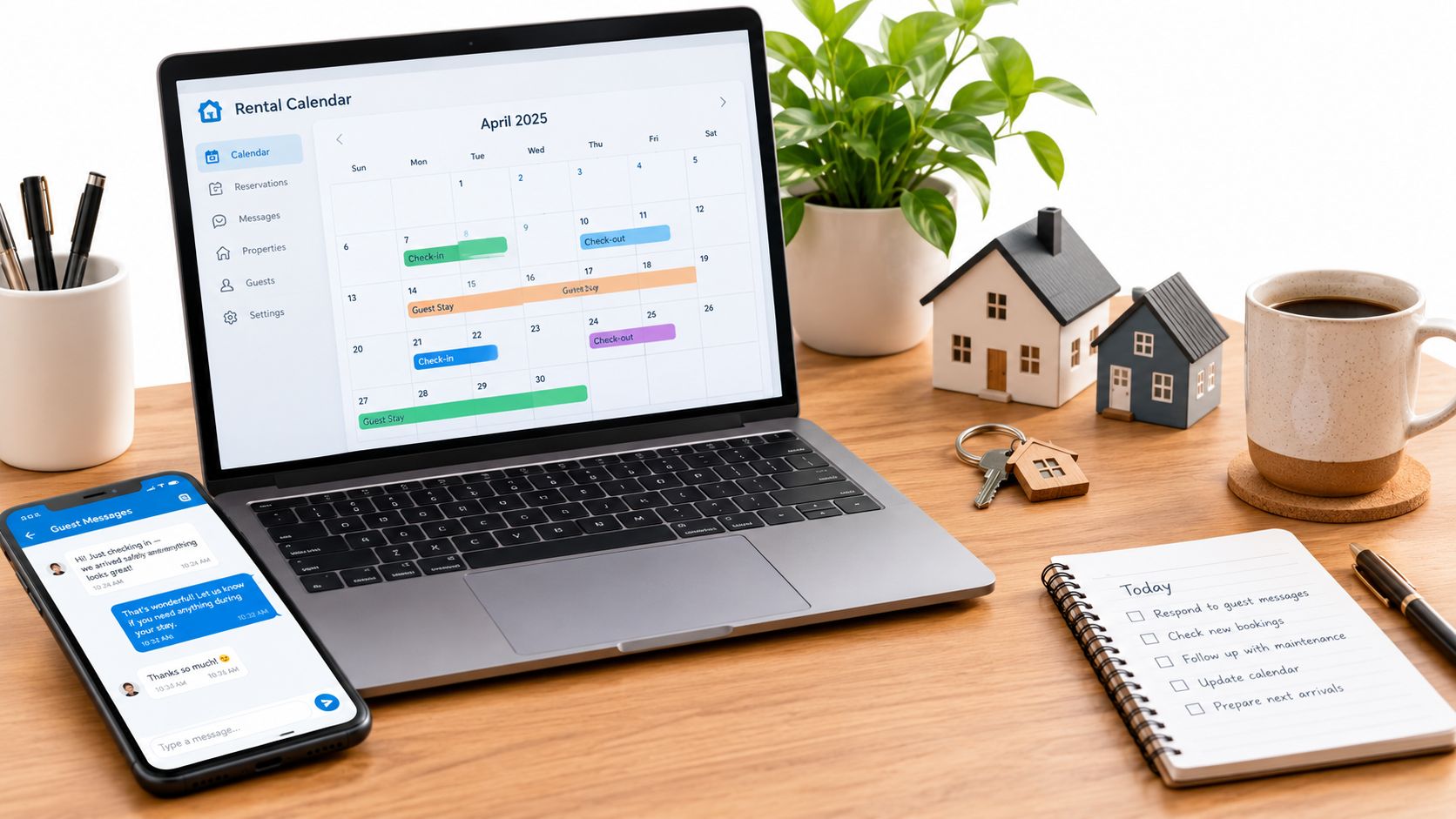
Stage one is a channel manager with iCal synchronization. Two-way calendar updates reduce the risk of accepting overlapping reservations across Airbnb, Vrbo, Booking.com, and a direct site. Rentabble is one hosted option that combines a branded direct-booking site with availability, pricing, booking requests, and two-way iCal synchronization.
Stage two is a property management system. Add a PMS when reservation volume, guest records, task assignments, and message templates become difficult to manage from separate tools. The PMS should create one operating view, not another inbox that staff must check.
Stage three is accounting and owner reporting. Separate business funds from owner funds, document approvals, reconcile transactions, and produce consistent statements. Consult local professionals about licensing, trust accounting, tax treatment, and insurance because requirements vary by jurisdiction.
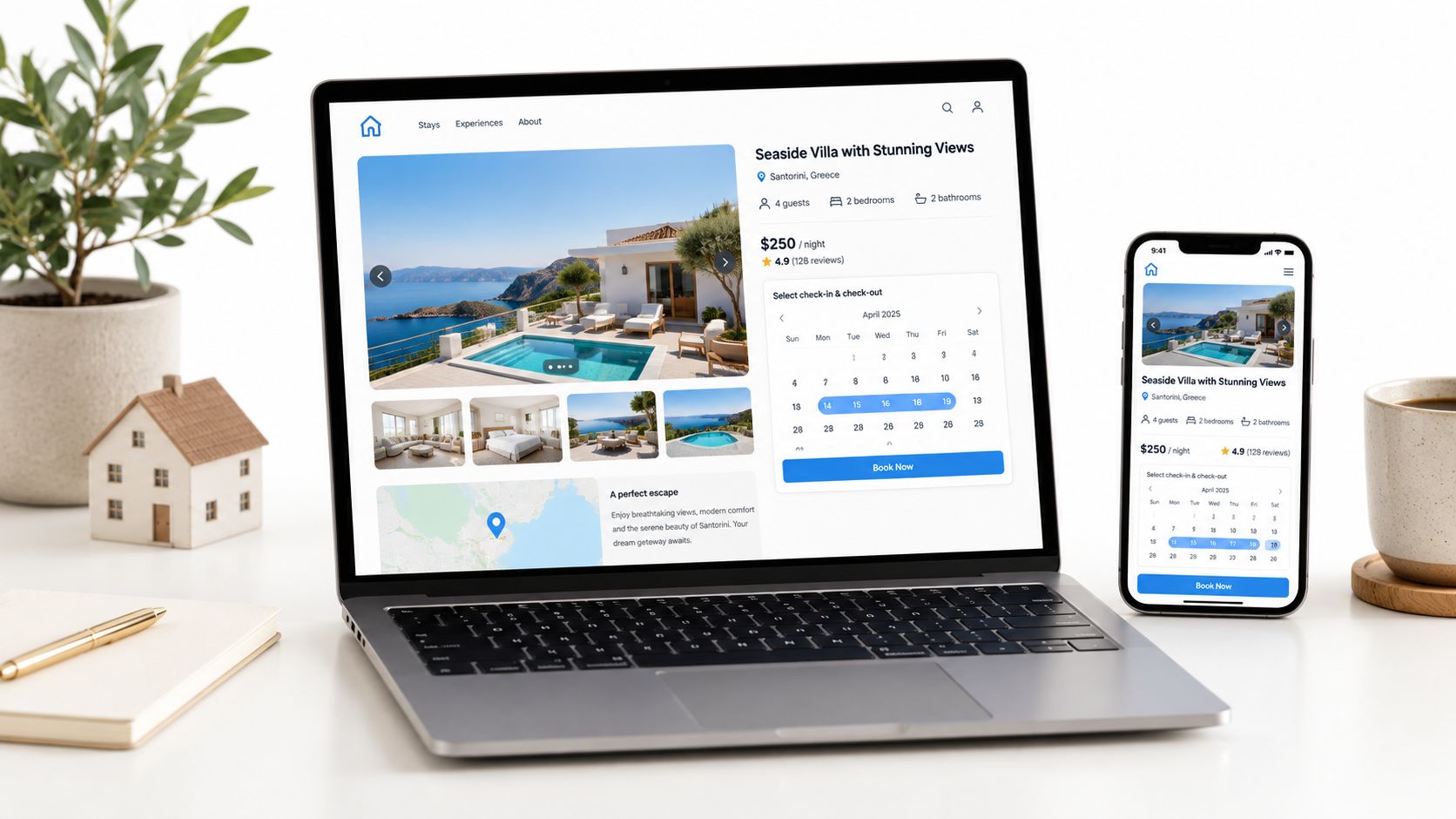
Stage four is the hosted direct-booking site. It should show live availability, calculate the guest's total clearly, support booking requests or reservations, and keep the channel calendar aligned. A custom build can wait until the business has a proven demand and a specific reason to own development.
The supplied product information describes Rentabble as a hosted platform with property pages, seasonal pricing controls, request management, owner dashboards, and iCal synchronization. For broader operational context, compare the requirements of an online rental management system with the workflows your team performs.
Give every weekday a job
A simple weekly rhythm helps prevent urgent work from consuming all planning time:
- Monday, inventory review: Check availability, restrictions, upcoming gaps, and channel parity.
- Tuesday, owner reporting: Review statements, unresolved maintenance, owner blocks, and approvals.
- Wednesday, guest communication: Prepare arrival information, special requests, and escalation notes.
- Thursday, turnover control: Confirm cleaners, inspect exceptions, and resolve supply shortages.
- Friday, direct-channel marketing: Follow up on past-guest opportunities, referral traffic, and content updates.
A 30-unit boutique manager can often begin with an operations lead, two contract turnover cleaners, and a part-time administrator. That isn't a fixed staffing prescription. The correct structure depends on property layout, service level, seasonality, and how much work the owner handles personally.
The supplied plan assumptions place an entry-level stack around $200 to $500 per month, with a fuller PMS and accounting setup scaling to $800 to $1,500 monthly once revenue exceeds $15,000 per month. Those figures are planning inputs from the brief, not universal vendor pricing. Build them into your forecast and test whether the labor saved is worth the subscription.
Financial Projections, Break-Even, and KPIs to Track
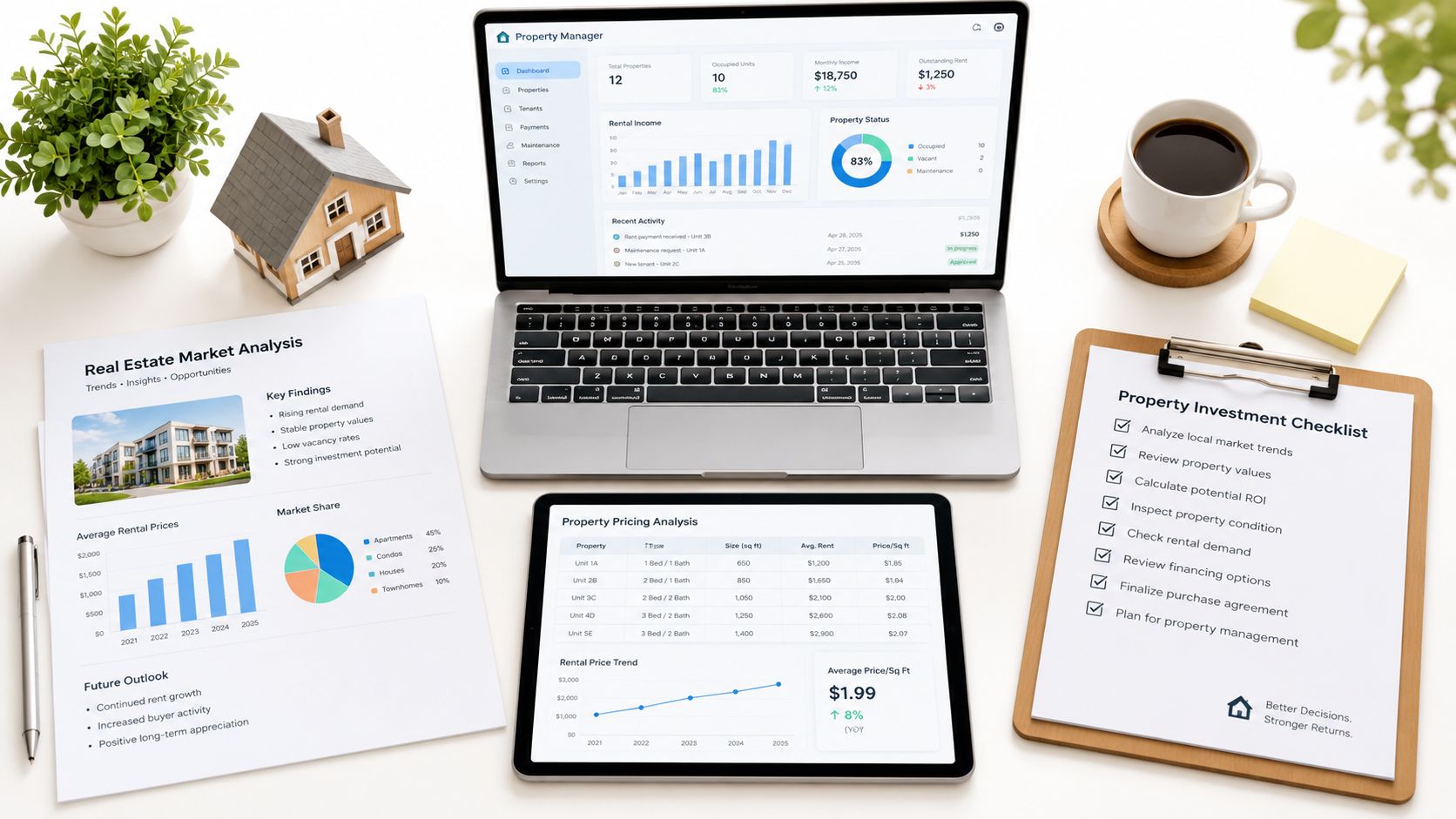
Your financial model should begin with one property, then roll up to the portfolio. Forecast booking revenue, management income, add-ons, payment and channel costs, labor, software, insurance, marketing, taxes, and owner distributions separately. Don't treat gross bookings as company revenue. The manager earns the agreed fee and approved ancillary income, while the owner's funds require careful accounting.
The supplied model uses a 30-unit portfolio, 55% occupancy, $145 ADR, an 18% blended OTA commission, and a direct mix that rises from 15% to 35%. It also models break-even at roughly 22 managed units at 60% occupancy. These assumptions are provided for scenario planning and should be replaced with local demand, unit-level rates, and signed owner agreements.
| Scenario | Occupancy | ADR | Direct Mix | Annual Revenue | Break-Even Units |
|---|---|---|---|---|---|
| Conservative | 55% | $145 | 15% | Model with lower booking volume and higher OTA exposure | Above the base case |
| Base | 60% | $145 | 25% | Model using stabilized operating assumptions | About 22 units |
| Upside | 65% | $145 | 35% | Model with stronger utilization and owned-channel share | Below the base case |
The table reflects the brief's supplied assumptions, not a guaranteed projection. It deliberately leaves annual revenue as a model output because a credible plan must specify whether “revenue” means gross booking revenue, management income, or total business receipts.
Track the revenue stack, not occupancy alone
The core performance measures are occupancy, ADR, and RevPAR. Occupancy is booked nights divided by available nights. ADR shows the average daily rate. RevPAR combines rate and utilization, helping you see whether a full calendar is producing adequate revenue.
The supplied vacation-rental benchmarking guidance places the U.S. average occupancy at 48.4%, with healthy ranges around 65% to 75% in strong urban markets, while leisure markets can show lower seasonal bands (RedAwning's vacation-rental benchmarking guide). Treat those figures as context, not a target for every property.
Review these secondary indicators monthly:
- Direct-channel share: Shows whether owned demand is becoming meaningful.
- Net revenue by channel: Separates gross rate from actual contribution.
- Cost per acquisition: Measures whether marketing creates profitable bookings.
- Owner satisfaction: Use a consistent survey or NPS process.
- Turnover cost per stay: Reveals whether pricing covers labor and supplies.
- Maintenance response time: Identifies service failures before owners do.
A five-point occupancy change can matter materially, but the exact effect depends on unit count and ADR. Recalculate the model whenever occupancy, pricing, staffing, or channel costs move. Review the full P&L monthly, run a deeper sensitivity check each quarter, and trigger action when cash runway tightens, owner reporting slips, direct-channel conversion weakens, or turnover labor consumes more margin than planned.
Final Checklist and Common Pitfalls Before You Launch
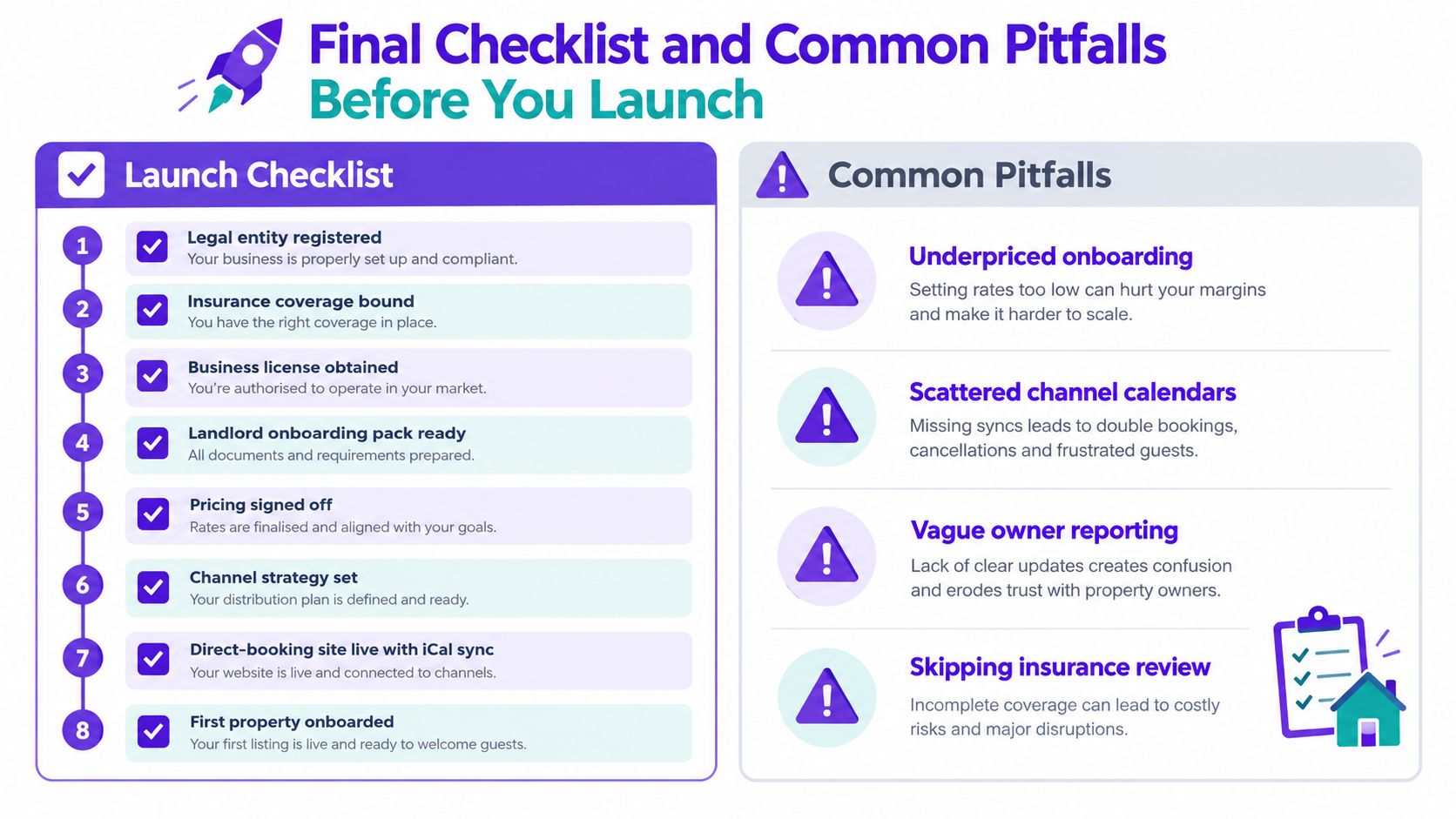
A launch checklist should be sequential, not aspirational. Complete the legal and financial foundation before accepting management responsibilities, then make the service promise operationally deliverable.
Complete the launch sequence
- Register the legal entity: Confirm the appropriate structure with a qualified professional.
- Bind insurance coverage: Review general liability, professional liability, property responsibilities, and vendor coverage.
- Obtain required licenses: Check state and local requirements before managing for owners.
- Prepare the landlord pack: Include the agreement, scope of services, fee card, reporting example, and onboarding checklist.
- Approve pricing: Test the model against actual labor, software, turnover, and support costs.
- Set the channel policy: Decide what each channel does and how inventory is rebalanced.
- Launch the direct channel: Use a site and calendar process that prevents conflicting availability.
- Assign the first KPIs: Give the first 30, 60, and 90 days clear performance measures.
The mistakes are predictable. New managers forecast occupancy without calculating break-even. They treat OTAs as the only acquisition source, accept vague owner instructions without a written service-level agreement, underprice turnover labor, or postpone technology until manual calendar work creates a failure.
Start this week with three actions: validate the monthly profit of one representative unit, draft the complete owner fee card, and test your direct-booking workflow before onboarding more inventory. A small plan that matches actual operations is more valuable than a polished forecast no one uses.
Rentabble provides a hosted direct-booking website with branded property pages, availability and pricing controls, booking requests, and two-way iCal synchronization for small operators and boutique managers. Use Rentabble to evaluate whether a lean owned-channel setup fits your property management business plan before you commit to custom development.