Luxury Short Term Rentals: The Complete 2026 Guide

A guest books your coastal villa because the photographs promise privacy, design, and ease. They arrive tired, enter with a code, and find a beautiful room that still feels strangely impersonal. The welcome sheet is generic, the kitchen lacks a few basic supplies, and nobody has explained who to contact when the air-conditioning behaves oddly.
That gap is where many owners lose the premium they thought their property had earned. Luxury isn't a marble bathroom or an expensive sofa by itself. It's the disciplined execution of every small decision before arrival, during the stay, and after checkout.
The opportunity is substantial. The global luxury vacation-rental market was estimated at approximately USD 26.5 billion in 2024 and is projected to reach an estimated USD 63.7 billion by 2034, with villas and estates representing roughly 49% of the market in 2024, according to Grand View Research's luxury vacation-rental market analysis. Owners don't need to imitate a five-star hotel. They need to operate their property with the consistency of one.
Table of Contents
- A Guest Walks Into Your Luxury Rental
- What Actually Defines a Luxury Short Term Rental
- Guest Expectations at Every Touchpoint
- Pricing and Seasonal Strategy That Protects ADR
- Marketing and Listing Optimization for Premium Bookings
- Building a Direct Booking Channel That Converts
- Calendar Integrity and Multi Channel Operations
- Your 90 Day Luxury Rental Action Plan
A Guest Walks Into Your Luxury Rental
A couple arrives at a premium coastal villa after a long international journey. The property looks exactly like the listing. The pool catches the evening light, the bedroom is immaculate, and the view is worth the rate.
The keys are waiting in a coded lockbox. No one meets them. A printed welcome sheet explains the Wi-Fi and checkout rules, but it doesn't tell them where to find dinner, whether the tap water is safe, or who can help if the gate remote fails. In the kitchen, the appliances are excellent, but there isn't enough cooking oil to prepare the meal they planned after traveling all day.
None of these details creates a dramatic complaint. Together, they change the emotional category of the stay. The guests stop feeling looked after and start feeling like temporary occupants in a well-designed house.
The first 48 hours reveal the operating standard
The next morning, they discover that the coffee machine requires a setting they can't identify. A message to the host receives a reply later than expected. That afternoon, a loose outdoor cushion blows into the garden, and the guests wonder whether anyone checks the property between stays.
A standard rental answers questions when guests ask them. A luxury operation anticipates the questions that interrupt the experience. Before arrival, the host confirms the expected temperature inside, checks the access instructions, and asks whether the guests have dietary preferences or a special occasion to celebrate. A named local contact is available if something goes wrong, while the primary host remains present without hovering.
The pantry doesn't need to be extravagant. It needs to be intentional. Basic cooking essentials, suitable coffee, chilled water, and a few locally relevant items tell the guest that somebody considered the first evening rather than just reset the room.
Practical rule: Treat arrival as a choreographed sequence, not a handover of keys.
The strongest luxury short term rentals make hundreds of small decisions invisible to the guest. The temperature is comfortable, instructions are easy to follow, towels are where they should be, and a local recommendation fits the actual purpose of the trip. The guest notices the experience, not the system behind it.
Audit your own property from the guest's perspective. What happens between payment and arrival? What does the guest know in the first ten minutes on site? Which small inconvenience would you tolerate because you own the property, but a premium guest would interpret as neglect?
What Actually Defines a Luxury Short Term Rental
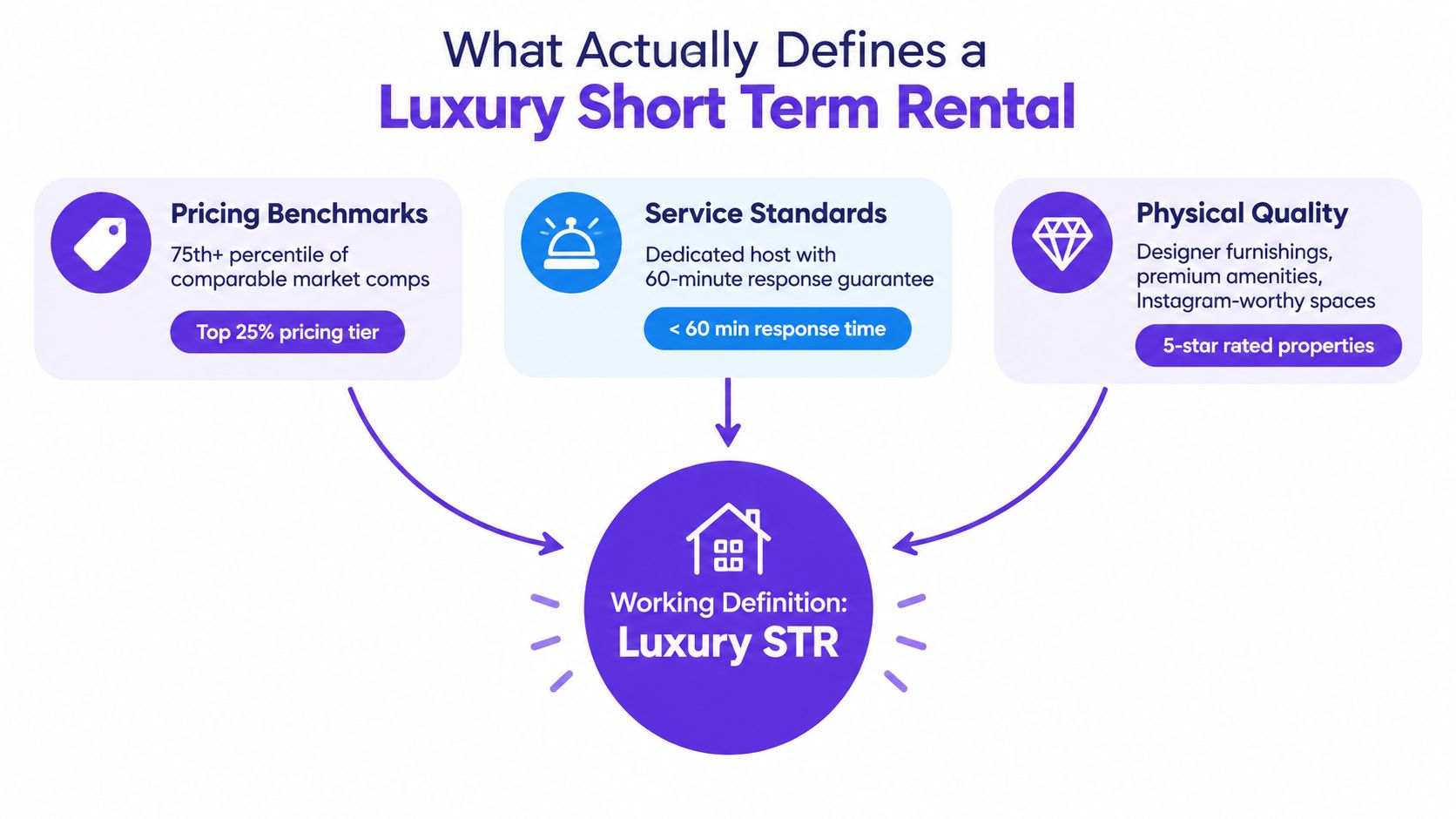
A luxury short term rental earns its rate through a repeatable experience. Revenue positioning, physical quality, operational reliability, and guest recognition must work together, because an expensive interior cannot compensate for inconsistent service or a difficult stay.
The market includes villas and estates, but presentation alone will not protect premium pricing. For a small operator, the practical test is simple: compare one bathroom, one kitchen drawer, and one outdoor seating area with the property's strongest photograph. If the guest sees a mismatch, the listing promise weakens before the first support request. The market overview from Grand View Research provides broader context for this category.
Four tests for a credible luxury position
Revenue position. Compare the property with similar homes, not every rental in the destination. A private villa with a pool, a view, and reliable support belongs in a different set from a basic apartment. Set the rate around the experience you can deliver repeatedly, then protect that rate through direct bookings that reduce dependence on marketplace fees.
Physical presentation. Luxury design requires coherence. Furniture, lighting, linens, kitchen equipment, outdoor areas, and photography should describe one property. Inspect the details guests touch, including bathroom supplies, drawer contents, and serving ware. One neglected room can undermine the visual standard that supports your ADR.
Operational response. Guests need accurate house information, clear access instructions, dependable maintenance, and one named person who can resolve problems. Document the response process, test it between stays, and make support easy to find. A beautiful home with uncertain help is a premium product running on a basic operating system.
Guest recognition. Personalization should remove friction. Record useful preferences, such as firm pillows, child-suitable dining equipment, or nearby walking routes, and apply them on a returning stay. Do not turn personal details into unnecessary upselling. Recognition builds repeat direct bookings when it improves the guest's actual experience.
A high-end long-stay property may offer excellent finishes with limited service flexibility. Short stays compress the guest's judgment into arrival, discovery, use, support, and departure. A repeated failure at any stage means the property is not delivering at its advertised level.
Score the operation. Can you defend the rate against comparable homes? Does every room photograph and function properly? Can guests reach help without searching old messages? Do returning guests receive a more considered stay than first-time visitors?
Guest Expectations at Every Touchpoint
Guests form opinions before they arrive. They assess the photography during discovery, the clarity of the booking process, the confidence of the confirmation message, and the quality of the first interaction. The property earns trust in layers, and a weak layer makes every later promise harder to believe.
The two most valuable moments are pre-arrival and the first fifteen minutes on site. Use the first to eliminate uncertainty. Use the second to prove that the listing was accurate.
| Touchpoint | Meets the Bar | Exceeds the Bar |
|---|---|---|
| Discovery | Accurate photography, clear location, honest amenities | A strong visual story showing how guests use the property |
| Booking confirmation | Dates, price, access information, and policies | A concise itinerary with travel context and useful next steps |
| Pre-arrival communication | Standard check-in instructions | A personalized message covering preferences, arrival timing, and local plans |
| Arrival | Clean rooms, working access, basic supplies | Comfortable temperature, named support, thoughtful pantry, and frictionless entry |
| In-stay support | Replies to questions and maintenance requests | Proactive check-in that respects privacy and offers relevant help |
| Mid-stay moments | The promised amenities work properly | A small, locally relevant gesture tied to the guest's purpose |
| Checkout | Clear departure instructions | A simple departure process plus a professional follow-up |
Personalization without overstepping
Recent industry research reports that 71% of travelers expect customized experiences based on preferences, travel history, or stated needs. It also reports average satisfaction scores of 4.7 out of 5 for properties responding within two hours, compared with 4.2 out of 5 for slower responders, as discussed in Staystra's report on short-term-rental industry trends.
Those figures don't mean every guest wants constant contact. They mean guests value evidence that the operator understands the context of their stay. Ask one useful question before arrival, store the answer responsibly, and act on it. Don't collect personal information that you won't use.
A family arriving for a beach holiday needs different guidance from a couple celebrating an anniversary. A guest with dietary restrictions needs a reliable pantry conversation, not a decorative gift basket. A remote worker needs dependable connectivity and a quiet workspace, not a list of nightlife venues.
Review your last five stays and identify the two touchpoints where guests had to ask for information you could have supplied earlier. Those are your highest-return improvements.
Pricing and Seasonal Strategy That Protects ADR
Luxury owners often chase occupancy when they should protect average daily rate, or ADR. Premium short-term rentals can outperform through rate strength rather than occupancy growth. U.S. AirDNA data reported by StayFi's vacation-rental statistics review showed upscale listing ADR rising 5.23% year over year, while budget-tier ADR declined 0.33%.
That pattern changes the operating question. Don't ask, “How do I fill every night?” Ask, “What revenue per available night justifies accepting this booking?”
Build four rate periods
| Season | Nightly Rate | Min Stay | Target Occupancy |
|---|---|---|---|
| Peak demand | Highest rate supported by demand and positioning | Firm minimum stay around valuable dates | Strong occupancy without unnecessary discounting |
| Shoulder season | Moderate premium rate | Flexible enough to capture shorter gaps | Balanced occupancy and rate quality |
| Midweek value | Reduced relative to peak, never indiscriminate | Shorter stay permitted where useful | Incremental demand without weakening weekends |
| Soft windows | Controlled promotion for specific open gaps | Rules protect high-value arrival dates | Targeted conversion rather than blanket discounting |
Use minimum stays around holidays, events, and high-demand weekends. For an isolated gap between two reservations, a limited gap-night adjustment may make sense. A broad reduction across the entire calendar usually signals that you haven't separated weak dates from strong ones.
A length-of-stay discount can protect the nightly rate better than a simple price cut. The guest receives value for committing to more nights, while your cleaning and turnover workload may fall. A last-minute offer needs a rate floor, because filling a date below the property's service cost can make the month look busy while reducing its quality.
Track ADR alongside occupancy, RevPAR, lead time, cancellation behavior, and conversion by stay length. The research on revenue management for short-term rentals indicates that hosts often react to competitor pricing while underusing historical demand and customer-behavior data. Build rate rules around your own pickup pace, seasonality, weekday pattern, and event calendar.
For a deeper operating framework, use this vacation-rental pricing strategy guide. The tool matters less than the discipline. Review future periods weekly, change open dates deliberately, and don't repeatedly discount reservations that already converted.
Marketing and Listing Optimization for Premium Bookings
Listing on every marketplace isn't a strategy. It creates more calendars, more guest messages, more policy variations, and more opportunities for inconsistent information. A deep, accurate listing with strong reviews and a clear brand usually serves a luxury operator better than shallow distribution across every available channel.
Start with the first three photographs. Lead with the strongest emotional image, follow with a scene that shows how guests use the property, and then show a distinctive amenity or view. Don't waste those positions on a hallway, a logo, or a generic bedroom.
Make the listing do the selling
Write the title around location, property type, and a specific reason to care. The description should answer practical questions quickly, including privacy, access, sleeping arrangements, outdoor use, workspace, parking, and nearby experiences. Luxury guests don't want vague promises. They want confidence that the property suits the trip.
Order amenities by decision value, not by the sequence in your property-management software. If the heated pool, direct beach access, chef's kitchen, and quiet workspace matter most, put them where the guest will see them. State limitations clearly. A transparent note about stairs or distance from the village prevents a mismatch that no welcome gift can repair.
Your host profile should make support feel human. State who responds, how guests receive help, and what local knowledge you can provide. After booking, use pre-arrival guidance to set expectations, a discreet mid-stay message to catch problems early, and a post-departure request that makes leaving feedback easy.
Listing principle: Don't market features you can't maintain at the same standard every stay.
Connect each improvement to a signal you can monitor. Better photography should improve inquiry quality and booking conversion. Clear policies should reduce repetitive questions. Stronger guest communication should produce more specific reviews. A higher rate should be supported by better positioning, not by confident wording alone.
Reviews are operational evidence. Ask guests for feedback after you have delivered the stay, not immediately after payment. If a guest reports a problem, resolve it before departure where possible, document the response, and use the complaint to improve the property rather than defend the listing.
Building a Direct Booking Channel That Converts
A direct-booking website isn't a brochure. It's a funnel that moves a qualified traveler from discovery to a confirmed request without making them repeat information or wait for a manual quote.
The funnel has four practical stages:
- Awareness. Publish focused landing pages for searches related to the destination, stay type, and experience. A page for a coastal villa near local walking routes is more useful than a generic homepage filled with adjectives.
- Consideration. Show current availability, total pricing, photographs, policies, and reviews in one place. Guests should understand the offer before they send an inquiry.
- Conversion. Use a booking flow that reduces back-and-forth. Secure payment options, recognizable branding, and clear cancellation terms remove avoidable hesitation.
- Retention. Follow up after the stay with useful seasonal information and a reason to return directly. A past guest already understands the property, so your message can be relevant instead of introductory.
Direct bookings can produce higher margins than marketplace reservations because the operator avoids marketplace commission on those requests. Don't treat that difference as pure profit until you account for marketing, payment processing, support, and the work required to generate demand.
A direct channel must show the same or better availability as your external channels. It also needs transparent totals, consistent policies, a recognizable visual identity, and email confirmations that feel connected to the property. If the website requires you to manually check every date, it won't scale and it won't create confidence.
Rentabble provides a hosted branded website with property pages, guest-visible availability and pricing, booking requests, seasonal pricing controls, reviews, and two-way iCal synchronization with external platforms. Owners who want to compare approaches can also review this guide to short-term-rental direct booking.
Start with one audience and one relevant search theme. Build the page, connect the calendar, invite past guests back, and measure direct inquiries by quality and conversion. A small operator doesn't need a complicated marketing machine. They need an owned path that works every time a previous guest or qualified prospect wants to return.
Calendar Integrity and Multi Channel Operations
A luxury property can survive an imperfect social post. It can't easily recover from a double booking. Calendar integrity is the operational backbone because every promise about price, arrival, privacy, and service depends on the dates being correct.
The U.S. short-term-rental sector had more than 2.4 million listings across approximately 1.8 million unique rental properties in 2024, according to the 2024 STR Benchmark Report. The difference between listings and properties reflects how one property may appear across several channels. That distribution creates demand, but it also makes synchronized availability essential.
Use one source of truth
Airbnb, Vrbo, Booking.com, and your direct site may all receive inquiries or reservations. A channel manager or central availability calendar should control the inventory, while two-way feeds update external channels. iCal can be useful, but operators should understand the refresh behavior of each connection and avoid assuming that every update appears instantly.
Set realistic buffers for cleaning, inspection, linen replacement, and maintenance. A Saturday-to-Saturday booking pattern may look efficient on paper, but compressing turnover can force the housekeeper to skip inspection or leave a repair for the next guest.
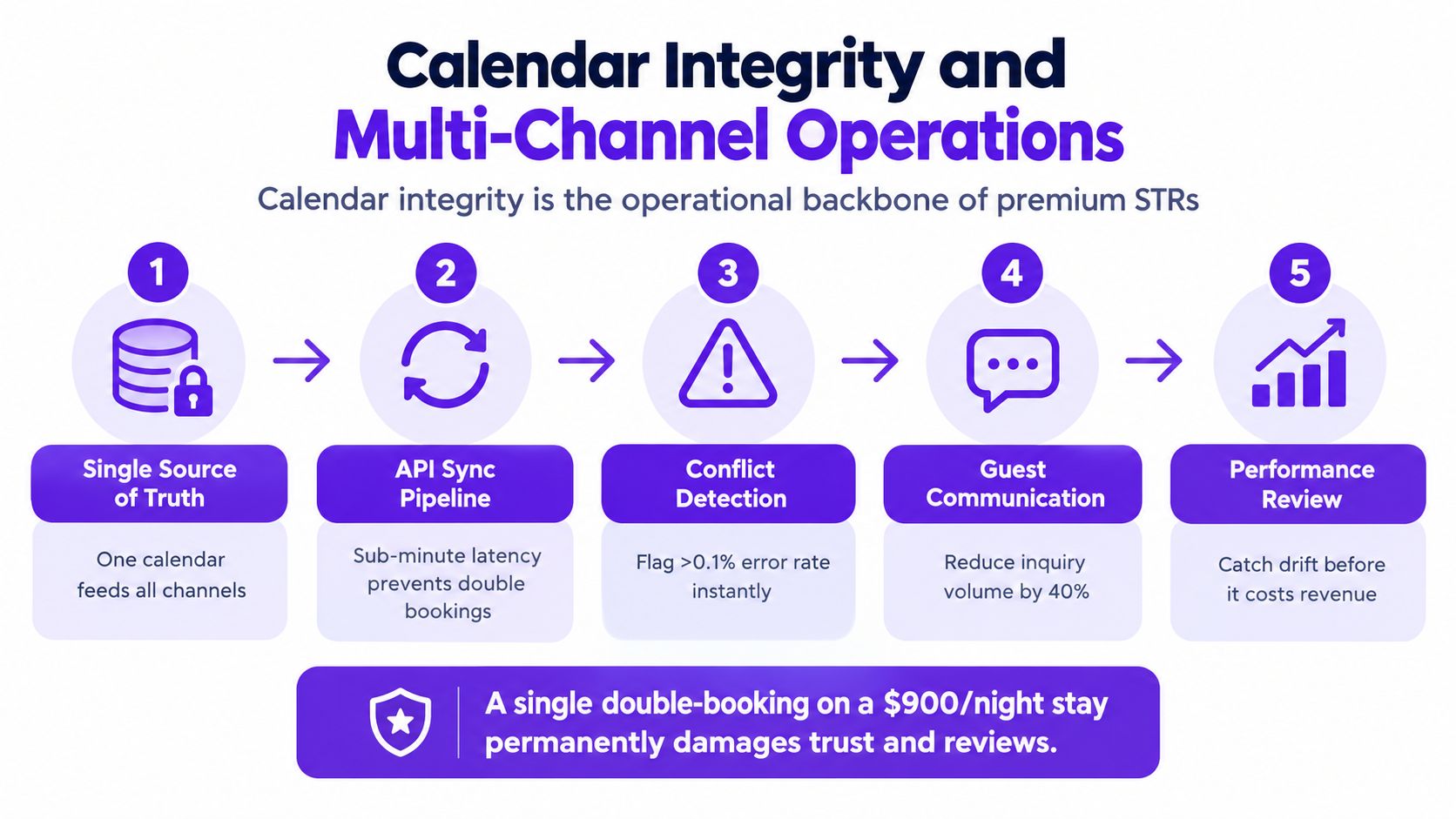
Use a nightly audit for high-value inventory:
- Check confirmed reservations: Compare the central calendar with every active sales channel.
- Check blocked dates: Verify owner stays, maintenance holds, and cleaning periods.
- Check change history: Look for modified dates, shortened stays, and unconfirmed requests.
- Check turnover capacity: Confirm that housekeeping and inspection slots still work.
- Escalate conflicts immediately: Freeze the affected dates, contact the channel with the weaker operational fit, and give the guest a clear alternative before promising anything.
If a conflict occurs, speed and honesty matter. Don't make the guest discover the error at arrival. Offer a credible solution, explain the next step, and record the failure so the same sync or workflow issue can't recur. Operators managing multiple homes should review the health of their calendars on a fixed schedule, not only after a reservation problem.
For a practical reference on maintaining availability across channels, see this rental availability calendar guide. Design attracts the booking. Calendar accuracy protects the relationship.
Your 90 Day Luxury Rental Action Plan
You don't need to rebuild the property and launch every marketing channel at once. You need a sequence that improves the guest experience first, protects revenue second, and creates repeatable demand third.
Days 1 to 30 build the foundation
Start with a hard audit. Review the property through four lenses: rate positioning, physical presentation, response quality, and guest recognition. Walk through the arrival as if you know nothing about the house. Test the access code, Wi-Fi instructions, kitchen supplies, lighting, climate control, and emergency contact path.
Then improve the evidence guests see:
- Refresh the photography: Photograph every important room in natural light and show the relationship between indoor and outdoor spaces.
- Rewrite the listing story: Lead with the experience, then explain the practical details that make the experience possible.
- Install a central calendar: Connect external channels and the direct site to one availability workflow.
- Set a rate floor: Decide which dates and booking patterns you won't discount below.
Days 31 to 60 improve revenue control
Build the seasonal calendar with distinct peak, shoulder, midweek, and soft-window rules. Add minimum stays around valuable dates, allow flexibility where it helps fill genuine gaps, and review ADR, occupancy, RevPAR, lead time, and cancellations each week.
Create one direct-booking landing page for one tightly defined audience or experience. Connect live availability and total pricing before promoting it. Then segment past guests by useful context, such as couples, families, repeat visitors, or guests who traveled for a particular event. Send a relevant re-engagement message instead of a generic discount.
Days 61 to 90 formalize service and retention
Write the review-request flow, including the timing, message, and response to private complaints. Create a repeat-guest offer that rewards direct rebooking without training guests to wait for constant discounts. Review the unit economics of marketplace reservations against direct requests, including the cost of acquiring and serving each booking.
Keep the operating rhythm simple:
- Monday: Audit calendars, blocks, arrivals, and turnover capacity.
- Wednesday: Review upcoming rates, pickup, gaps, and minimum-stay rules.
- Friday: Check guest communication, open maintenance tasks, and next-week arrivals.
- Monthly: Review ADR, occupancy, RevPAR, cancellations, direct inquiries, reviews, and repeat demand.
Luxury isn't achieved by adding another amenity to a room that still lacks reliable follow-through. It comes from making the property easy to trust, easy to use, and consistently personal from the first message to the final thank-you.
Rentabble gives small vacation-rental operators a hosted branded website with direct booking requests, transparent guest pricing, seasonal rate controls, live availability, and calendar synchronization across external channels. Visit Rentabble to create a more controlled direct-booking operation for your luxury rental.