Vacation Rental Pricing Strategy: A Practical 2026 Guide

Most hosts are told to lower prices to fill the calendar. That advice sounds practical, but on a small portfolio it usually just trains you to chase occupancy, cut ADR, and accept weaker revenue quality for the same cleaning workload.
A better vacation rental pricing strategy starts with one question, not two. How much revenue does each available night produce, and how fast is the pace moving on the dates that matter? If you only watch occupancy, you can end up feeling busy while leaving money on the table.
Table of Contents
- Why Chasing Occupancy Quietly Drains Your Revenue
- Set Your Pricing Foundations Before You Touch a Rate
- Build Seasonal Rate Periods That Match Real Demand
- Discount With Intent Instead of Across the Board
- Manual Rules vs Dynamic Pricing Engines
- Test, Measure, and Adjust on a 30-Day Cycle
- Your One-Page Pricing Playbook
Why Chasing Occupancy Quietly Drains Your Revenue
The reflex to discount an empty calendar is common, and it's usually wrong. Occupancy looks comforting because it makes the dashboard turn green, but RevPAR forces you to measure what the calendar is earning, not just how full it looks. The right benchmark is ADR multiplied by occupancy, not occupancy by itself, and a host can absolutely beat a fuller calendar with higher rate quality.
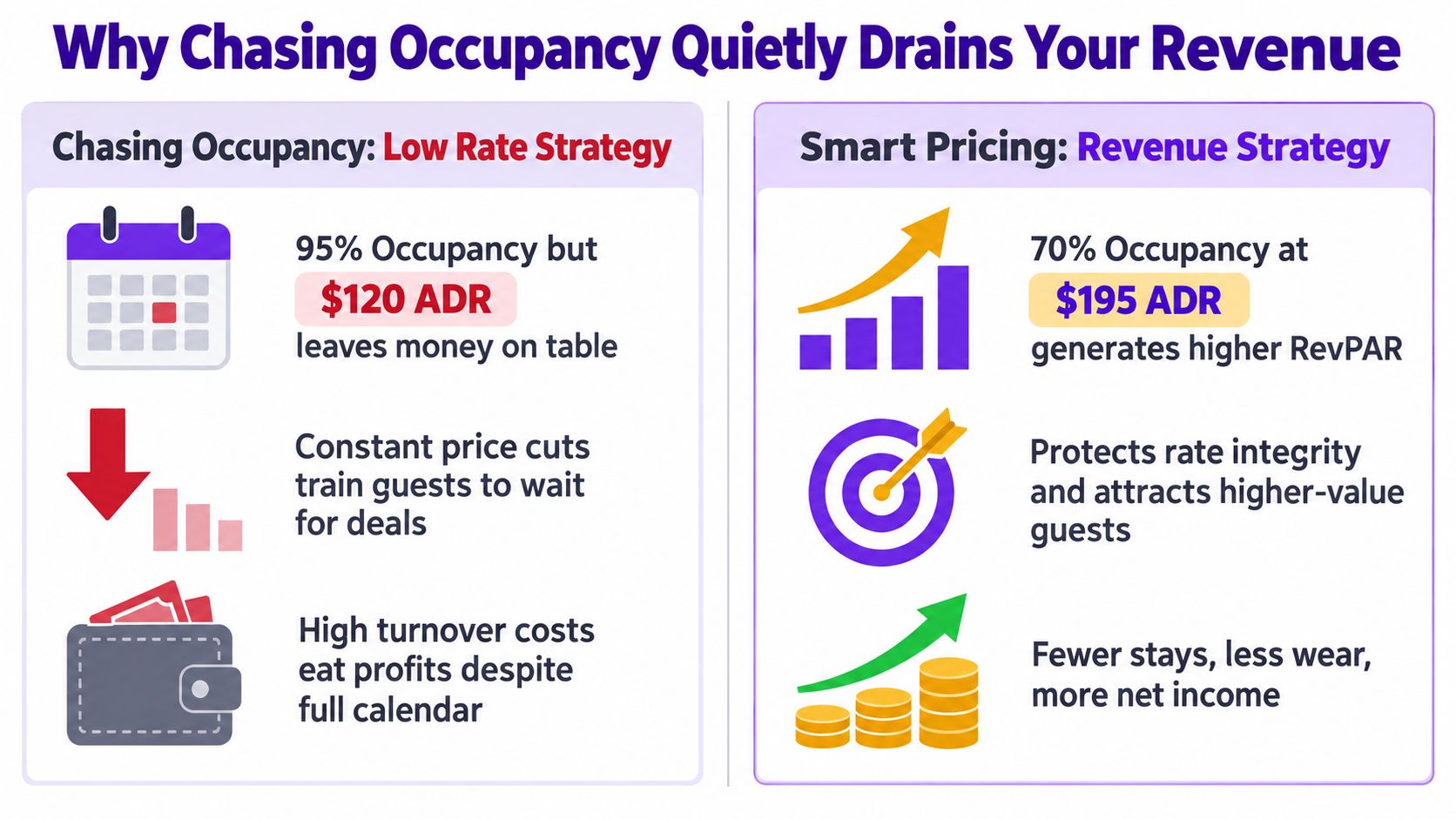
Take two units at the same 70% occupancy. One holds a $180 ADR, the other panics and drops to $130 ADR. The second calendar looks busier, but it's giving up roughly $25 per available night. That's the part most hosts miss when they slash rates just to make bookings feel safer.
Booking pace matters more than a blank calendar
A peak week that's selling 40% slower than last year is not automatically a discount problem, it's a pacing problem. If demand is still there, the guest who will pay your rate often just hasn't booked yet. This is why the smarter move is usually to hold rate integrity first, then discount only when the date is clearly soft and the market is soft with it.
Practical rule: if a date is valuable, protect the rate and watch the pace. Don't hand away margin just because the calendar looks quiet today.
That shift matters because vacation rentals no longer behave like a one-time seasonal calendar. Pricing is now a live revenue lever, and the host who manages it like inventory tends to outperform the host who manages it like a guess. The rest of your pricing decisions should follow that logic, not the old habit of filling nights at any cost.
Set Your Pricing Foundations Before You Touch a Rate
Before you change a single price, lock in the numbers that make the decision defensible. A good vacation rental pricing strategy starts with a comp set, a cost floor, and a baseline of your own performance. Without those three anchors, every rate change is just a hunch with a spreadsheet on top.
Build a comp set you'll actually use
Pick 5 to 8 comparable listings that sit close to your property and match on bedroom count, amenities, and guest capacity. Don't compare a lakefront home to a city studio just because they share a platform category. Pull their published rates for the next 90 days, keep the snapshot, and use it as your weekly reference point.
Don't chase every listing in the market. Compare against the few that guests would genuinely consider instead.
Set a hard floor and stop pretending discounts are harmless
Your floor should cover the true nightly cost of the unit, including mortgage, utilities, cleaning, platform fees, and a maintenance reserve. After that, add your target margin and treat the result as a baseline. If a proposed discount falls below that floor, the date stays open.
Track your own benchmark before you optimize
Measure your trailing performance using ADR, occupancy, RevPAR, average length of stay, and lead time. That gives you a before-and-after view that means something. If you don't know your starting point, you can't tell whether a rate change improved revenue or just moved bookings around.
A simple one-page sheet is enough. Put the comp set, the floor, and your KPI baseline in one place, then review it on the same day every week. Hosts who do that make cleaner decisions because they stop arguing with the calendar and start comparing real numbers.
Build Seasonal Rate Periods That Match Real Demand
Seasonality is not one long peak and one long off-season. It's a series of demand pockets, and your rates should behave like they know that. A cleaner approach is to divide the year into distinct periods, then tie each one to rate, minimum stay, and check-in rules that support the booking pattern.
Use demand periods, not calendar labels
Map your calendar into high peak, peak, shoulder high, shoulder low, low season, and event windows tied to local demand. That lets you price around what people are doing, not what the month name says. A holiday weekend, a concert run, and a random Tuesday in shoulder season should not share the same rate logic.
Use this table as the structure, then refine it to your market.
| Demand Period | Rate Multiple vs Low Season | Minimum Stay | Check-In Days |
|---|---|---|---|
| Low Season | 1.0x | 1 to 2 nights | Flexible |
| Shoulder Low | 1.2x | 2 nights | Flexible |
| Shoulder High | 1.2x to 1.4x | 3 nights | Friday to Monday |
| Peak | 1.5x to 1.8x | 4 to 5 nights | Friday only |
| High Peak | 2.0x to 2.5x | 7 nights | Restricted |
| Event Window | Event premium | As needed | Restricted |
Treat minimum stays as a revenue tool, not a convenience setting
Longer minimum stays make sense when turnover eats too much of the upside. In quieter periods, short stays help you catch midweek and weekend gaps. In peak periods, stricter stays protect your best nights from being broken into low-value fragments.
Restrict check-in days when operations would otherwise get messy
If your cleaner can't absorb midweek turnovers without hurting quality, stop pretending every arrival day is equally useful. A Friday-to-Monday window during shoulder periods keeps the calendar smoother, and a Friday-only policy during peak weeks protects both rate and sanity. Rentabble supports seasonal pricing tools, minimum stays, and allowed check-in days, so this kind of structure can live in the booking flow instead of a separate spreadsheet.
Rate periods, stay rules, and check-in limits work best as one system. Split them up, and the calendar starts fighting itself.
Discount With Intent Instead of Across the Board
Discounting isn't a strategy by itself. It's a tactical response when a date is slipping and you have a reason to believe price is the blocker. If you use it too freely, you just teach the market to wait for markdowns.
Use three discount types and nothing sloppier
The first is length-of-stay pricing, which rewards longer bookings and raises total booking value without giving away the whole calendar. The second is last-minute pricing, which only belongs inside the short booking window when a date is clearly drifting unfilled. The third is soft-date targeting, where you trim a specific shoulder week or awkward gap that would otherwise stay empty.
- Length-of-stay discounts: Use them when a longer booking helps reduce turnover and stabilize revenue.
- Last-minute discounts: Use them only when the date is close, the pace is weak, and the market is also soft.
- Soft-date markdowns: Use them for specific weak dates, not entire months.
Watch the trigger, not your mood
Discount when booking pace is clearly behind, lead time is short, or your comp set is softening faster than yours. Don't discount just because a week looks lonely on the calendar. That's emotional pricing, and it usually costs more than it saves.
Never stack your way into a margin problem
Promo codes, member rates, and seasonal discounts can pile up quickly. When hosts stack them without a floor, they often cut deeper than they realize. If the combined price falls under your cost floor plus target margin, the answer is no.
A discount should solve a pacing problem. If it doesn't, hold the rate and keep the date dark.
Manual Rules vs Dynamic Pricing Engines
A small portfolio can work with either manual pricing or a dynamic engine, but the trade-off is real. Manual control gives you judgment, local knowledge, and zero software cost, which matters when you know exactly how a school calendar, a wedding season, or a neighborhood event affects demand. The downside is simple, you have to stay on it, and most hosts don't review rates often enough.
Manual control is strong on judgment, weak on speed
If you manage one to three units, manual rules can work well when you're disciplined. You can encode your own knowledge, hold rates for special weeks, and avoid letting an algorithm undercut a date that should stay firm. You also own every decision, which is useful when you don't want software making value calls for you.
Dynamic engines win on cadence
Algorithmic tools like PriceLabs, Beyond, Wheelhouse, and Airbnb's own pricing tools can react faster than a human who checks the calendar once a week. Research on Airbnb pricing history found that listed prices can be sticky, with the estimated cost of changing a listed price about 0.9% to 2.2% of the listed price in New York City, which helps explain why many hosts update too slowly. A live pricing engine reduces that drag by refreshing rates on a regular cadence instead of waiting for you to remember.
Match the method to your size
For 1 to 3 units, I'd use dynamic pricing as the base and manual overrides for holidays, local events, and any date where your judgment beats the software. For 4 to 6 units, lean much closer to automation and review the overrides monthly. That hybrid setup gives you speed without surrendering control of the dates that matter most.
The best version is usually not pure automation. It's a base engine that handles the routine work, paired with host judgment on the handful of dates where local context matters more than the model.
Test, Measure, and Adjust on a 30-Day Cycle
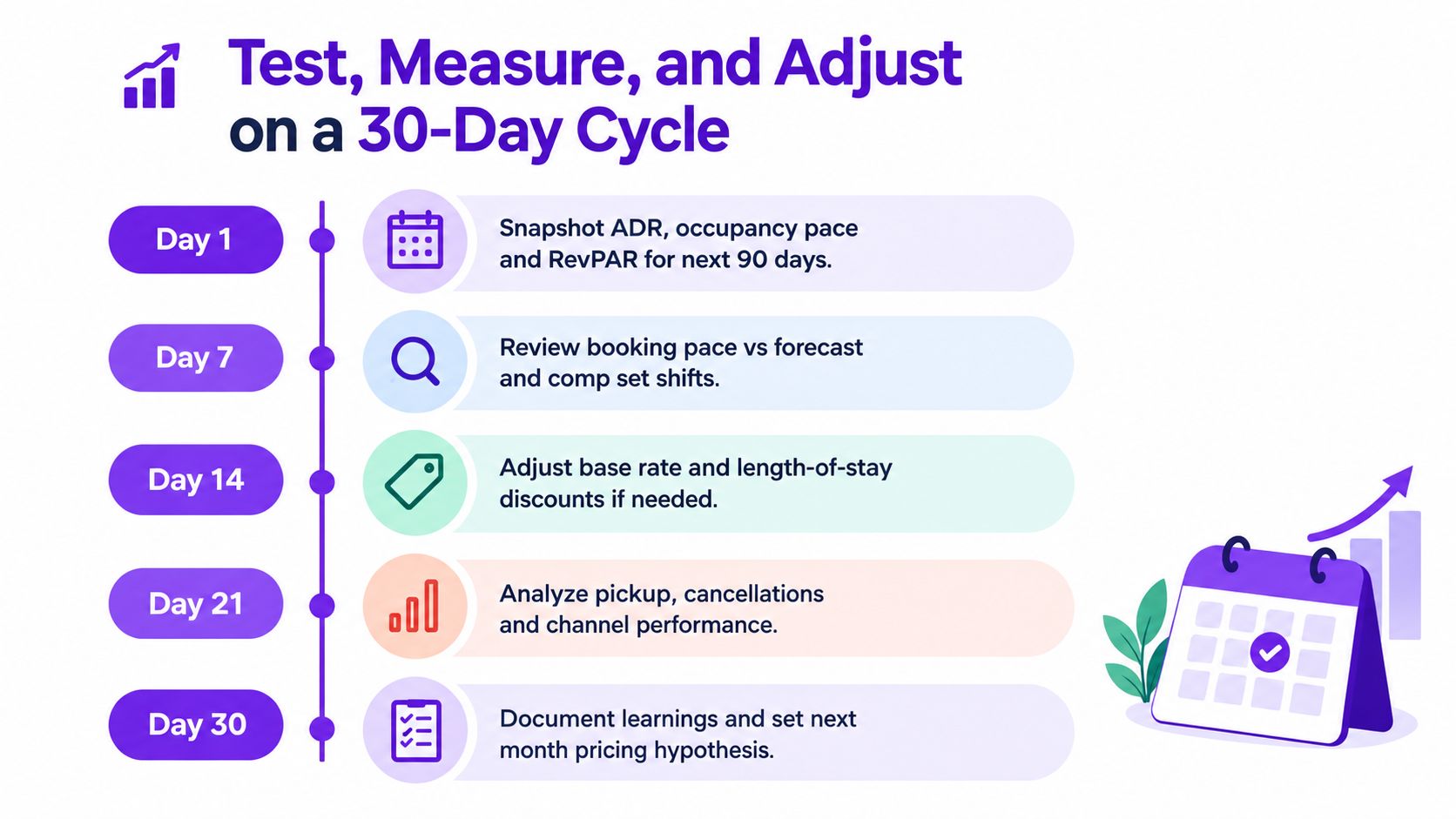
Pricing gets better when you treat it like a monthly experiment. The point isn't to change rates constantly, it's to change them with discipline and then check whether the move improved ADR, occupancy, and RevPAR. If you can't tie the result to a specific action, the lesson is useless.
Keep the rhythm tight
On day 1, snapshot your current ADR, occupancy pace, and RevPAR for the next 90 days. On day 7, compare pace with the same window last year and the comp set. On day 14, isolate the two or three dates trailing most heavily and choose one response, rate hold, minimum stay change, or targeted discount.
On day 21, audit comp-set ADR and flag any date where you sit too far above or below the median. On day 30, log every change with the date, the rate before, the rate after, and the trigger that caused it. That log becomes your pricing memory, which is more valuable than trying to remember what you “felt” a month ago.
Change one variable at a time
If you lower the rate and shorten the minimum stay in the same week, you won't know what drove the pickup. Keep the test clean. One lever, one result, one lesson.
Use the same metric set every month
Track ADR, occupancy, RevPAR, lead time, and length of stay. That gives you enough signal to see whether a change improved revenue quality or just filled gaps with cheap nights. The point is consistency, not complexity.
Your One-Page Pricing Playbook
A useful vacation rental pricing strategy should fit on one page and live next to your calendar. If it takes a full meeting to understand, it's too complicated to use consistently. The best playbook is the one you can run every week without guessing.
Put these six actions on repeat
- Pull your comp set nightly: Track a small group of nearby similar listings and watch for rate moves that change your own positioning.
- Confirm your cost floor: Make sure cleaning, fees, and target return are covered before you open any discount.
- Lock seasonal periods by demand signal: Use actual booking behavior and event windows, not just month names.
- Set min and max rates: Protect ADR with rate bands so nothing drifts into panic pricing.
- Enable alerts for gaps: Watch for occupancy thresholds and last-minute holes that need a targeted response.
- Pin the playbook beside the calendar: Review it weekly so pricing stays a habit, not a fire drill.
Use direct-booking tools as part of the system
If you sell direct, your pricing logic needs to live where guests can see it. A platform like Rentabble lets hosts set seasonal rates, minimum stays, and check-in days while automatically calculating the booking total from those rules. That matters because the rate strategy and the booking flow should match, not conflict.
Review the exit triggers before every week starts
Revisit the pricing plan when comp-set ADR moves materially, a comparable listing changes its base rate, or local event inventory shifts. Those are the moments that justify a fresh look. Otherwise, stay with the plan and let the data accumulate.
If you want a cleaner way to manage direct-booking pricing, calendar sync, and request flow in one place, visit Rentabble and see how it handles seasonal rates and availability rules for small operators. Then build your next pricing review around the dates that move revenue, not the ones that only make the calendar look busy.