Vacation Rental Online Booking: A Practical Guide
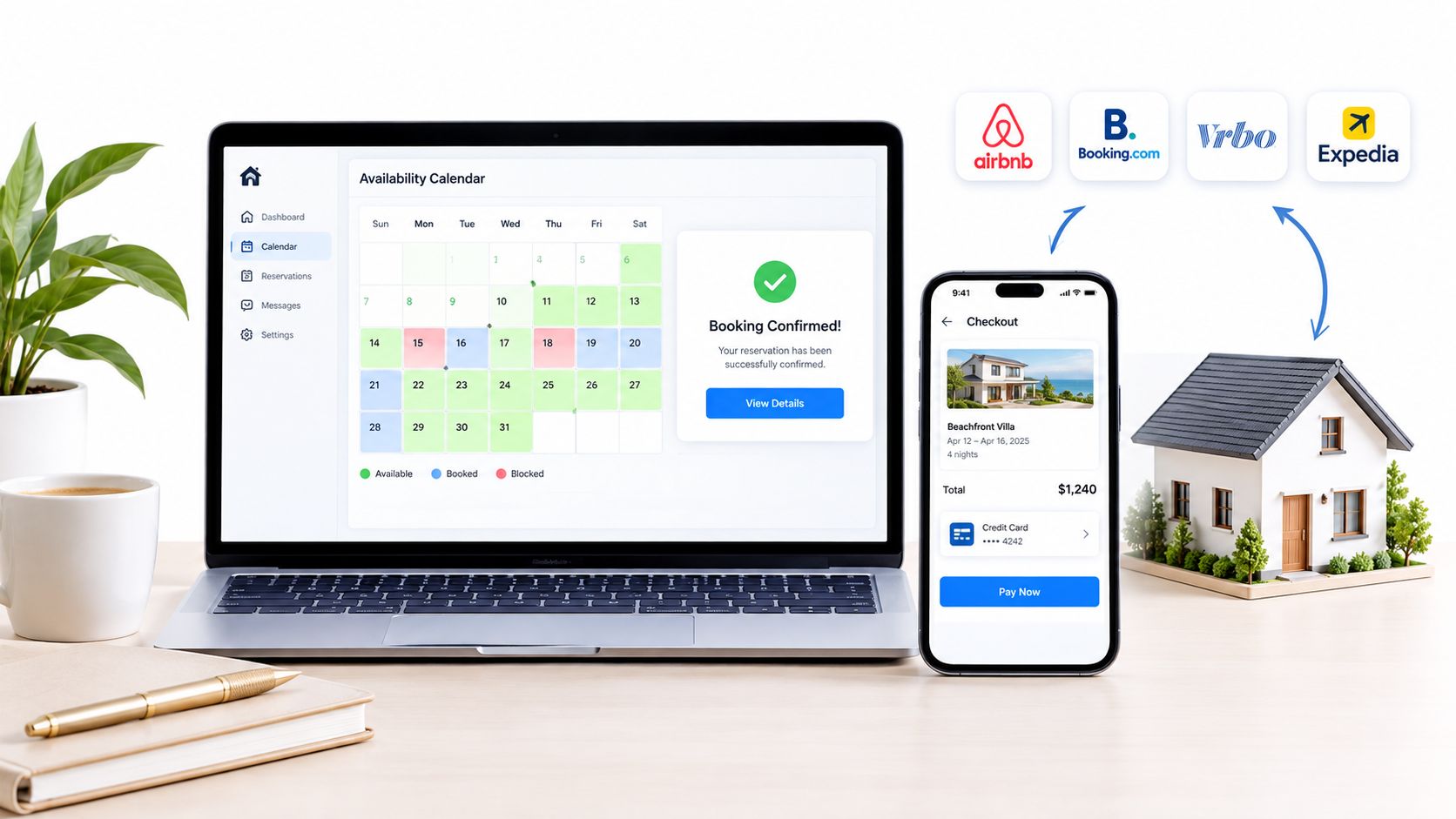
You're on the host side when the guest clicks Book Now. The calendar is open, the pricing looks right, the message inbox is quiet, and the only thing standing between interest and a reservation is the booking flow itself. That moment is where vacation rental online booking either feels effortless or starts leaking guests, because every extra second of confusion, every unclear fee, and every stale calendar update gives people a reason to leave.
The scale behind that moment is no longer small. Guests in the European Union booked 951.6 million short-stay accommodation nights through major online platforms in 2025, which was 11.4% higher than the previous year, a sign that digital reservation paths are now a core channel for short-term stays, not a side channel (Stayfi). The market has also become platform-driven, with online sales representing 73% of the global vacation rental market in 2025 and 74% in 2026, alongside Airbnb's scale of 9 million+ active listings worldwide, over 5 million hosts, and more than 2 billion guest arrivals worldwide (BuildUp Bookings). For owners, that means the booking mechanics inside your own site have to work as cleanly as the platforms guests already trust.
Table of Contents
- The Moment a Guest Hits Book
- Core Building Blocks of a Booking Flow
- Request to Book vs Instant Book
- Payment Capture, Deposits, and Fees
- Availability Checks and Calendar Sync Across Channels
- Putting It Together on a Direct Booking Site
- Why the Mechanics Matter for Your Bottom Line
The Moment a Guest Hits Book
Maya is looking for a two-bedroom apartment in Lisbon for the second weekend in October. She lands on a direct site, picks her dates, and the page flips from a simple listing view to a live price quote with a Book Now button. That single change looks small on screen, but behind it the system is checking whether those nights are still free, whether the stay length matches the property's rules, and whether the total is being assembled in a way the guest can trust.
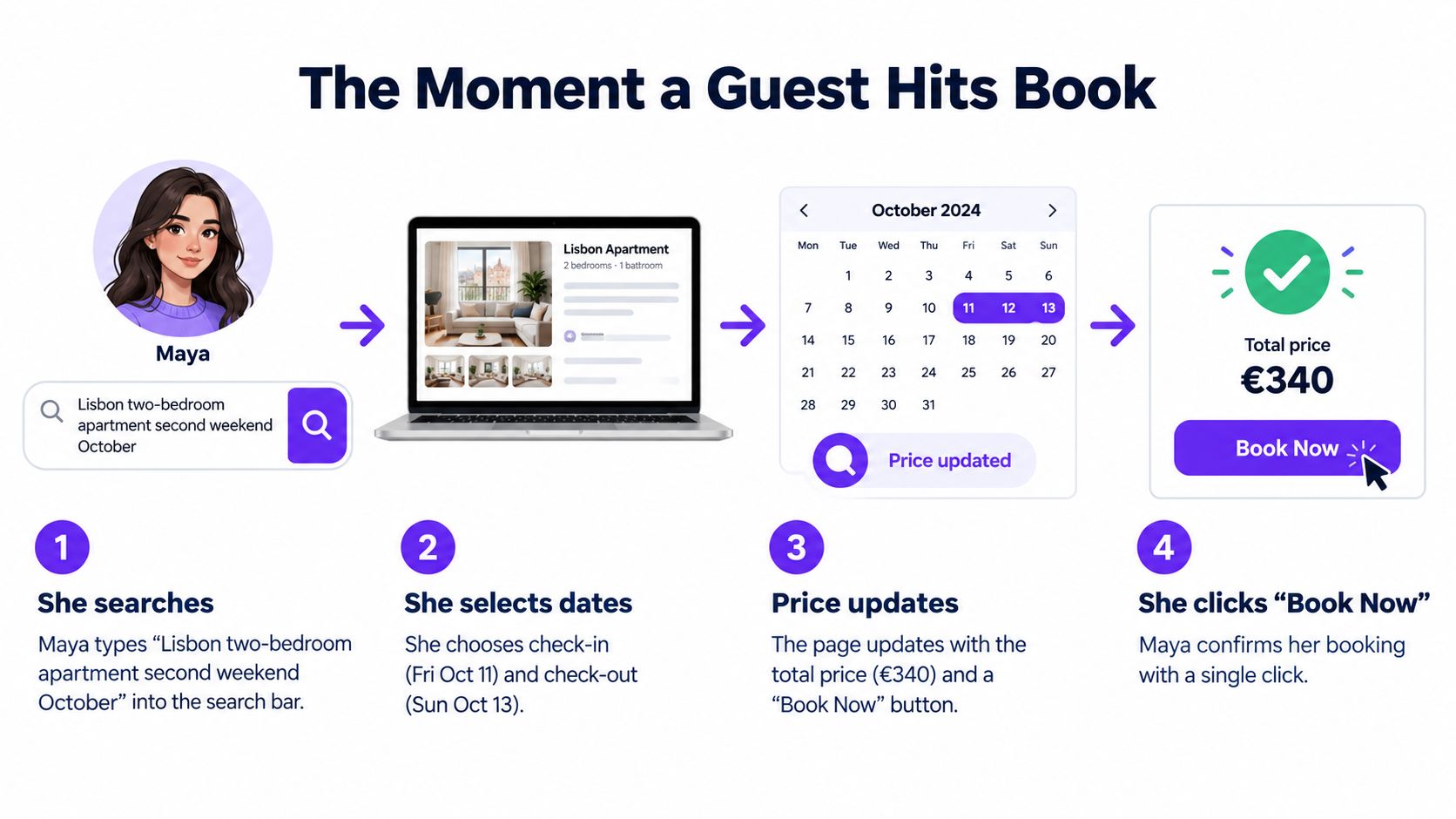
What happens in those two seconds
The booking engine first queries the property's calendar for the exact date range. If no reservation conflicts exist, it moves to pricing, where base rate, seasonal rules, length-of-stay logic, and any required fees are combined into a quote token that can be safely displayed and later confirmed. That token matters because it prevents the price from drifting while the guest is still deciding.
Practical rule: a good booking flow doesn't make the guest interpret the math. It does the math first, then shows the answer.
If the property is set to Instant Book, the flow can jump from quote to payment authorization as soon as the guest clicks. If it is set to Request to Book, the system packages the guest details, booking dates, and message history into a request that waits for the host's approval. On an OTA, much of this is hidden inside a marketplace wrapper, but the underlying mechanics are similar, live availability, price assembly, and a confirmation decision that needs to happen without hesitation.
Why the visible screen matters
Guests don't care that a quote token exists. They care that the price didn't change when they clicked, that the dates didn't mysteriously go unavailable, and that the final step didn't suddenly ask them to email the host. That's why direct-booking interfaces have to surface availability and total cost early, while keeping the backend strict enough to prevent double bookings.
The same action on Airbnb or Booking.com is wrapped in a marketplace UX, but the trust question is identical. Can the system confirm the stay without making the guest wonder whether the listing is available? If the answer feels uncertain, the booking path weakens right at the finish line.
Core Building Blocks of a Booking Flow
A vacation rental booking flow is easier to manage when you stop treating it like one giant feature and start seeing it as a handful of separate systems that hand work to one another. The clearest way I've seen owners understand it is to compare it to a restaurant: the calendar is the table grid, the booking engine is the host stand, and the payment module is the card swipe.
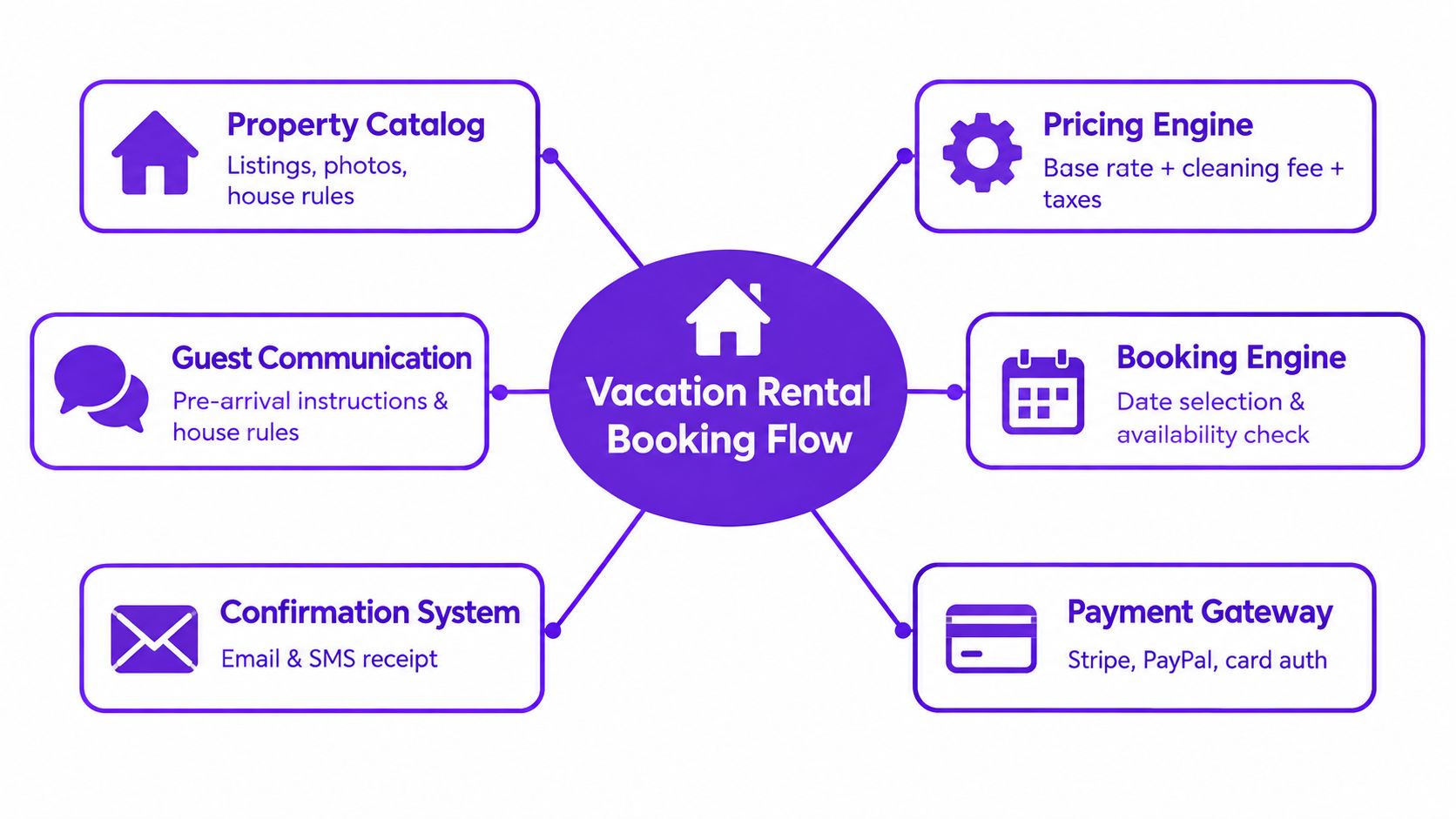
The six parts that have to work together
The first block is the property catalog, which holds the listing content, photos, amenities, and house rules. If the catalog is messy, guests start with confusion before they've even picked dates. The second block is the pricing engine, which takes the base rate and layers on seasonal adjustments, discounts, and fee logic so the quote is consistent.
The third block is the availability store, the source of truth for each night being free, held, or booked. That's the part owners often underestimate, because it's what protects the business from accidental overlap. The fourth block is the reservation state machine, which moves the booking from pending to confirmed, and later to cancelled or refunded when needed.
Where money and messages enter the flow
The fifth block is the payment module, which handles authorization, capture, and payout through a processor such as Stripe or Adyen. That is where the guest's intent becomes a financial commitment. The sixth block is the notification layer, which sends emails, webhooks, and status updates to the guest, host, and any connected channel.
If one of these systems is manual while the rest are automated, the whole flow starts behaving like a half-finished spreadsheet.
For operators, the key test is whether each module has a clear job. The catalog should describe. The pricing engine should calculate. The availability store should decide whether a stay can be held. The payment layer should collect funds. The notification system should tell the right people what happened.
If you want a more product-level breakdown of how booking software is usually assembled, this overview of vacation rental booking software is a useful companion reference.
Request to Book vs Instant Book
These two models solve different problems, and pretending they're interchangeable causes avoidable friction. Request to Book gives the host a screening step, while Instant Book gives the guest speed. The right choice depends on whether your business needs control at the approval stage or completion at the checkout stage.
| Dimension | Request to Book | Instant Book |
|---|---|---|
| Guest action | Sends a booking request | Confirms immediately |
| Host involvement | Manual approval needed | Usually no manual approval |
| Payment timing | Often after approval | On click or at confirmation |
| Best fit | Bespoke pricing, screening, edge cases | Tight inventory, faster conversion |
| Operational feel | More control, more handling | Less control, smoother flow |
Where request to book helps
Request to Book works well when the property needs manual judgment. If you manage special pricing, special access rules, or stays that depend on context, the approval step protects you from mistakes. It also helps when the listing isn't a simple fixed product and you need to review the guest before committing inventory.
The downside is operational drag. Every request introduces a waiting period, and waiting is where attention drops. Even a clean request flow can leave the host holding questions while the guest is comparison shopping elsewhere.
Where instant book pays off
Instant Book strips out the pause. The system checks availability, runs the risk screen, authorizes the card, and confirms the guest in one movement. That creates less back-and-forth, fewer abandoned conversations, and a booking experience that feels close to what guests already expect from major marketplaces.
For operators with multiple listings and tight inventory, this is usually the cleaner model. For boutique hosts with bespoke pricing or a strong need to screen every stay, request-to-book may still be the safer operational choice. The decision is less about ideology than about how much manual judgment you can afford to preserve.
Payment Capture, Deposits, and Fees
Money handling is where a lot of otherwise decent booking flows become awkward. The guest may be ready to commit, but the checkout path gets in the way if the site is unclear about whether it wants a full charge, a deposit, or a follow-up payment link. That decision also affects refund handling, cancellation pressure, and how much admin the host absorbs after the reservation is made.
Three ways the money can move
A full charge at booking is the simplest from an operational standpoint. The guest pays once, the reservation is secured, and the commitment is immediate. A partial deposit with balance due later reduces the upfront barrier but creates a second administrative moment, which can become a chase if the remaining payment isn't automated.
A manual payment link sent after confirmation is the most flexible and the most fragile. It gives the host more room to adjust terms, but it also adds a delay between guest intent and actual cash collection. That delay is where cancellations and reminders tend to pile up.
What changes when the processor is involved
The payment processor matters because it determines whether you're only taking card details, placing an authorization, or settling the charge. A pre-authorization is not the same as a settled payment, and operators should treat that difference seriously. If the stay is approved before funds are captured, the host carries more risk if the guest disappears or disputes the charge later.
Fee presentation matters too. Guests react badly when third-party costs appear late, whether those are gateway charges, platform commissions, or OTA-specific surcharges that show up after the main rate. I've seen plenty of booking pages lose trust because the site didn't explain the total early enough.
Operational rule: if the deposit or balance step needs a reminder from the host, the flow is already asking for too much manual work.
A useful fraud screen starts with simple mismatch checks. Billing country, booking timing, and reservation value can all signal whether a transaction deserves review before capture. The goal isn't to block every unusual booking. It's to avoid approving a payment path that looks clean until the refund request arrives.
| Method | Cash Flow Timing | Guest Commitment | Admin Load |
|---|---|---|---|
| Full charge at booking | Immediate | High | Low |
| Partial deposit | Split over time | Medium | Medium |
| Manual payment link | After follow-up | Variable | High |
Availability Checks and Calendar Sync Across Channels
Availability checks only work if the calendar is accurate at the exact moment the guest clicks. A direct site has to query its master calendar first, then reconcile that availability with connected channels so it doesn't confirm a stay that Airbnb or Booking.com already received elsewhere. The calendar is not a decorative feature. It is the control system that keeps the business from selling the same night twice.
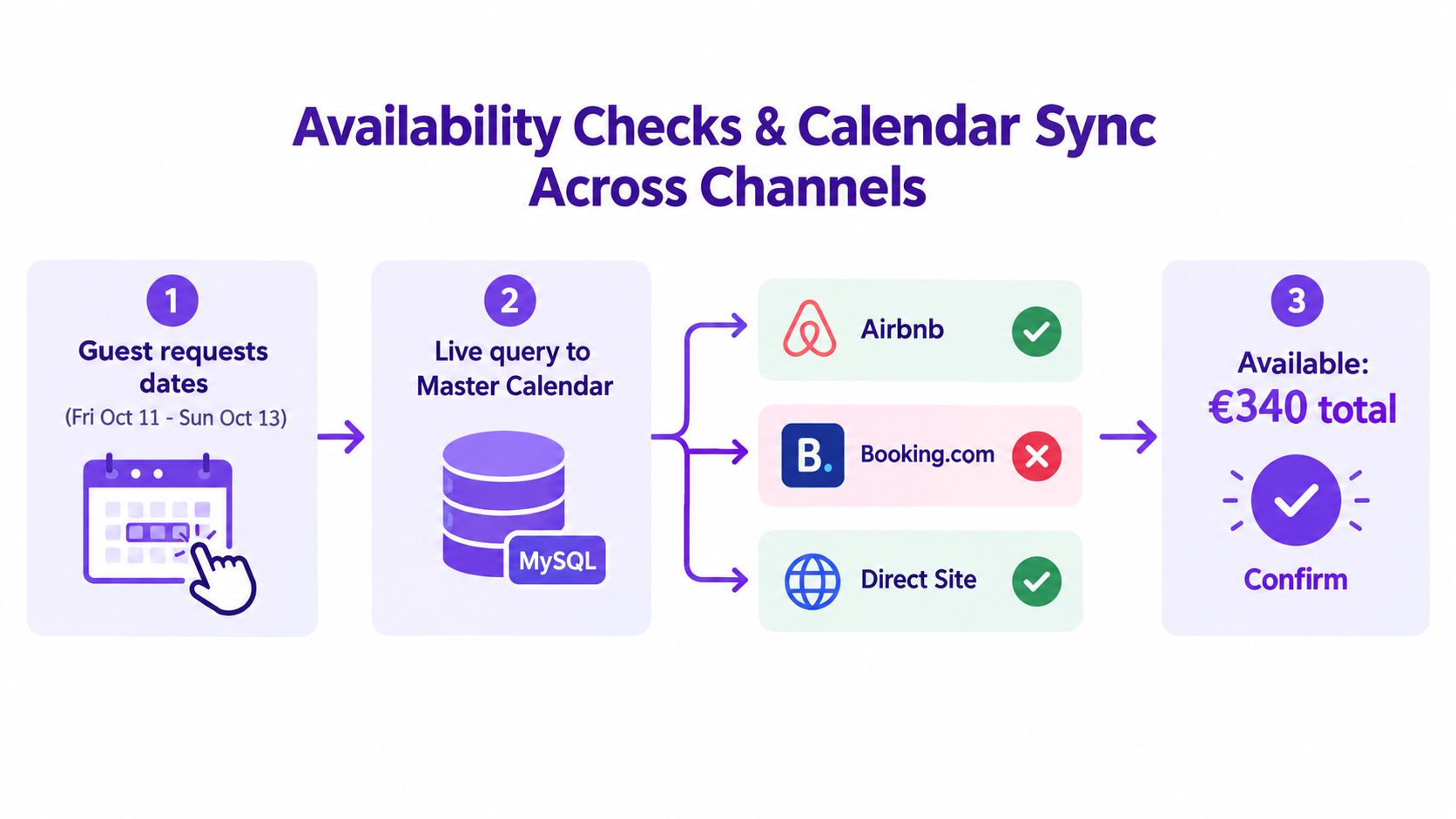
How sync usually works
Most setups rely on iCal two-way sync, where each channel generates a feed URL and the calendar service polls that feed every few hours. The system then translates feed updates into blocked or available dates across platforms. That process is simple in theory and a little messy in practice, because each channel has its own refresh timing and event formatting.
If you want a deeper look at calendar logic from an operator's angle, this guide to a rental availability calendar is a useful companion. The important point is that every connected source needs to agree on the same date state before the booking is finalized.
Where sync breaks
The most common failure modes are predictable. A feed can be stale, a timezone can shift a reservation window, or one channel can ignore an update longer than expected. The worst case is a race condition, where two guests hit Book within seconds and both systems think the dates are still open long enough to proceed.
A clean workaround is to use a property management system or channel manager with native connections, then add a soft hold during checkout so the dates are temporarily locked while the guest completes payment. When a manual override is needed, the platform should flag it immediately so the host can resolve the conflict before check-in rather than after the guest has arrived.
The practical rule for operators
If your site confirms availability without checking the master calendar first, that's a bug, not a feature. If your channels are synced but nobody is watching for failed updates, that's only slightly better. Reliable vacation rental online booking depends on the boring part working every single time, because guests only notice it when something goes wrong.
Putting It Together on a Direct Booking Site
A small operator with two units can run a surprisingly clean setup without custom development. A branded direct site handles the listing pages, a connected payment gateway takes the deposit or full charge, and iCal feeds push and pull availability to Airbnb and Booking.com. The guest sees a polished path, but the operator is really running a coordination layer behind the scenes.
In practice, the guest starts on the site, selects dates, sees live availability, reviews the total price, and sends the booking request or completes the booking if instant confirmation is enabled. The system then issues an automated confirmation email with check-in instructions, while the operator receives a booking notification and sees the reservation reflected in the dashboard. That visibility matters because it turns scattered bookings into one working calendar instead of three disconnected inboxes.
For many owners, a hosted platform like Rentabble is one way to combine the public site, pricing rules, availability calendar, and booking request flow in a single setup, while still keeping the operator in control of branding and channel synchronization.
What still needs human judgment
Not every part of the process should be automated away. Flagged bookings still need a review, seasonal pricing rules still need tuning, and messages that come in after hours still need a person to answer them with context. If the flow is healthy, the manual work shifts from repetitive administration to exception handling.
The channel manager dashboard becomes the operator's early warning system. A sync error, an unexpected overlap, or a payment issue should surface there before it turns into a guest-facing problem. The goal is not to remove the owner from the business. It's to keep the owner focused on decisions that require judgment.
A strong direct-booking site feels simple on the surface because the mechanics beneath it are disciplined. That's what creates repeatability, and repeatability is what makes direct reservations feel safer to accept than marketplace inquiries.
Why the Mechanics Matter for Your Bottom Line
Booking mechanics shape margin long before marketing does. If the site confirms availability correctly, captures payment cleanly, and handles request versus instant booking without constant host intervention, the operator stops paying an operational tax that often pushes business back toward OTAs. The visible cost is commission. The less visible cost is losing control over the guest relationship after the first stay.
The broader market already reflects how much of the category has moved online. Online/platform-based bookings still dominated the sector globally at 68.6% in 2025, while U.S. OTA booking revenue remained high at 81.4%, which is exactly why independent operators need pricing UX and trust signals that make direct booking feel safe (Grand View Research). When a guest is deciding between an OTA and your own site, the winner is often the one that looks more certain at checkout, not the one with the prettiest photos.
The moat is operational, not cosmetic
A reliable booking flow improves more than conversion. It protects calendar integrity, shortens the time between intent and confirmation, and keeps guest data inside your own business instead of trapped in a marketplace. That matters because repeat booking potential only exists when you can reach the guest again.
If you're evaluating your direct channel, use a simple checklist. Instant Book should be configured or deliberately disabled. Payment capture should be tested end to end. iCal sync should be verified in both directions. Notification routing should reach the right inboxes. Cancellation policy enforcement should match what the guest saw before submitting.
What to fix first
If any one of those pieces is weak, the whole channel feels fragile. If all five are working, the direct site stops behaving like a side project and starts functioning like a real sales channel. That is the difference between a booking form and a booking system.
For pricing, calendar logic, and guest-facing trust, this pricing strategy guide for vacation rentals is a good next reference if you're tightening the economics behind your direct flow. The mechanics and the pricing have to fit together, or the guest will feel the mismatch immediately.
If you want a direct-booking setup that keeps pricing, availability, and reservation requests in one place, visit Rentabble and see how a hosted booking site can fit your channel mix. It's built for owners who want to reduce manual back-and-forth, keep calendars synchronized, and offer guests a cleaner path from search to confirmation.