10 Vacation Rental Management Software Options
The worst advice in vacation rental software is to start with the longest feature list. Independent owners don't need the most buttons, they need the system that matches how they take bookings, sync calendars, message guests, and collect payments without turning setup into a second job. The decision is whether you need a hosted direct-booking site, a deeper PMS, or a channel-first stack that can handle OTA sync, pricing rules, and owner reporting without developer help.
That's why the best fit depends on your operating model. If you run one to six units and want a branded site you can launch quickly, a lightweight direct-booking platform can make more sense than a heavyweight suite. If you manage a wider portfolio or want stronger automation, a fuller PMS may justify the extra setup and complexity. Rentabble is included here as a hosted, no-code direct-booking option for owners who want control of their own booking channel without custom development, alongside broader tools that lean harder into automation, integrations, and ops depth.
Table of Contents
- 1. Rentabble
- 2. Lodgify
- 3. OwnerRez
- 4. Hostaway
- 5. Guesty for Pros
- 6. Hostfully
- 7. Hospitable
- 8. Smoobu
- 9. iGMS
- 10. Uplisting
- Top 10 Vacation Rental Management Software Comparison
- Choose the Simplest System That Fits Your Next Stage
1. Rentabble
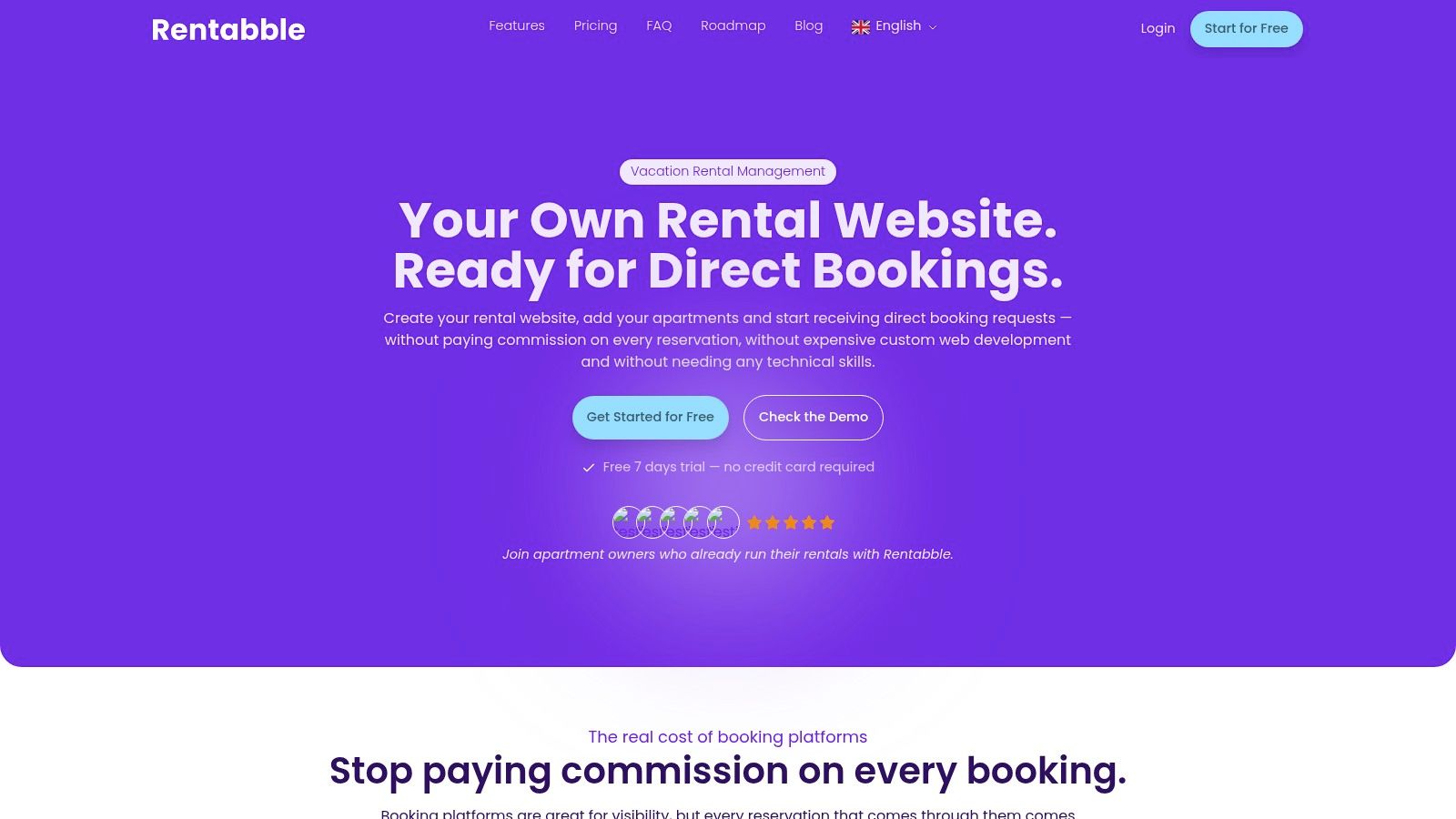
Rentabble is the clearest fit for owners who want a direct-booking website without hiring a developer or absorbing marketplace commissions on every request. The platform gives each account a public, branded rental site, property pages with photos and amenities, live availability, and automatically calculated totals from seasonal pricing. It's built for speed, and the product positioning is explicit, sites can go live the same day. Rentabble
The practical advantage is operational, not flashy. Owners can see apartments, bookings, occupancy, and revenue in one dashboard, while iCal synchronization helps keep calendars aligned across OTAs. The platform also adds SEO-ready pages, multilingual support in English and Croatian, guest reviews, secure hosting with regular backups, and support through email and Discord.
Where it fits, and where it doesn't
Rentabble is strongest when a host wants a simple owned channel to sit beside Booking.com or Airbnb, not replace them. The value proposition is easy to understand, predictable subscription pricing, no commission on direct requests, and transparent pricing shown to guests before they submit a booking request. That combination reduces back-and-forth and can help small operators move faster with fewer manual quotes.
Practical rule: if your bookings are mostly straightforward and you care more about ownership than enterprise automation, a hosted site often beats a complex PMS you'll only use halfway.
The tradeoffs are equally clear. Guest payments are currently limited to bank transfer or cash on arrival, with online card payments listed as coming soon. Basic and Pro plans also cap apartment counts at 3 and 6 respectively, and language support is currently limited to English and Croatian. For an owner in the 1 to 6 unit range, that's still a sensible fit. For larger portfolios, the ceiling arrives quickly.
2. Lodgify
Lodgify suits hosts who want a no-code booking website and an integrated channel manager in one place. It combines a direct-booking site, an embeddable booking widget, API connections to major OTAs, and centralized calendar and messaging tools. For owners trying to collect direct bookings without assembling separate tools, that setup is practical.
Implementation is the main test. Lodgify is built to get a working site and booking flow live without technical staff, so it fits hosts with one or two properties who want a faster launch than DIY website tools usually allow. The plan structure is also easy to follow, which matters more than feature lists when you are setting up the system yourself.
Integration details matter once the site is live. Google Vacation Rentals exposure comes with the Pro tier, so owners who want broader search visibility need to account for the higher plan. The platform also lists a 0% booking fee on its plans, which keeps direct-booking math simpler for smaller operators.
If you're evaluating website-building tools alongside channel management, this guide to vacation rental website builders covers the key differences.
Direct booking tools only work if guests trust the site enough to book. A clean site, clear rates, and fast calendar sync matter more than a crowded feature list.
The main caution is cost creep. Paid add-ons, such as smart-lock integrations, can push the actual monthly bill above the headline plan. For owners who need a straightforward website and OTA sync, Lodgify is a sensible fit. For those keeping operating costs tight, the add-on model needs a careful look.
3. OwnerRez
OwnerRez is a good match for detail-oriented hosts who want automation depth and are willing to spend time learning the system properly. It offers direct API connections to major OTAs, digital rental agreements with e-signatures, and strong rules-based automation. That makes it especially useful for owners who are tired of manually repeating the same booking and follow-up steps.
The platform's modular design is part of the appeal. You can add hosted websites, QuickBooks sync, and property-management owner statements as needed instead of buying a bloated all-in-one package on day one. That flexibility helps owners who know exactly which gaps they need to fill and don't want to pay for extras they won't use.
Why owners choose it anyway
OwnerRez is often favored because it avoids guest or commission fees and supports unlimited bookings and team logins. For operators managing the same properties month after month, that can be a strong fit, especially when rules, triggers, and document handling need to be dependable. The support reputation also matters here, because a feature-rich system is only useful if help is available when setup gets messy.
The downside is obvious. The learning curve is steeper than in lighter tools, and some advanced functions are sold as premium features rather than bundled by default. That means a buyer needs to compare the full intended stack, not just the entry plan.
Read this before you assume a channel manager alone solves the problem: the difference between a basic calendar sync and a real operating system shows up when you need agreements, owner statements, pricing rules, and task automation to work together. For that reason, this guide to online rental management systems is worth reading if you're comparing setup effort against operational depth.
4. Hostaway
Hostaway is aimed at growing managers who need a broad integrations layer and enough automation to support a larger portfolio. It combines deep OTA connections, a unified inbox, workflow automations, and a marketplace of third-party tools. That breadth is valuable when your stack is already bigger than just bookings and messaging.
The upside is scale. Hostaway is built for teams that need pricing, fees, tasks, and communications to move together across a portfolio without constant manual intervention. If your operation depends on many connected tools, the marketplace approach gives you room to expand without ripping out the core system.
The tradeoff is quote-based complexity
There's no public list price, so buyers have to go through sales for a custom quote. That's not necessarily bad, but it does make comparisons harder for independent owners who want predictable costs before they commit. The lack of public pricing also means the actual package may differ quite a bit depending on property count and use case.
Hostaway works best when you know you'll need more than a lightweight site and channel manager. It's less attractive if you're still validating direct-booking demand or you only need a clean OTA sync layer. For those buyers, the overhead can feel unnecessary.
A good way to judge Hostaway is to ask whether your current pain is missing integrations or too much manual work. If you're still small, a simpler platform can get you operational faster. If your team already depends on multiple connected services, Hostaway's depth starts to make more sense.
5. Guesty for Pros
Guesty for Pros is built for professional managers who need a single operational stack that goes beyond booking intake. It supports multi-calendar management, owner statements, accounting, branded direct-booking websites, and an in-house dynamic pricing tool called PriceOptimizer. That scope puts it closer to an enterprise system than to the lighter tools many independent owners start with.
The main advantage is consolidation. Larger managers can keep reporting, financials, pricing, and owner communication inside one platform instead of stitching together separate tools. That reduces handoffs once a portfolio is large enough that these tasks come up every day.
Why it can be too much for small owners
Guesty's pricing is sales-gated and not publicly published, so buyers have to evaluate it before they can compare costs clearly. For independent owners, that adds friction to budget planning. The platform is also broad enough that some buyers will pay for functions they never fully use.
For larger portfolios, the value is easier to justify because the system brings several operational pieces into one place. For a smaller operator, the same depth can slow setup and add complexity if the need is only a direct-booking channel and dependable calendar control.
If you are comparing Guesty with a hosted, no-code option, the key question is whether your bottleneck is brand control or portfolio management complexity. Owners with one to six units often need the first more than the second.
6. Hostfully
Hostfully fills the gap between lightweight direct-booking tools and heavier suite software. It gives owners and small teams a direct-booking site, a booking pipeline, a unified inbox, InboxAI for drafted replies, a mobile app, and an integration marketplace that covers pricing, cleaning, and smart devices. That mix matters most for operators who want working automation without building a custom stack.
The platform is strongest when you need to see reservation status and the next task at a glance. Pipeline views and owner reporting help replace the patchwork of calendars, messaging tools, and spreadsheets that many smaller managers outgrow. The open API adds flexibility for teams that rely on outside tools, but it also raises the bar on setup.
A quick rule of thumb: if your staff asks, “What needs attention today?”, pipeline views are doing real work.
The tradeoff is setup effort. Users often note that onboarding takes time, especially once integrations start to stack up. Pricing is not a flat number, so the actual cost depends on property count and add-ons, which makes early comparison harder for owners planning a budget.
Hostfully suits teams that can spend time getting the system in place and want more than a basic hosted site. If you need something operational quickly, a simpler hosted option may fit better.
7. Hospitable
Hospitable is designed around automation first. It leans heavily into AI guest messaging, a unified inbox, team collaboration, and built-in dynamic pricing, which means small hosts can get a lot of operational help without buying separate tools. That matters for owners who want to reduce repetitive communication more than they want a highly customized back office.
The pricing model is also easy to understand at a glance, with a base fee plus per-property charges. That transparency is helpful for portfolios in the 1 to 6 unit range, where every added tool needs to earn its keep. For seasonal operators, the FLEX-style logic can be especially appealing because it gives you a more granular relationship between usage and cost.
Where the limits show up
Direct Booking is optional and doesn't come free of commission, with transparent commission choices listed at 1% or 4% + 3%. That makes the direct channel more flexible than all-or-nothing platforms, but it also means you need to read the plan details carefully before assuming direct bookings are commission-free.
Some advanced capabilities, including owner portals, statements, and device integrations, sit behind higher tiers. Dynamic pricing availability also varies by market, so buyers should verify whether the feature is supported where they operate.
Hospitable suits owners who want to automate messaging and pricing quickly without a heavy setup burden. It's less compelling if your main goal is a commission-free direct-booking website from day one. In that case, the direct channel economics may matter more than the automation stack.
8. Smoobu
Smoobu is a lightweight option for small-to-mid hosts who want a direct-booking website, OTA connections, and a clear set of core tools without building a heavier stack. It handles Airbnb, Booking.com, Vrbo, and iCal support, then adds a native Dynamic Pricing tool that can push rates to connected channels. For owners who want calendar control and rate updates in one place, that combination is practical.
The main advantage is predictability. Smoobu's per-property pricing is easy to follow, which helps smaller portfolios avoid enterprise-style pricing structures. The product also appears to move quickly, with features such as AI reply suggestions and dynamic pricing showing a more active roadmap.
Regional fit is the main check. Some integrations or messaging channels may lag competitors or be limited by region, so buyers should verify that the exact integrations they depend on are available in their market. Pricing is shown in euros, which can make cross-currency comparison less straightforward.
A lightweight stack only works if the exact integrations you depend on are available in your market.
Smoobu suits hosts who want enough functionality to run efficiently without adding much setup overhead. If your priority is keeping operations lean, that tradeoff makes sense.
9. iGMS
iGMS is built for owners who want a flexible mix of channel management, operations, messaging, and booking tools. It offers two pricing models, FLEX per booked night or fixed per-property plans, which gives seasonal operators more ways to match software cost to actual usage. That alone can make it easier to adopt than a rigid flat-fee system.
The platform also includes a direct-booking website, an owner portal on higher tiers, brand tools, and revenue features. That's a useful combination for managers who want to present a more polished direct channel without sacrificing task coordination. Native dynamic pricing is part of the story too, although availability depends on country.
Best for seasonal or variable occupancy
The FLEX model is the part that stands out. If you don't want to pay the same amount in slow months as you do in busy ones, per-booked-night billing can be easier to justify. That makes iGMS appealing to hosts with uneven occupancy patterns or a more tentative direct-booking strategy.
The tradeoffs show up in the tier structure. Customer support options and advanced analytics are gated to higher plans, so a buyer looking for richer reporting may need to move up quickly. That's normal in this category, but it still changes the budget conversation.
iGMS fits owners who want clear pricing mechanics and a broad enough feature set to manage both guest and operational workflows. It's less attractive if you want the simplest possible direct-booking site with minimal software overhead.
10. Uplisting
Uplisting is the right kind of boring for owners who care about reliability, sync consistency, and predictable operations. It emphasizes dependable OTA synchronization, automation for messaging and tasks, and a commission-free direct-booking website. That design philosophy appeals to managers who don't want to babysit the system every week.
The platform also puts a lot of attention on fee and tax handling across channels. That matters more than many buyers realize, because mismatches in fees or taxes can create ugly guest surprises and internal reconciliation headaches. If you've ever had a rate show up one way in one channel and another way somewhere else, the value of consistent propagation is obvious.
The fit is simple, the pricing may not be
Uplisting's public site leans more on the product than on list pricing, so many buyers end up with individualized quotes. That can be fine for a growing portfolio, but it isn't ideal for owners who want a quick yes-or-no price comparison. Some advanced capabilities, including reporting and device integrations, may also require add-ons.
The main reason people choose Uplisting is trust. It's built for managers who'd rather have a system that behaves predictably than one that dazzles in demos but requires constant tuning. That's a good sign if your biggest risk is operational drift, not lack of bells and whistles.
For small-to-mid portfolios, Uplisting is a credible choice when calendar integrity and fee handling are more important than customization. If you need a simpler branded direct channel, though, a hosted no-code option can still be faster to deploy.
Top 10 Vacation Rental Management Software Comparison
| Product | Core features | Quality (★) | Pricing & value (💰) | Target audience (👥) | Unique selling point (✨) |
|---|---|---|---|---|---|
| 🏆 Rentabble | Hosted branded site, property pages, live availability & totals, seasonal pricing, central calendar, 2‑way iCal, SEO, reviews | ★★★★☆ | 💰 Basic €9/mo (≤3) · Pro €19/mo (≤6) · 7‑day trial · no commission | 👥 Independent owners (1–6), boutique managers | ✨ Turnkey owned channel + fast setup; transparent pricing |
| Lodgify | No‑code website & widget, channel manager (API/iCal), calendar, unified inbox | ★★★★☆ | 💰 Clear tiering; 0% booking fee advertised · add‑ons may increase cost | 👥 Small hosts (1–2), API users | ✨ Embeddable widget & OTA API integrations |
| OwnerRez | Modular PMS, strong automations/triggers, direct API connections, e-sign rental agreements, optional hosted sites | ★★★★★ | 💰 Per‑property sliding pricing · no booking commissions | 👥 Detail‑oriented hosts & growing portfolios | ✨ Deep automation & legal/finance tools (e‑sign, owner statements) |
| Hostaway | Scalable PMS + channel manager, deep OTA integrations, automations, integrations marketplace | ★★★★☆ | 💰 Quote‑based; tailored to portfolio size | 👥 Growing managers and larger portfolios | ✨ Large integration marketplace & scale focus |
| Guesty | Enterprise-grade calendar, owner financials, branded sites, native PriceOptimizer dynamic pricing | ★★★★★ | 💰 Sales‑gated enterprise pricing (custom quotes) | 👥 Professional managers, enterprise portfolios | ✨ All‑in‑one enterprise stack + native dynamic pricing |
| Hostfully | Direct‑booking site, booking pipeline, InboxAI (AI replies), mobile app, large integrations | ★★★★☆ | 💰 Per‑property/add‑ons; SMB‑friendly pricing | 👥 SMB managers, small teams & owner‑focused ops | ✨ AI‑aided inbox + strong onboarding resources |
| Hospitable | Automation‑first PMS, AI messaging, built‑in dynamic pricing, optional Direct Booking add‑on | ★★★★☆ | 💰 Transparent calculator · Direct Booking may add commissions (1% or 4%+3%) | 👥 Small portfolios (1–6) | ✨ Built‑in dynamic pricing + automation emphasis |
| Smoobu | Lightweight PMS, direct‑booking engine, OTA/iCal sync, native Dynamic Pricing | ★★★★☆ | 💰 Predictable per‑property pricing (EUR) | 👥 Small → mid hosts seeking simple pricing | ✨ Native Dynamic Pricing with simple UI |
| iGMS | Channel manager, ops (cleaning/tasks), AI guest messaging, direct‑booking engine; FLEX or per‑property pricing | ★★★★☆ | 💰 FLEX (per booked night) or fixed per‑property plans | 👥 Seasonal operators & those needing billing flexibility | ✨ Two billing models (FLEX or PRO) + ops tools |
| Uplisting | Reliable OTA sync, automations, 0%‑commission direct‑booking engine, consistent fee/tax handling | ★★★★★ | 💰 Quote‑based; predictable fee/tax propagation | 👥 Small→mid portfolios valuing reliability | ✨ ‘Works as expected' reliability & fee/tax consistency |
Choose the Simplest System That Fits Your Next Stage
The best choice usually comes down to how much complexity you're willing to absorb. If you want ownership, fast setup, and predictable costs, a lightweight direct-booking platform is often the smarter move. If you need automation, owner reporting, broader integrations, or stronger back-office controls, a deeper PMS can justify the extra learning curve and price.
Before you commit, verify the details that create hidden friction later. Check the OTA connection type, whether calendar sync is API-based or iCal-based, how fast updates move between channels, what payment methods are supported, how fees and taxes propagate, which support channels are included, what the plan limits are, and whether migration will require manual work. Those are the issues that decide whether software feels smooth after launch or becomes another system you keep working around.
The market context points the same way. Software demand has grown into a serious category, with the vacation rental software market estimated at USD 20.14 billion in 2024 and USD 21.87 billion in 2025, rising to USD 45.84 billion by 2034 in one projection (Market Research Future). Vacation rental demand itself keeps expanding too, which is why owners keep looking for better direct-booking, calendar, and pricing tools (Grand View Research). That growth doesn't mean every owner needs a heavyweight stack, it means the wrong stack is easier to justify than ever.
For independent owners who want a branded direct channel without developers, Rentabble is a strong place to start. It's especially relevant if you manage 1 to 6 apartments, want transparent booking requests, and can work within its current language and payment limits. If that matches your operating model, start there and only move to a heavier system if your workflow outgrows it.
Rentabble gives small operators a hosted way to publish a branded booking site, show live availability, and handle direct requests without custom development. If you're comparing vacation rental management software and want a simple direct-booking channel first, visit Rentabble to see how it fits your portfolio and workflow.