Vacation Rental Channel Manager Explained for Owners
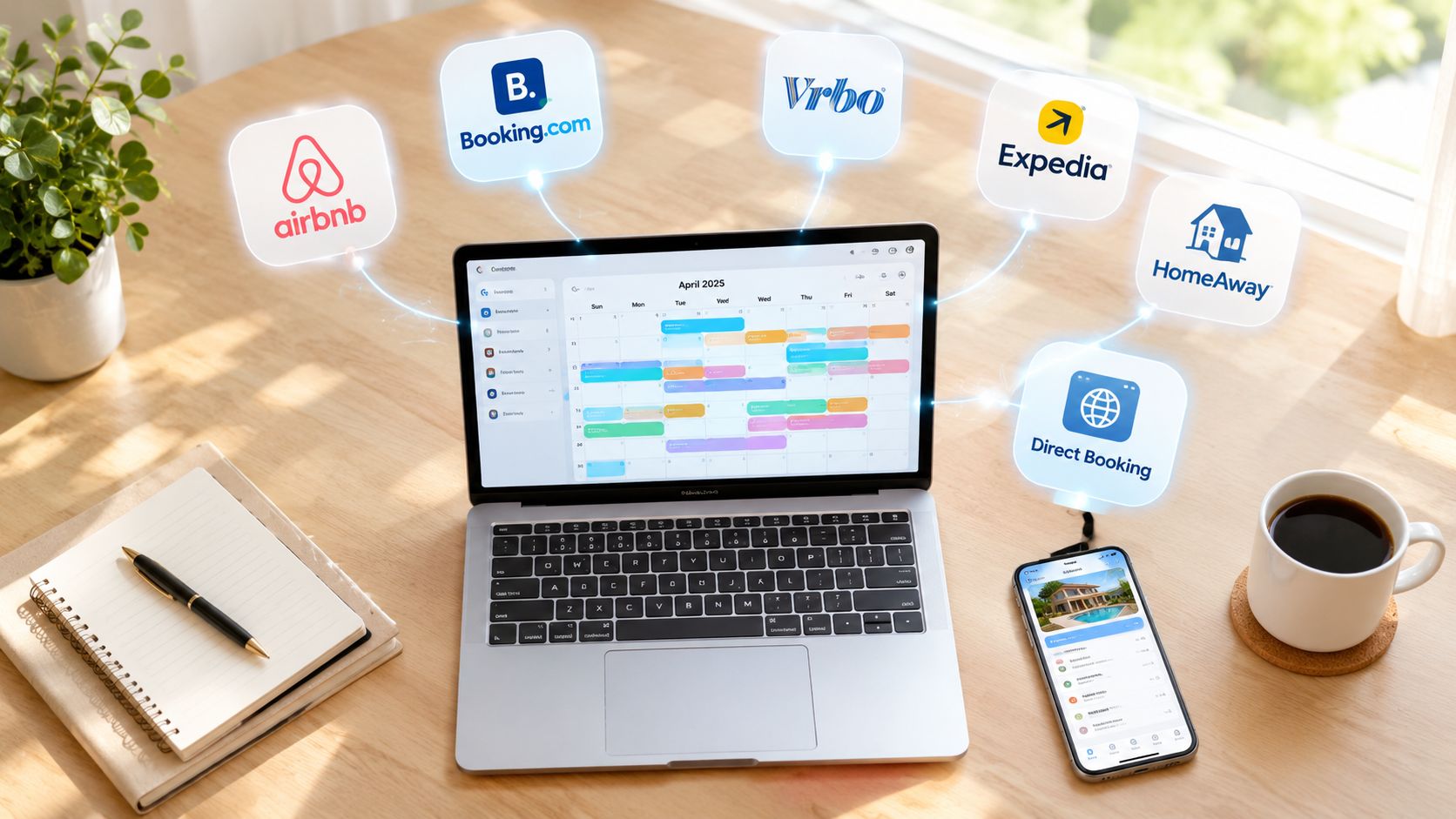
You've got a weekend guest asking if the place is still open, another booking request sitting in your inbox, and a blocked date you know you updated on Airbnb but haven't checked on Booking.com yet. That's the exact moment a small owner starts feeling the cost of manual distribution, because one missed refresh can turn into a double booking, a refund conversation, and a bad review.
A vacation rental channel manager exists to stop that kind of scramble. For owners with one to six units, it's less about “software” in the abstract and more about keeping calendars, rates, and booking rules aligned across the places guests book. That matters even more when you want to add a direct-booking site without creating a second full-time job for yourself.
The tricky part is that many still think of a channel manager as a calendar tool. That's too small. Modern distribution is closer to an event-driven layer that moves updates across OTAs, direct sites, and internal systems whenever something changes, whether that's a new reservation, a price adjustment, a minimum-stay rule, or a cancellation.
By the end, you'll be able to tell the difference between a simple sync tool and a true distribution setup, understand where iCal falls short, and decide whether your portfolio needs a lightweight connection or a more complete booking workflow.
Table of Contents
- Introduction Why One Calendar Is No Longer Enough
- What a Vacation Rental Channel Manager Actually Does
- How Channel Sync Works From iCal to API Connections
- Key Benefits for Small Operators and Boutique Managers
- How to Choose the Right Channel Manager Without Overbuying
- Building Your Direct Booking Channel Alongside OTAs
- Putting It All Together and Next Steps for Owners
Introduction Why One Calendar Is No Longer Enough
A host with two apartments often starts out the same way. One unit books on Airbnb, the other gets a steady trickle from Booking.com, and both calendars look manageable until a peak weekend lands on the same dates. Then a guest message arrives asking for a late check-in, the second reservation is still pending, and the calendar in your head is suddenly more important than the one on screen.
That's where the old idea of “just keep the dates synced” starts to fail. The market around this software has become large and cloud-led, with the vacation rental channel manager market valued at $1.2 billion in 2025 and projected to reach $3.1 billion by 2034, which implies 11.5% CAGR over the 2026 to 2034 period MarketIntelo. The same estimate says software accounts for 72.3% of the segment and cloud-based deployment holds 78.9% of revenue MarketIntelo. That's a strong sign that this is now core infrastructure, not a side tool.
Why the pressure shows up faster for small portfolios
Small operators feel the pain first because they usually run lean. One person answers messages, updates pricing, blocks dates, and handles guest questions, so every manual step slows the business down. A calendar that only partly reflects what's sold becomes a liability the moment more than one channel matters.
The channel mix also changed a lot. By 2024, Airbnb, Booking.com, and Expedia Group controlled 71% of global short-term rental revenue, up from 53% in 2019 B2B Reviews. Independent industry data also said only 33% of vacation rentals were listed across multiple top OTAs, while 57% of global inventory was listed solely on Airbnb B2B Reviews. That's why one-channel dependence feels safe until it isn't.
Practical rule: if a reservation on one channel can affect pricing or availability on another, you need more than manual calendar checking.
For owners with one to six units, the goal isn't to build a huge system. It's to keep enough control to add channels without multiplying mistakes. A good channel manager helps you do that, and a direct-booking site can extend the same logic to your own domain later.
What a Vacation Rental Channel Manager Actually Does
Start with a single listing on one OTA. You can update the dates yourself, adjust the nightly rate in one place, and manage guest messages from one inbox. There's no real distribution problem yet because there's only one surface to keep aligned.
Add a second OTA, then a direct-booking website. Now you're not managing one calendar, you're managing inventory state, which is the live truth of what's available, what's reserved, what's blocked, and what rules apply to each date. A vacation rental channel manager sits in the middle and keeps that state synchronized so the same night doesn't get sold twice.
Think of it like air traffic control
Air traffic control doesn't fly the planes. It watches the runway, coordinates who can land, and prevents collisions when timing changes. A channel manager does something similar for distribution. It coordinates availability, rates, restrictions, and content across sales surfaces so each channel sees the same operational picture.
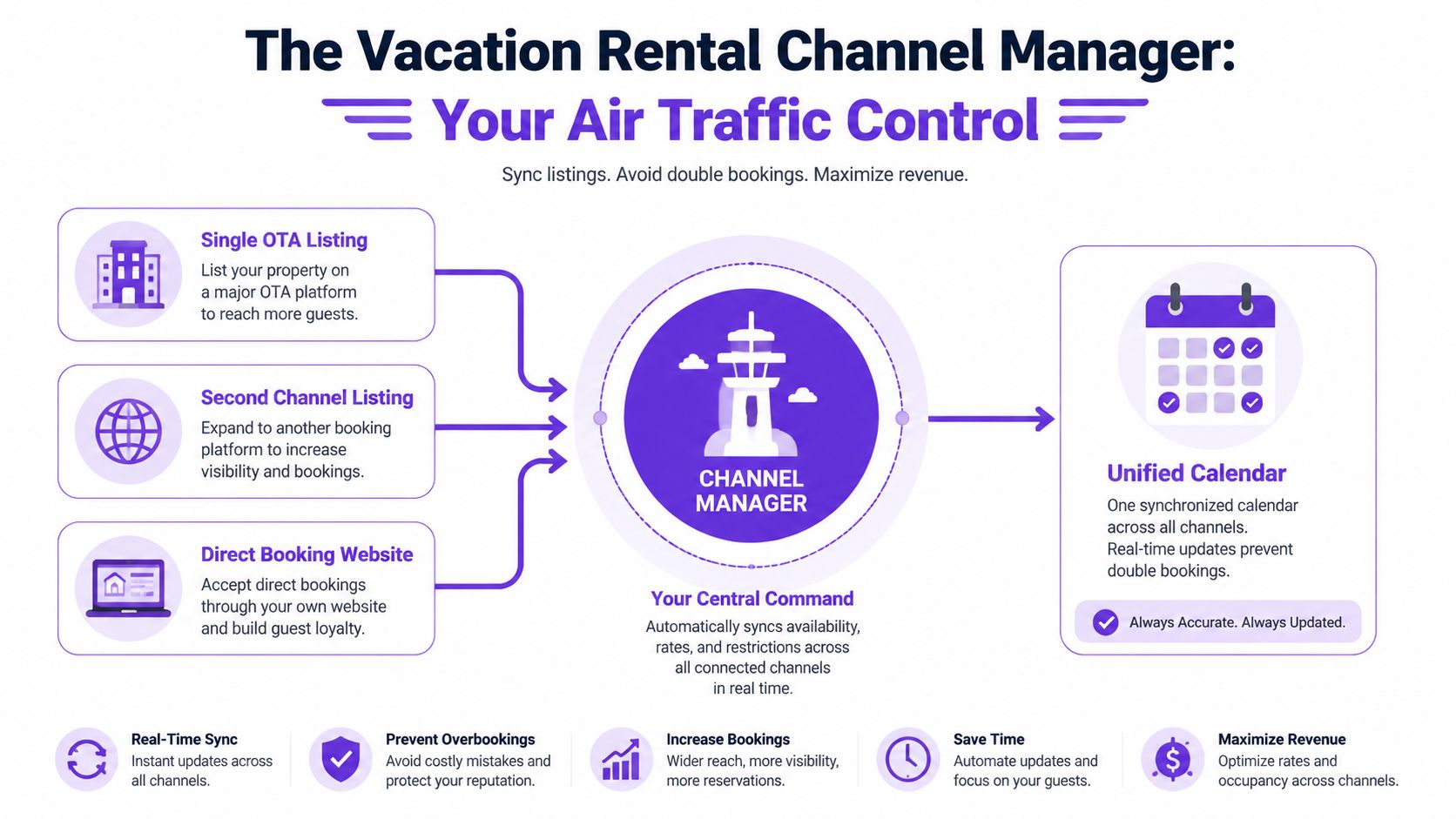
The modern version is not just a calendar blocker. Recent coverage describes channel managers as an event-driven distribution layer that pushes rates, restrictions, reservations, and listing content across OTAs, direct-booking sites, and other systems RealtyAPI. That matters because the core job isn't only stopping overlap, it's keeping every change consistent when a booking is modified, canceled, or rebooked.
A reservation is only one event. A real channel manager handles the follow-up events too, including rule changes and content updates.
The plain-language version of the moving parts
Availability means whether the nights are open or blocked.
Rates mean the price you want guests to see.
Restrictions mean rules like minimum stay or allowed check-in days.
Content sync means the listing details, not just the dates, stay aligned where they need to.
That's why the tool matters even for small portfolios. If a weekend is blocked on your site but still open on an OTA, the guest-facing experience breaks. If your pricing changes but your rules don't, you can end up with a reservation that looks right on the calendar and wrong in practice.
A channel manager is basically the control layer that keeps those pieces from drifting apart.
How Channel Sync Works From iCal to API Connections
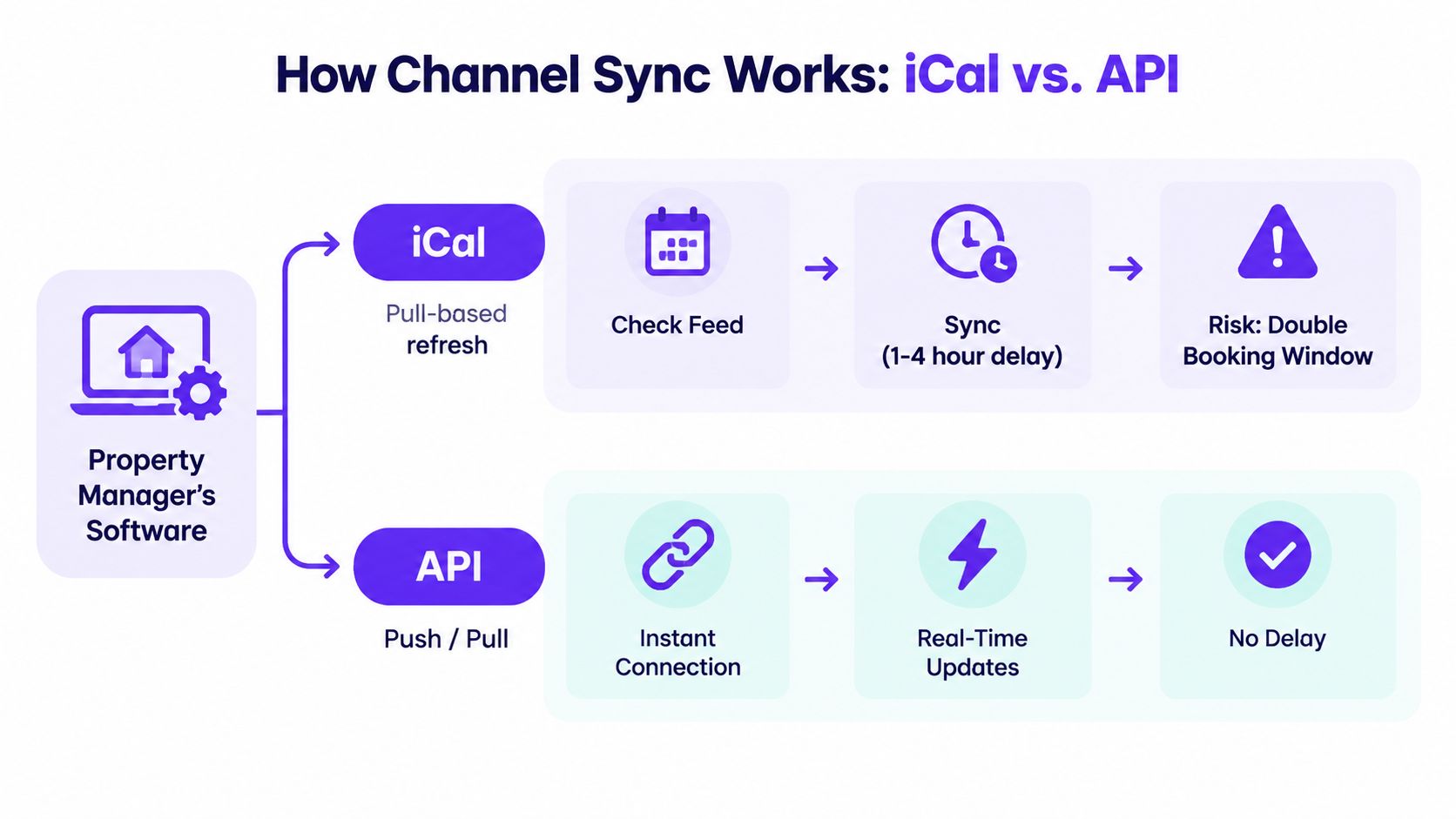
The easiest way to understand sync is to compare a mail pickup route with a live phone call. iCal is the pickup route. It pulls calendar data on a schedule, so the other channel sees the update only after the next refresh. That refresh usually happens every few hours and can take up to 12 hours in some cases Rentals United. API connections are much closer to a live conversation, because the systems can push and pull changes in near real time.
Why iCal creates a double-booking window
iCal is useful because it's simple and widely supported, but it carries only availability. It does not carry rates, minimum-stay rules, guest details, or content updates Rentals United. That means you still need separate workflows for pricing and restrictions, and the calendar can lag behind a fresh booking long enough to create a risk window.
If a reservation comes in on Channel A at 3 p.m. and Channel B doesn't refresh until later, B may still show the dates as open. On a quiet property that might just be an annoyance. On a high-demand weekend, it becomes a real collision risk.
| Sync type | What it does well | What it misses |
|---|---|---|
| iCal | Basic availability sharing | Rates, rules, guest data, content |
| API | Faster, bidirectional updates | Depends on the vendor and channel support |
Why API connections change the workflow
With API-based sync, the manager can move more than dates. It can update rates, minimum-stay rules, and booking states faster, which is the difference between “the calendar looks okay” and “the whole listing state is current.” That's especially valuable when a guest changes dates, a booking gets canceled, or you want to open and close inventory for a specific stay pattern.
The core takeaway is simple. iCal is acceptable when you're keeping a light setup alive and you can tolerate slower refreshes. API connections fit better when multiple OTAs are active, when you care about rules as much as dates, or when one booking change needs to ripple quickly across every surface.
Rule of thumb: if your pricing or restrictions change often, don't rely on a calendar feed alone.
For a one-unit owner, iCal may be enough if the direct booking site is the main channel and OTAs are secondary. For a small operator juggling Airbnb, Booking.com, and a branded site, the slower feed can become the weak link, especially on high-value dates.
Key Benefits for Small Operators and Boutique Managers
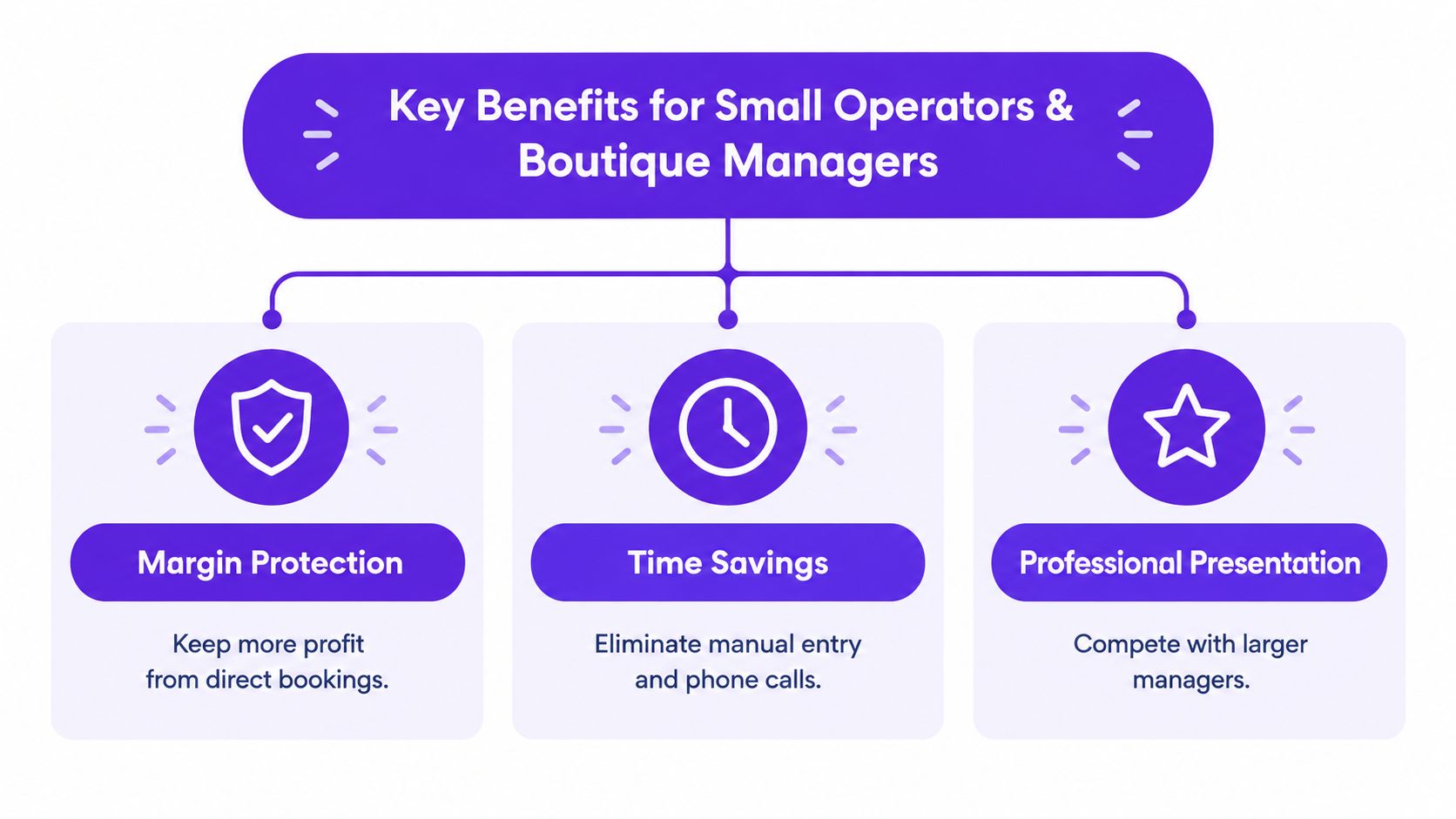
Small owners don't need a giant enterprise stack to feel the benefits of cleaner distribution. They need fewer manual checks, fewer guest back-and-forths, and fewer moments where a rate or rule is wrong on one channel. That's where a channel manager starts paying off in practical, everyday terms.
Margin protection without extra admin
A guest lands on your direct site, sees a live total price, and sends a request. Without that setup, you might spend ten minutes quoting, correcting dates, and checking whether a discount should apply. With the right flow, the pricing and availability are already presented clearly, so the guest can move forward without a chain of messages.
That matters because the bigger market context has changed. Channel management is now a software-led, cloud-delivered category rather than a niche add-on MarketIntelo. Small operators are being asked to run more channels with less friction, and the tool has to support that reality.
Less time spent babysitting calendars
Manual calendar checks are easy to underestimate. A host might open three tabs, compare dates, and then still wonder whether the booking that arrived five minutes ago has already propagated everywhere. A manager that centralizes inventory state cuts that uncertainty down.
The same is true for repeat guests. If someone has stayed before and wants to book again, an owned site gives you a cleaner path than sending them back into an OTA flow. You keep the relationship, and the guest sees a branded experience instead of a marketplace listing.
Practical example: one owner with three units can move from “check, quote, reply, confirm” to “request arrives, total is visible, dates are already protected.”
The final benefit is presentation. Boutique managers compete with much larger operators, and a consistent booking flow makes a small portfolio look organized. That professionalism is not cosmetic, it reduces friction at the exact point where guests decide whether to book.
How to Choose the Right Channel Manager Without Overbuying
A lot of small operators overbuy because they confuse breadth with fit. They see PMS-style dashboards, reporting layers, and automation menus, then end up paying for features they won't use. The better question is whether the system can protect your calendar, handle your rates and rules, and support the channels you plan to sell on.
A quick comparison lens
| Channel Manager Fit Checklist for Small Portfolios | What to Ask | Good Fit Signal |
|---|---|---|
| Sync type and speed | Does it rely on iCal, API, or both? | Clear explanation of how fast updates move |
| Rate and restriction coverage | Can it handle minimum stays and rule changes? | Pricing and rules sync, not just dates |
| OTA and direct-site compatibility | Does it connect to your main OTAs and your own site? | Works with your current and planned channels |
| Ease of setup | How long does onboarding take and who sets it up? | Simple launch path without developer work |
| Pricing transparency | Are fees clear as you add units? | Easy-to-read pricing with no surprise layers |
| Support | What happens when a sync issue appears? | Responsive help, not a ticket black hole |
For a deeper look at how an online rental management system fits around channel sync, see this guide to online rental management systems.
Questions worth asking in a trial
Ask how the system handles a booking modification, because that's where weak tools reveal themselves. Ask what happens when a guest changes dates after the reservation is already confirmed. Ask whether the channel manager blocks overlaps automatically or leaves you to clean up conflicts later.
A good test period is a low-risk window, not your busiest holiday stretch. Add one listing, connect the channels you use most, and watch whether a new booking updates the other surfaces without manual intervention. If rates and rules don't travel with the availability, the system is only solving part of the problem.
Don't buy for the roadmap you hope to have someday. Buy for the portfolio you're operating this season.
That's how small operators avoid turning a simple distribution problem into a full platform migration.
Building Your Direct Booking Channel Alongside OTAs
A direct-booking site works best when it behaves like a real channel, not a side project. It should show branded property pages, seasonal pricing, live availability, and a clear path for guest requests while still staying aligned with your OTA calendars. That's the point where a website and a channel manager become one distribution system instead of two separate chores.
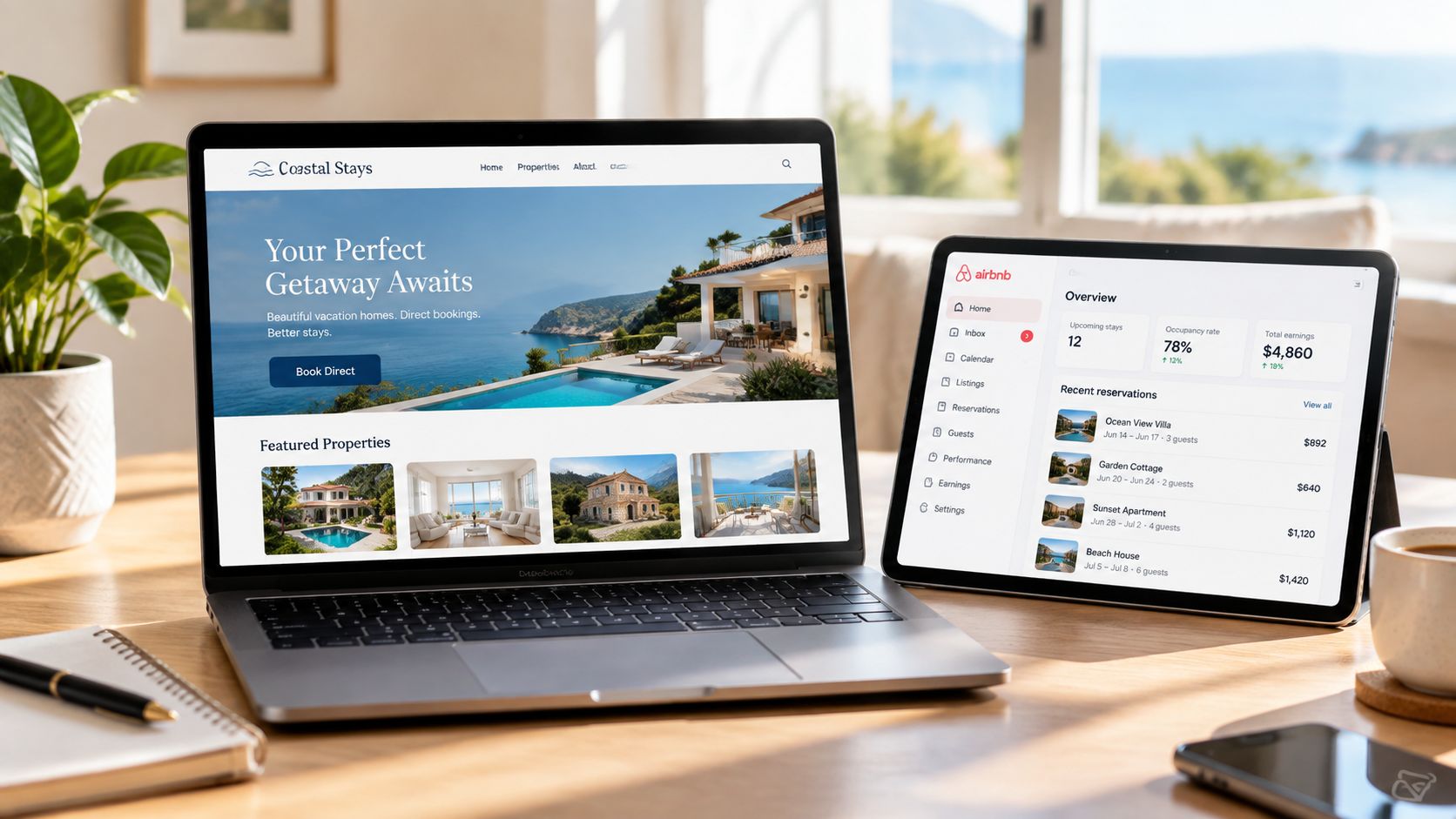
A hosted setup can go live fast because you're not building from scratch. The value is that the owner keeps control of the domain, the content, and the guest relationship while the site handles availability and request flow without custom development. That's what makes direct booking useful for a small portfolio, especially when repeat guests already trust you.
Where direct booking fits in the economics
The main question isn't whether direct booking sounds better. It's whether it improves margin after you account for guest acquisition, staff time, and compliance pressure. Independent industry reporting found 73% of property managers said operations and staffing pressure were the biggest barriers to 2026 targets, 23% cited marketing and distribution pressures, and 42% expected legal or regulatory issues to constrain growth StayFi. That makes margin a systems question, not just a commission question.
So the decision is practical. If you can operate a direct site without adding chaos, it can keep more reservation value in-house. If it creates more quoting, more back-and-forth, and more manual checks, the savings may be weaker than they look on paper.
For hosts comparing website-first setups, this overview of vacation rental website builders is useful context.
The clean setup flow
Start with the site, then connect your existing calendars. After that, keep OTA and direct requests moving through the same availability logic so one booking blocks the others. That's the part owners often miss. A direct site isn't a separate business line, it's another sales surface that still needs disciplined sync.
The best outcome is a blended model. OTAs keep demand flowing, while your own site gives returning guests and brand-aware travelers a direct path to book with you.
Putting It All Together and Next Steps for Owners
The big shift is mental. A channel manager is not just a calendar tool, it's the distribution layer that keeps availability, rates, and rules coherent across every place you sell. iCal can work for simpler setups, but once timing, pricing, and booking states matter together, you need a system that moves more than dates.
Before you add another channel, audit what you already have. Check whether your current sync covers rates and restrictions, not only availability. Then connect or launch your direct site, and test a booking modification from start to finish so you can see how changes travel through the system.
If you're scaling from one unit to six, the goal is not enterprise complexity. It's calendar integrity, clear pricing, and a guest experience that still feels controlled when the portfolio gets busier. For owners comparing website and booking-channel options, this guide to vacation rental websites can help frame the next move.
If you want a direct-booking setup that keeps calendars aligned, shows live availability, and gives you control of your guest relationship, Rentabble is built for that job. Visit Rentabble to see how a hosted booking site can fit alongside your OTA channels without custom development.