10 Vacation Rental Booking Software Options
The most feature-rich platform isn't automatically the best vacation rental booking software for a small owner. A self-managing host with two apartments has a different problem from a property manager coordinating a large portfolio. The right choice starts with the booking model: whether you want to own a branded direct channel, keep Airbnb and Booking.com calendars aligned, automate guest communication, accept online payments, control complex pricing rules, or build a larger operating system over time.
This comparison evaluates ten tools by the operational problem they solve, not by the length of their feature lists. For each option, the important questions are practical: How reliable is calendar synchronization? Can guests book through a branded site? How are payments handled? Who is the intended user? Where does the platform add complexity? Pricing also needs careful checking. Confirm current plan limits, add-ons, booking fees, payment costs, and contract terms before comparing monthly totals.
The category is expanding beyond basic calendar utilities. The vacation rental software market was estimated at USD 20.14 billion in 2024 and USD 21.87 billion in 2025, with a projection of USD 45.84 billion by 2034 at an 8.57% CAGR, according to Market Research Future's vacation rental software market analysis. That growth makes fit more important, not less. Rentabble stands out for owners who want a hosted branded website, transparent guest totals, iCal synchronization, and predictable subscription pricing without adopting a complex PMS.
Table of Contents
- 1. Rentabble
- 2. Lodgify
- 3. OwnerRez
- 4. Smoobu
- 5. Uplisting
- 6. Hospitable
- 7. Hostfully
- 8. iGMS
- 9. Beds24
- 10. Tokeet and AdvanceCM
- Top 10 Vacation Rental Booking Software Comparison
- Choose the System That Fits Your Next Booking
1. Rentabble
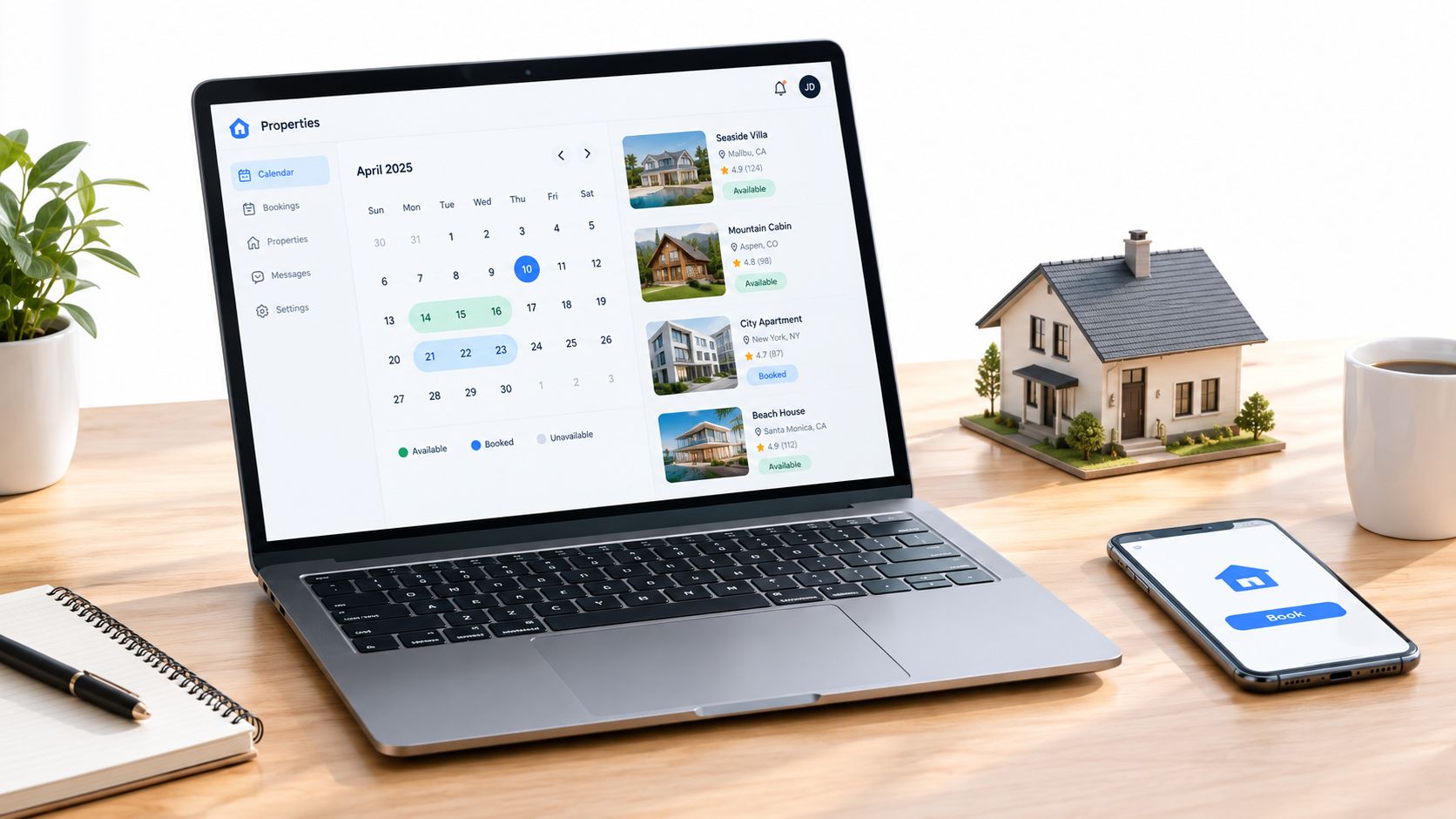
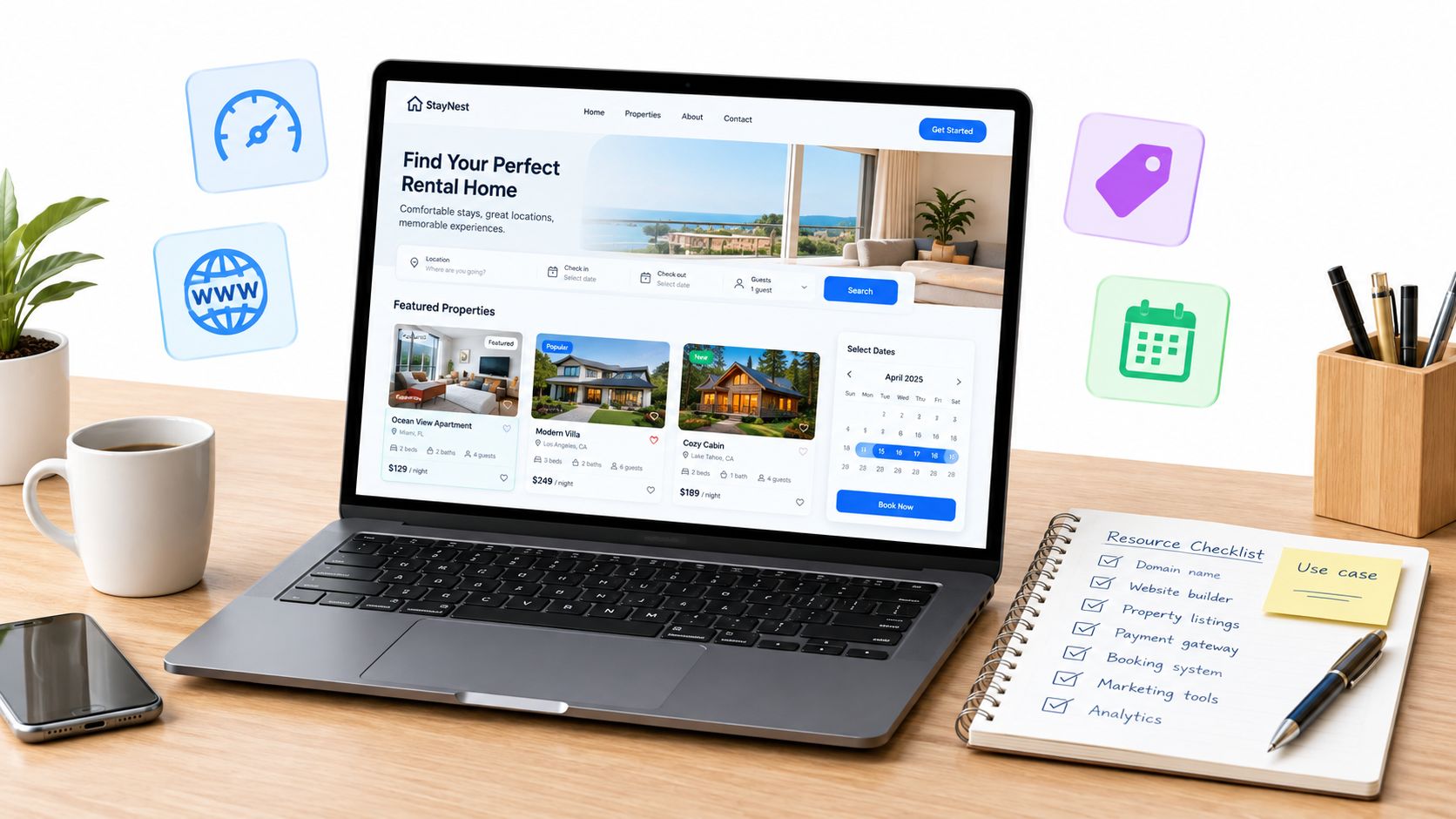
Rentabble addresses a narrow operating problem: building an owned direct-booking channel while keeping Airbnb, Booking.com, Expedia, and VRBO workflows in place. It provides a hosted, branded website with property pages, photos, amenities, availability, seasonal rates, and booking requests. Guests see the calculated total before submitting a request, reducing manual quotes for direct inquiries.
The setup suits owners without a developer or web designer. A logo and optional custom domain support basic branding, while the dashboard combines apartments, prices, bookings, reviews, occupancy, and revenue snapshots. In practice, Rentabble functions more like a direct-booking layer than a full property-management system.
Best fit: Owners who want marketplace visibility while building a simple, branded booking destination they control.
Calendar and pricing control
The central calendar handles manual blocks, prevents overlaps when reservations are confirmed, and supports two-way iCal import and export. Documented connections include Airbnb, Booking.com, Expedia, VRBO, and other services. For a small operator, this keeps the direct site from becoming a separate availability island. iCal can align dates across channels, but owners should test refresh timing and confirmation behavior before depending on the setup.
Seasonal controls cover rate periods, minimum stays, permitted check-in days, and discounts. Rentabble also includes SEO-ready pages, a generated sitemap, multilingual pages in English and Croatian, guest reviews, an optional Pro blog, hosted security, backups, email notifications, and support through email and Discord.
Payment limitation and verified pricing
Payment handling is the main operational constraint. Online card payments are listed as coming soon, so guests currently pay by bank transfer or cash on arrival. Owners requiring immediate card authorization, automated deposits, or integrated chargeback workflows should exclude Rentabble until those capabilities are available.
Pricing is clearly stated. Basic costs €9 per month or €99 per year for up to three apartments, while Pro costs €19 per month or €199 per year for up to six apartments, according to the Rentabble platform information. A free seven-day trial without a credit card and a 14-day refund policy after purchase lower the commitment for testing. The plan limits fit owners with one to six units. Larger portfolios may require a custom arrangement or a broader PMS.
2. Lodgify
Lodgify is built for hosts who want a direct-booking website and property-management foundation in one product. Its templates, booking engine, embeddable widget, and channel connections let an owner launch a branded site without assembling separate website and reservation tools. Direct bookings through the site are presented as commission-free, while Airbnb, Booking.com, VRBO, and Google Vacation Rentals connections support a broader acquisition strategy.
The practical advantage is speed. A host can use a purpose-built vacation-rental template rather than designing a general website from scratch, then place the booking widget on an existing site if a separate web presence already matters. Google Vacation Rentals support is particularly relevant to owners who want direct-site demand to sit alongside OTA exposure rather than choosing one channel exclusively.
Where Lodgify earns its place
Lodgify's mobile app and task calendar make it more suitable than a basic booking widget for owners who share cleaning or guest responsibilities with a small team. Optional smart or dynamic pricing can extend the platform's pricing capability, but it also changes the cost calculation. Don't assume that the base subscription includes every revenue-management function.
The trade-off is controlled flexibility. Lodgify templates are designed for a fast launch and booking conversion, but they won't provide the same design freedom as a fully custom CMS. That's often a sensible exchange for an owner who values an operationally ready site more than complete visual control.
Owners comparing direct channels should also consider vacation rental SEO fundamentals, because a branded site needs useful property content and discoverable pages, not only a booking form. Visit Lodgify to confirm current plans, add-on charges, channel coverage, and payment options before choosing it.
3. OwnerRez
OwnerRez is the strongest candidate here for owners whose main difficulty is not launching a site, but expressing complicated business rules accurately. Its direct-booking engine, hosted websites, API connections, configurable fees, taxes, pricing, and rule engine give experienced operators a high level of control. The platform connects with Airbnb, VRBO, Booking.com, and Google Vacation Rentals through direct API integrations.
That depth changes the setup burden. A host who needs custom fees, taxes, restrictions, and reporting can benefit from the configuration. A host who wants a clean direct page and a synchronized calendar may find the power-user interface heavier than necessary.
Rules matter more as operations mature
OwnerRez includes a channel manager with the subscription, so channel synchronization doesn't require a separate channel-management fee according to the supplied product information. Its hosted websites can use an owner's domain, but the design is more utilitarian than the visual systems offered by dedicated website builders.
The central question is whether your pricing model needs a rules engine. If you charge different fees by property, channel, stay condition, or booking context, OwnerRez gives you room to model that logic. If every unit uses straightforward rates and a small set of seasonal adjustments, the added configuration may produce more administration than value.
Calendar quality still deserves a live test. Ask whether an update to availability, rates, taxes, and restrictions appears correctly across each intended channel, then verify how direct bookings affect the shared calendar. A rental availability calendar guide can help frame that test around the owner's actual workflow rather than the vendor's feature terminology.
See OwnerRez for current subscription details, integration requirements, website options, and support documentation. Pricing should be confirmed directly because the important cost is the total for your configuration, not just the headline subscription.
4. Smoobu
Smoobu targets hosts who want a quick operational setup rather than a customizable property-management environment. Its central calendar, two-way channel synchronization, direct-booking website, guest messaging, online check-in, guest app, and Airbnb-specific controls create a practical package for small portfolios.
The direct site is commission-free according to the supplied product notes, and the platform connects the website with Airbnb, Booking.com, and Expedia calendars. That makes Smoobu suitable for an owner who wants one view of reservations while still receiving bookings from multiple sources.
A useful split between plans
Smoobu's Professional and Flex options create an important pricing distinction. Flex combines a lower monthly charge with a small booking fee, so it may suit an owner who prefers lower fixed costs during quieter periods. Professional is the more predictable structure for owners who want to avoid a variable charge on each reservation. Confirm the current fee model and included features before comparing either plan with a flat subscription.
Smoobu also includes practical Airbnb controls such as discounts, markups, and automated reviews. Those features are less glamorous than a custom website, but they can reduce repetitive account work for a host who spends much of the week managing one dominant OTA.
The compromise is design control. Its website customization is template-driven, which supports speed but limits deeper visual experimentation. For a host with a small number of units, that may be the right trade. Choose Smoobu when quick calendar alignment and guest communication matter more than a distinctive, highly customized brand experience.
Review Smoobu for current plan limits, Flex booking charges, OTA connections, and payment workflows.
5. Uplisting
Uplisting is aimed at operators who want a direct-booking website tied closely to a reliable PMS and channel-management workflow. Its branded site can launch quickly or connect with an existing website, while the multi-calendar and pricing structure position the PMS as the operating source of truth. Native Stripe integration gives it a clearer path to direct online payments than platforms that rely on manual bank transfers or arrival payments.
The direct site can use a request-to-book option, which gives owners control over whether reservations are confirmed immediately or reviewed first. That distinction matters for hosts with unusual house rules, manually verified availability, or a preference to screen requests before accepting them.
Strong payment fit, less design freedom
Uplisting's operational appeal is the connection between the guest-facing flow and the underlying calendar. If the owner changes pricing or fees centrally, the system is intended to distribute that logic across channels rather than requiring separate updates. The platform is also positioned around fast OTA synchronization, a priority for operators who view double bookings as a greater risk than limited website customization.
The site builder is deliberately minimal. Owners who want a conversion-ready booking path may appreciate fewer design decisions, while brand-focused hosts may find the experience restrictive compared with a custom CMS.
Public pricing isn't fully available in the supplied information. Unit count, plan terms, and the final subscription should be confirmed through a trial or quote rather than inferred from third-party pages. Also verify Stripe transaction costs separately from software fees.
For owners comparing synchronization architecture, this vacation rental channel manager explanation provides useful terminology for distinguishing calendar exchange from deeper API connectivity. Visit Uplisting to test the booking flow, payment setup, calendar updates, and current pricing.
6. Hospitable
Hospitable is the messaging and automation specialist in this comparison, although its Direct product also provides hosted booking sites, fee controls, and a shared calendar with OTA reservations. It suits an owner whose largest daily burden is repetitive communication, including pre-arrival messages, check-in instructions, and post-stay follow-up.
The Direct product lets owners configure service and host fees for direct reservations. Its unified communications system keeps direct and OTA conversations in the same operating environment, which can reduce the risk of answering from the wrong inbox or losing context between channels.
Payment risk becomes a product choice
Hospitable's Direct Premium option uses a Merchant-of-Record model. In the supplied plan notes, the example structure includes a 4% guest fee and a 3% host fee, so those figures must be treated as plan-specific examples rather than a universal current price. Confirm the applicable rates, subscription, payment coverage, chargeback handling, and booking policies before calculating net revenue.
This model can be attractive when the owner values outsourced payment risk management. It can also be more expensive than a simple direct-payment connection, particularly when the owner already has a preferred processor and is comfortable managing payment disputes.
Hospitable's strength is therefore not merely “direct bookings.” It is the combination of direct reservations with automation and communication controls. Choose it when saved administrative effort justifies the fee structure. Choose another tool if the priority is the lowest fixed cost, a highly designed website, or manual payment arrangements.
See Hospitable for the current Direct and Direct Premium terms. Check whether each automation, inbox feature, and payment option belongs to your subscription or requires an add-on.
7. Hostfully
Hostfully is a full PMS for property managers who want a direct-booking site connected to a wider operational and revenue ecosystem. Its built-in site builder is described as free with the PMS, and the platform supports SEO-friendly pages, open API access, and integrations with tools such as Beyond, Wheelhouse, and PriceLabs.
That integration breadth changes the intended user. A single owner may appreciate the convenience of an included site, but a manager coordinating revenue tools, operations, and custom connections is more likely to benefit from Hostfully's ecosystem.
The site is useful because it shares PMS data
A direct site tied to PMS data can reduce duplicate listing maintenance. Availability, property information, and booking records remain connected to the management environment instead of living in a separate website plugin. Open API access also gives technically capable teams a path to tailor integrations.
The main limitation is commercial clarity. Pricing is sales-led for many accounts, and total cost can depend on the PMS package, property count, integrations, and additional services. The supplied notes also mention a 1% fee in some upsell or Guidebook Stripe flows, which should be confirmed for the exact transaction path rather than treated as a universal Hostfully charge.
Some users report integration quirks with certain channels, so test every high-value connection before migration. Don't stop at a successful listing import. Test availability changes, cancellations, rate updates, guest messages, and payment records.
Visit Hostfully for a current quote and ask for a complete cost breakdown. It's a better fit for portfolio growth and integration depth than for an owner who only needs a lightweight direct-booking layer.
8. iGMS
iGMS gives small teams several ways to capture direct reservations. An owner can create a hosted direct-booking website, embed the booking widget on an existing site, or enter manual reservations while keeping messaging automations and a unified inbox connected to the PMS.
That flexibility solves a common transition problem. An owner doesn't have to replace an existing website to start accepting direct bookings, and a manager can keep phone or email reservations visible alongside online reservations. Stripe integration supports direct payments, while request-to-book provides an alternative to instant confirmation.
Choose the booking surface that matches your brand
The hosted site is the simplest route for an owner without a web presence. The widget is more useful when an existing site already ranks well or contains destination content that shouldn't be rebuilt. Manual reservations help keep the calendar complete, but they require disciplined data entry because every offline booking can affect availability across channels.
iGMS promotes 0% booking fees on plan pages in the supplied notes. Confirm whether that applies to the exact plan and booking flow, then separate the software charge from Stripe processing costs. Feature access also varies by plan, so the comparison should include messaging automations, inbox functions, payment tools, and the number of supported properties.
Website customization is functional rather than fully custom. That's acceptable when the goal is to give guests a reliable path to check availability and submit a reservation, but less suitable for an owner building a highly differentiated destination brand.
Explore iGMS and test the hosted site, widget, Stripe connection, request flow, and calendar update before committing.
9. Beds24
Beds24 takes a modular approach. Instead of presenting one tightly bundled operating system, it lets owners pay for the modules and channel connections they use. That can make it cost-efficient for a small portfolio with advanced rate requirements, but it also places more responsibility on the owner to understand the configuration.
Its strongest feature is granular pricing control. Daily price rules, channel-specific rates, restrictions, and connections to dynamic-pricing services such as PriceLabs and RoomPriceGenie give experienced users room to model complex strategies. The direct-booking page can also serve as the primary site, which removes the need for a separate booking engine in simpler setups.
Technical control has a training cost
Beds24 is a good match for an owner who wants to control how prices and restrictions behave on each channel. It's less attractive for someone who wants to choose a template, enter basic rates, and begin accepting bookings without learning a detailed interface.
The modular structure also makes headline comparisons unreliable. A low base cost may not represent the total needed for the desired channels, booking page, pricing tools, and operational features. Review every selected module, connection, billing term, and payment cost before deciding that Beds24 is cheaper.
Euro-based billing may also affect the final cost for US-based owners because foreign-exchange treatment and card charges depend on the payment arrangement. Verify those terms directly.
Visit Beds24 with a written list of required channels and rate rules. If the owner can't explain the intended configuration, the platform's flexibility may become a source of errors rather than savings.
10. Tokeet and AdvanceCM
Tokeet, also referred to as AdvanceCM in the supplied product notes, combines a direct-booking website builder, booking engine, channel manager, automation tools, and online payments. Its responsive templates support a custom domain, while the channel manager is described as offering more than 50 connections. That makes it relevant to hosts who want broad distribution without assembling several separate systems.
Rategenie is available as a dynamic-pricing add-on, and the platform supports automated rates and fees, messaging automation, and secure online payments. The direct-booking flow is therefore more complete than a simple request form, particularly for owners who want guests to pay online from the beginning.
Verify the product and the price path
The naming deserves attention. Evaluators may encounter Tokeet and AdvanceCM during the same research process, so confirm which product, dashboard, support model, and contract terms apply to the account being offered. Product naming can affect documentation, onboarding expectations, and the way features appear during a trial.
The supplied notes say the platform can scale features without strict feature-gating across tiers, but historical pricing changes mean owners should verify current total cost and terms. Include the website, channel connections, Rategenie, payment processing, and any automation add-ons in the calculation.
Tokeet is a sensible option for an owner who values template-based direct sales and broad channel coverage. It's less suitable when the evaluation requires a very simple brand-first product or when the naming and pricing structure remain unclear after a sales conversation.
Test Tokeet by creating a property, setting rates and fees, submitting a booking, processing payment, and checking the resulting calendar update across the intended channels.
Top 10 Vacation Rental Booking Software Comparison
| Product | Core features | UX & reliability | Pricing & value | Target audience | Unique selling points |
|---|---|---|---|---|---|
| 🏆 Rentabble | Hosted branded site, property pages, live availability, seasonal pricing, central calendar, 2‑way iCal | ★★★★, fast setup, secure hosting, backups | 💰 €9/mo Basic (≤3) · €19/mo Pro (≤6) · 7‑day trial | 👥 Self‑managing owners & small operators | ✨ No marketplace commission · exact guest pricing · hosted maintenance · 🏆 |
| Lodgify | Branded site builder, embeddable widget, channel connections, optional dynamic pricing | ★★★★, template‑led, conversion focused | 💰 Subscription + add‑ons (dynamic pricing extra) | 👥 Hosts wanting quick, conversion‑focused sites | ✨ Google VR support · 0% fee on direct bookings |
| OwnerRez | PMS + hosted sites, API channel integrations, configurable rules/fees engine | ★★★★, powerful, feature‑dense (steeper setup) | 💰 Subscription; channel manager included | 👥 Scaling managers needing granular control | ✨ Highly configurable pricing/fees · robust reporting |
| Smoobu | Channel manager, quick direct site, 2‑way sync, guest messaging & check‑in | ★★★, very quick launch, template driven | 💰 Plans incl. Flex (lower monthly + per‑booking fee) | 👥 Small portfolios / single‑digit units | ✨ Fast setup · Airbnb‑specific levers |
| Uplisting | Channel manager + PMS, branded site, multi‑calendar source, native Stripe | ★★★★, reliable OTA sync, clean booking flow | 💰 Pricing by quote; Stripe native | 👥 Hosts wanting reliable sync + Stripe payments | ✨ Native Stripe · conversion‑ready sites |
| Hospitable | Messaging automations, direct site, Direct Premium (MoR) payment option | ★★★★, excellent automations, unified comms | 💰 Subscription; Direct Premium MoR fees apply | 👥 Hosts valuing automations & payment handling | ✨ MoR option (payments/chargebacks) · strong automations |
| Hostfully | PMS with SEO‑friendly site builder, broad integrations, API access | ★★★★, PMS‑integrated sites, many integrations | 💰 PMS subscription; sales‑led pricing on some features | 👥 Property managers needing integrated PMS + tools | ✨ Integration marketplace · SEO‑friendly sites |
| iGMS | Quick site or embeddable widget, Stripe, messaging automations, unified inbox | ★★★, functional sites, strong messaging tools | 💰 Subscription; Stripe payments; “0% booking” messaging | 👥 Small teams wanting multiple direct paths + inbox | ✨ Multiple direct‑booking options · unified inbox |
| Beds24 | Modular booking engine, pay‑as‑you‑use modules, granular daily pricing rules | ★★★, very powerful but technical UI | 💰 Pay‑for‑modules; cost‑efficient for advanced pricing | 👥 Tech‑savvy hosts needing granular rate control | ✨ Granular daily rules · modular pricing model |
| Tokeet (AdvanceCM) | Responsive templates, channel manager 50+ connections, dynamic pricing add‑on | ★★★, broad feature set, some naming/UX quirks | 💰 Subscription + optional add‑ons (Rategenie) | 👥 Hosts seeking wide channel coverage & scalability | ✨ Wide channel coverage · scalable feature set |
Choose the System That Fits Your Next Booking
The best choice depends on the next operational problem you need to remove. Start by counting your units and booking channels, then decide whether the primary goal is an owned direct site, stronger OTA synchronization, automated communication, payment handling, pricing control, or portfolio growth. That sequence will usually eliminate more unsuitable products than starting with a long feature list.
Owners with one to six units and a clear need for a branded direct channel should look closely at focused products such as Rentabble, Lodgify, Smoobu, or iGMS. The distinction is in the workflow. Rentabble prioritizes a hosted branded site, transparent totals, iCal synchronization, and fixed low subscription tiers. Lodgify adds a broader all-in-one structure and Google Vacation Rentals support. Smoobu emphasizes fast setup and practical guest operations, while iGMS gives owners multiple direct-booking surfaces and a unified inbox.
A more complex pricing or management model points elsewhere. OwnerRez and Beds24 are better suited to operators who need granular rules, fees, restrictions, or channel-specific rate logic. Uplisting emphasizes a direct flow with native Stripe. Hospitable makes automation and payment-risk handling central. Hostfully and Tokeet or AdvanceCM are more relevant when the owner wants broader PMS or distribution capabilities.
Calendar reliability should be tested, not assumed. Add a property, block dates, change a rate, create a direct request, cancel it, and confirm how each event appears in the central calendar and external channels. iCal synchronization can be useful for keeping availability aligned, while API connections may offer a deeper channel relationship. The right choice depends on the channels you use and the level of control you need.
Payment design can change the decision completely. Rentabble currently handles guest payments through bank transfer or cash on arrival, with online card payments listed as coming soon. Uplisting offers native Stripe integration, iGMS connects with Stripe, and Hospitable's Direct Premium can manage payment risk as a Merchant of Record, but its supplied example includes a 4% guest fee and 3% host fee that must be confirmed for the current plan. Don't compare these systems without separating software subscriptions, booking fees, payment processing, add-ons, and any unit limits.
Market direction supports taking these infrastructure questions seriously. Among hosts already using direct-booking software, one 2025 analysis reported bookings split 31.6% through direct-booking sites, 47.2% through Airbnb, and 21.2% across other channels. It also reported that direct bookings produced 45.2% longer average stays and 51.3% longer booking windows than OTA bookings, according to Houfy's direct-booking analysis. Those figures describe a specific group, not every host, but they support a useful conclusion: a direct site can be an economic channel, not merely a backup page.
Before switching, test the complete guest journey. Search availability, inspect the calculated price, submit or confirm the request, process payment, send the confirmation, and verify the calendar update. Small owners should favor the reliable system they'll operate over advanced features they won't configure. If Rentabble is on your shortlist, pay particular attention to its fixed Basic and Pro tiers, included apartment limits, two-way iCal workflow, and current bank-transfer or cash payment process.
Rentabble offers small vacation-rental owners a hosted branded website, transparent booking requests, seasonal pricing, and calendar synchronization without custom development or marketplace commissions on direct requests. If that operating model matches your next booking goal, visit Rentabble to review the platform, pricing tiers, trial terms, and direct-booking workflow.