10 Rental Property Website Builder Options
Most advice about choosing a rental property website builder starts with templates, photo layouts, and brand polish. That's backwards. The decision sits underneath the design: how you'll handle availability, rates, booking requests, payments, and OTA synchronization once guests start using the site.
That operating choice matters more now because direct booking websites aren't a side project anymore. A 2024 industry report cited in BuildUp Bookings' vacation rental statistics roundup said direct booking sites accounted for nearly 34% of bookings, second only to Airbnb's 46%. In follow-up 2025 and 2026 industry coverage summarized in the same source, hosts using direct-booking software reported 31.6% of bookings from direct sites, 47.2% from Airbnb, and 21.2% from other channels.
So the right builder depends on which job you need it to do. Some operators need a fast hosted site they can launch in a day. Others already have a WordPress, Squarespace, or custom CMS presence and need a booking engine layered onto it. Others need a broader PMS with direct-booking functionality because their real problem isn't design. It's rate logic, channel sync, and reservation operations.
This comparison focuses on those operating decisions first: setup speed, hosted versus embedded implementation, domain and branding control, booking and calendar depth, recurring or per-reservation costs, and portfolio fit. Rentabble is the small-operator reference point for a fast, hosted direct-booking site. Most of the other tools lean further toward PMS depth, integrations, or CMS flexibility.
Read each entry for four things: who it's best for, what the implementation looks like, where booking control lives, and what cost signals to watch before you commit.
Table of Contents
- 1. Rentabble
- 2. Lodgify
- 3. Smoobu
- 4. OwnerRez Hosted Websites
- 5. Uplisting Direct Booking Website Builder
- 6. Hostaway Direct Booking Website Builder
- 7. Guesty Websites and Guesty for Hosts Website Builder
- 8. Hostfully Direct Booking Site
- 9. Tokeet Webready
- 10. Bookster
- Top 10 Rental Property Website Builders, Feature Comparison
- Match the Platform to Your Operating Model
1. Rentabble
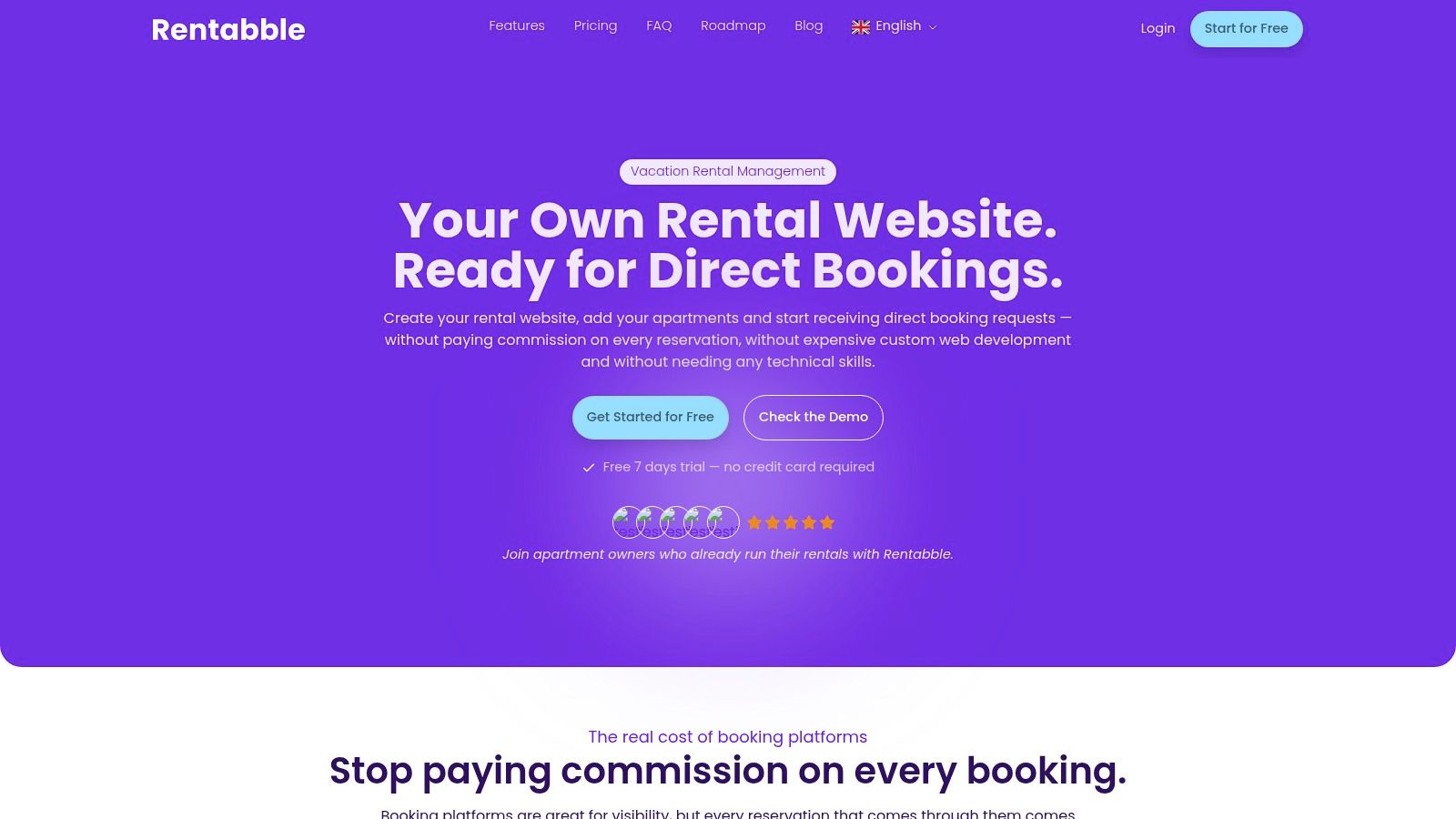
Rentabble is the clearest fit if you don't want to assemble a stack. It gives independent apartment owners and small vacation-rental operators a hosted direct-booking website with property pages, galleries, SEO-ready pages, an auto-generated sitemap, and a guest-facing booking-request flow.
The practical appeal is speed and ownership. You can publish a branded public site, connect a custom domain, manage pricing and availability from one dashboard, and avoid custom development altogether. For owners who mainly want an owned booking channel beside Airbnb or Booking.com, that's a very different purchase from buying a full PMS.
Why the workflow matters here
Rentabble's booking flow is built around live availability and exact guest-visible totals generated from seasonal pricing rules, including rate periods, minimum stays, check-in rules, and discounts. Guests send a booking request, then the host confirms it in one click. That's simpler than a broader PMS checkout stack, but it also means you're choosing a request-led workflow rather than a card-on-file, instant-book-heavy model.
Its two-way iCal import and export syncs calendars with major OTAs. That's useful, but iCal-based synchronization comes with a known timing limitation. Houfy's guide to vacation-rental calendar sync notes imported iCal feeds are commonly refreshed every 1 to 6 hours, with Airbnb around every 3 hours and Vrbo up to 6 hours in some cases. Rentabble partly addresses that risk with overlap prevention and confirmation-time blocking, which is exactly the kind of safeguard small operators should look for.
Practical rule: If a builder relies on iCal rather than deeper API sync, treat buffer rules and overlap prevention as core booking features, not extras.
Best fit and trade-offs
Rentabble works best for owners managing a small portfolio who want predictable subscription pricing, branding control, and a fast launch. It supports multilingual sites in English and Croatian, guest reviews, secure hosting, regular backups, email notifications, and an optional blog on the Pro plan.
The main limits are operational rather than aesthetic. Payment collection currently relies on bank transfer or cash on arrival, card payments are planned but not yet available, and the product is tuned for smaller portfolios rather than large property-management teams.
- Best for: Independent owners and small operators who want a hosted direct-booking site without developers.
- Strongest advantage: No per-booking commissions, clear subscription pricing, and setup measured in hours.
- Watch closely: Payment method fit, language requirements, and plan caps if your portfolio is growing.
Rentabble's pricing is unusually straightforward. Basic is €9/month or €99/year for up to 3 apartments. Pro is €19/month or €199/year for up to 6 apartments, adding two-way iCal sync with major OTAs, your own domain, multilingual sites, guest reviews, a blog, and priority email support. It also offers a free 7-day trial without a credit card and a 14-day money-back window after purchase.
Use it if your buying decision is really, "I need my own booking channel this week."
Website: Rentabble
2. Lodgify
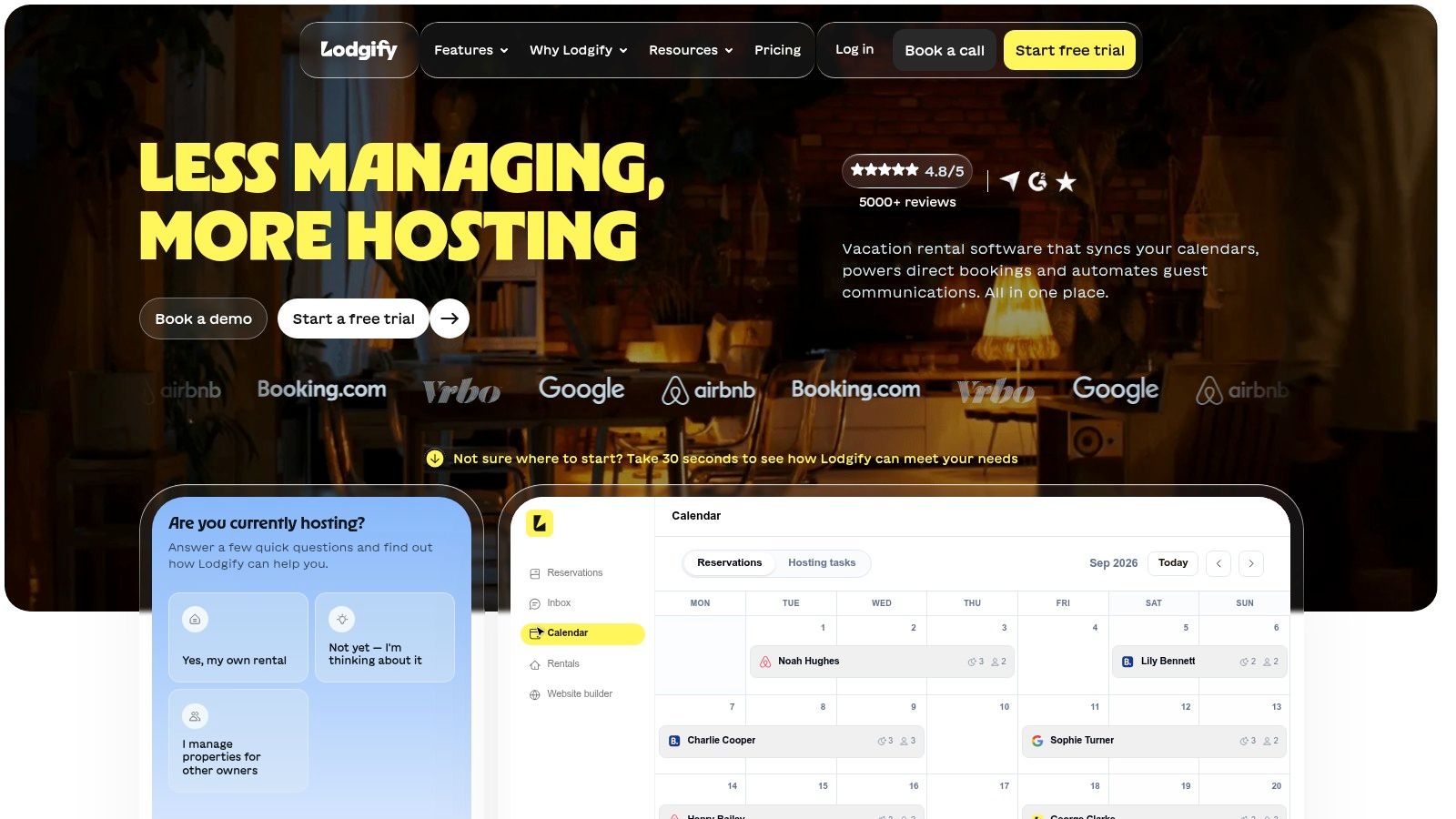
Lodgify sits in the middle of two categories. It can be your full no-code rental property website builder, or it can act more like a booking layer attached to an existing site through its widget.
That makes it a strong option for operators who already have content, local landing pages, or a house brand they don't want to rebuild from scratch. If you're comparing hosted tools with CMS-friendly tools, Lodgify is one of the more flexible bridges.
Where Lodgify fits
Its native booking engine, templates, drag-and-drop editing, and channel-manager orientation make it more operational than a generic site builder. But the key buying question isn't "does it have templates?" Most do. The question is whether you want your booking engine embedded into your current web presence or whether you want Lodgify to become the whole front end.
That's the same decision many owners face when moving beyond early website experiments. If you're weighing hosted simplicity against embedded flexibility, this guide to a vacation rental website builder is useful context for framing the trade-off.
- Best for: Owners who want a purpose-built direct-booking stack but may need widget-based deployment on WordPress, Squarespace, or Wix.
- Setup implication: Faster if you accept its native site structure. More involved if you're preserving an existing CMS and brand system.
- Cost signal: Watch add-ons. Features like dynamic pricing may introduce extra or usage-based costs.
Lodgify also connects to Google Vacation Rentals, which matters if you want the site to work as a distribution endpoint rather than just a brochure with a booking button.
Website: Lodgify
3. Smoobu
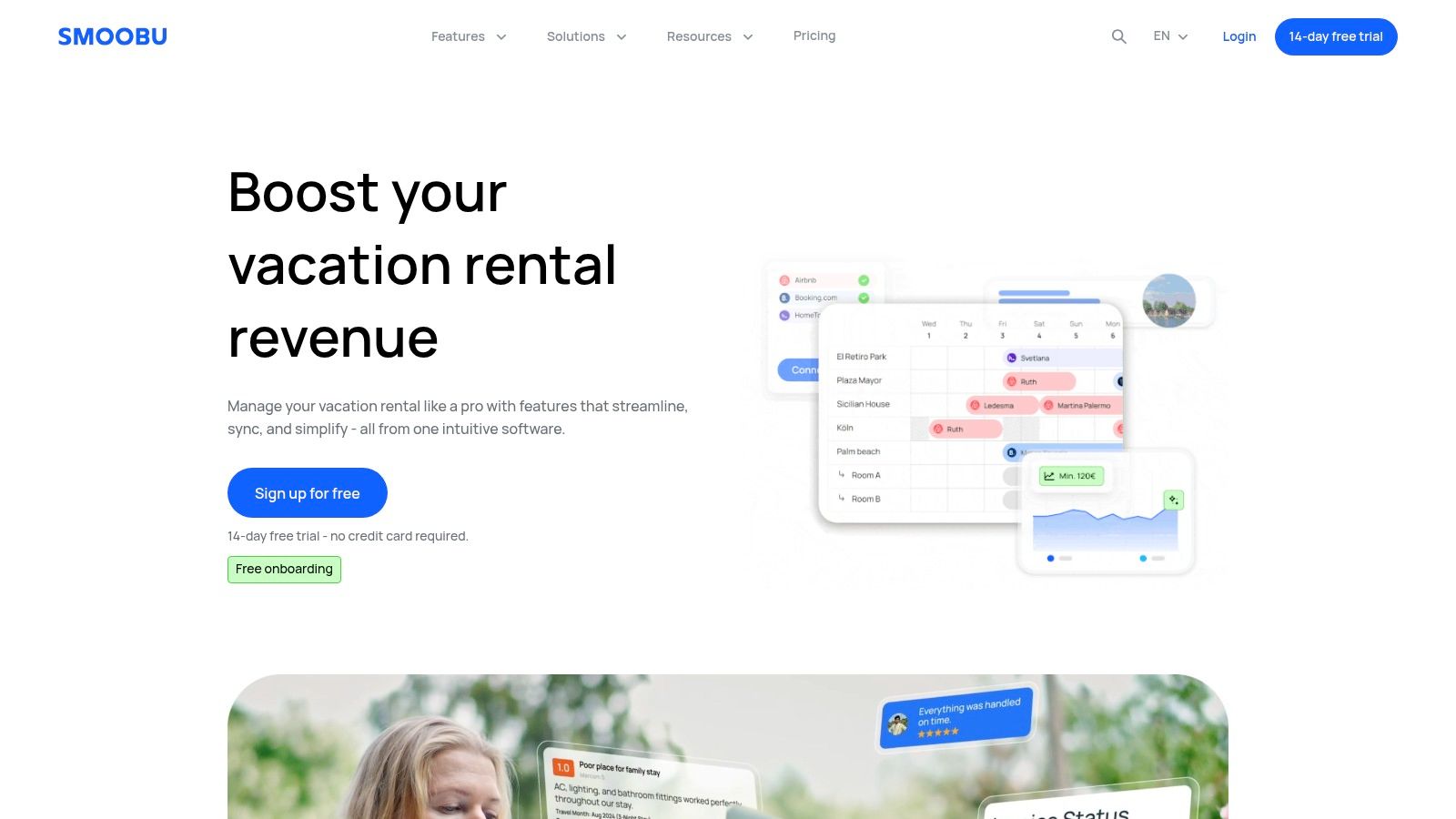
Smoobu is better understood as a small-portfolio operating hub that happens to publish a direct-booking site. That distinction matters. You're not buying pure web design flexibility. You're buying a centralized calendar, OTA sync, and a website that inherits property data from the same system.
For owners who dislike duplicating listing data across tools, that's a strong argument. Add your properties, rates, and core details once, then let the direct-booking site reflect that operational setup.
Decision logic
Smoobu's website builder is hosted, multilingual, and tied to the rest of the Smoobu environment. That usually means a quicker path to launch than CMS-plus-plugin setups, but less design freedom than a custom site or an editable content platform.
Its direct-booking reservations sit beside OTA bookings for unified reporting and management. That's useful if you're trying to measure the business impact of direct channels rather than just publish a site and hope it works.
Visibility isn't the same as commercial performance. Owners need to track the path from landing page to search, property view, enquiry, checkout, and completed booking.
That measurement gap is easy to miss. Codativity's analysis of vacation-rental location pages and local SEO argues that operators should tie analytics to the full journey and build page strategy from real booking origins, guest questions, Search Console queries, and booking data, not generic SEO advice.
- Best for: Small operators who want site publishing tightly connected to calendar and guest-communication workflows.
- Trade-off: Template-driven design means faster implementation but less granular page control.
- Cost consideration: Optional tools such as dynamic pricing can sit outside the base website experience.
Website: Smoobu
4. OwnerRez Hosted Websites
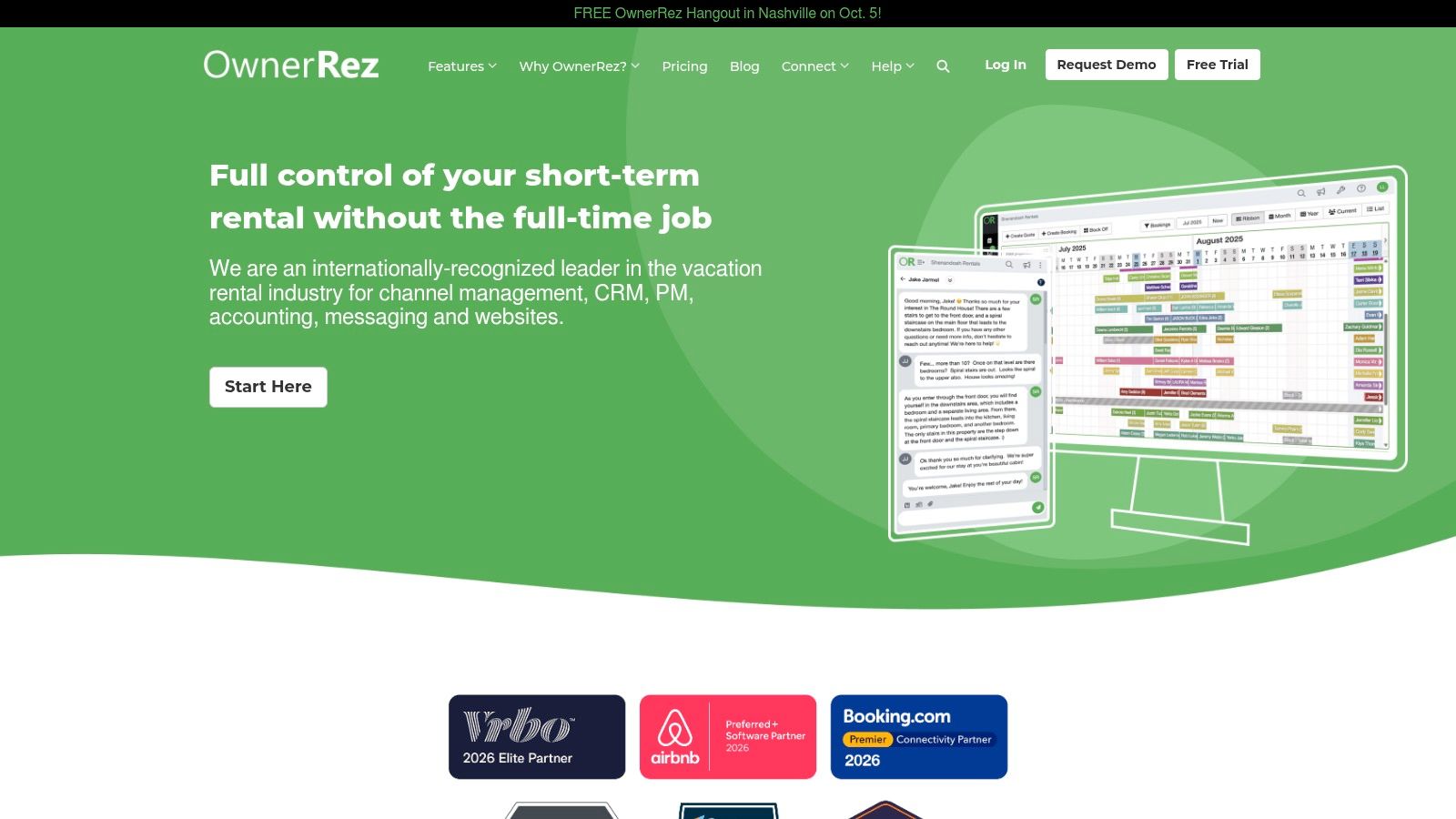
OwnerRez is for operators who already think in terms of rules, settings, and operational detail. Its Hosted Websites add-on makes sense when your real center of gravity is the PMS and you want the site to inherit that depth.
That's different from buying a lightweight builder first and adding operations later. With OwnerRez, the website is downstream from the reservation system.
Who should choose it
OwnerRez offers hosted sites under your domain, secure checkout, availability search, rate display controls, sitemap support, and admin functions such as IP blocklists. It also gives WordPress users a self-hosting route, which is important if your business has already invested in a CMS and doesn't want to give it up.
This is a good fit if your direct-booking strategy is tightly connected to pricing rules and payment workflows. It's a weaker fit if you want something simple enough for a first-time host to understand in a single afternoon.
Operators comparing marketplace-heavy distribution with stronger owned-channel control may also want a grounded look at OTA vs direct booking, because the website choice only pays off if the channel strategy behind it is deliberate.
- Best for: Owner-operators who want a website tied closely to pricing logic, payments, and reservation controls.
- Main trade-off: More capability usually means more setup attention.
- Branding note: Styling tends to stay within theme or template boundaries rather than open-ended design freedom.
Website: OwnerRez
5. Uplisting Direct Booking Website Builder
Uplisting is a sensible choice when the website is one piece of a small team's channel-management setup. Its direct-booking site builder syncs to Uplisting calendars and rules, which keeps the guest-facing experience connected to the same data used for operations.
That means less manual work, but it also means the website is shaped by the PMS rather than treated as an independent marketing build.
Practical fit
Uplisting's strongest appeal is economic structure for operators with multiple units. Its website capability sits inside broader plans, and higher tiers add options like Request-to-Book. If you're managing several listings and already need channel management, account-level pricing can work better than website tools that charge or scale primarily at the individual-property level.
The trade-off is customization depth. You can get a live, consistent, brand-aligned site without much friction, but you won't approach the design flexibility of a bespoke CMS.
A lot of owners overestimate how much design freedom matters and underestimate discoverability. If organic acquisition is part of your plan, this overview of vacation rental SEO is the more important companion to the tool decision.
The prettiest site rarely wins on its own. The site that loads cleanly, keeps rates accurate, and removes booking friction usually does.
- Best for: Small teams already leaning on a PMS or channel manager and wanting direct booking without a second stack.
- Booking mechanics: Stripe payments and synced calendar rules keep the site operationally aligned.
- Limitation: Some direct-booking features are tied to higher plan tiers.
Website: Uplisting
6. Hostaway Direct Booking Website Builder
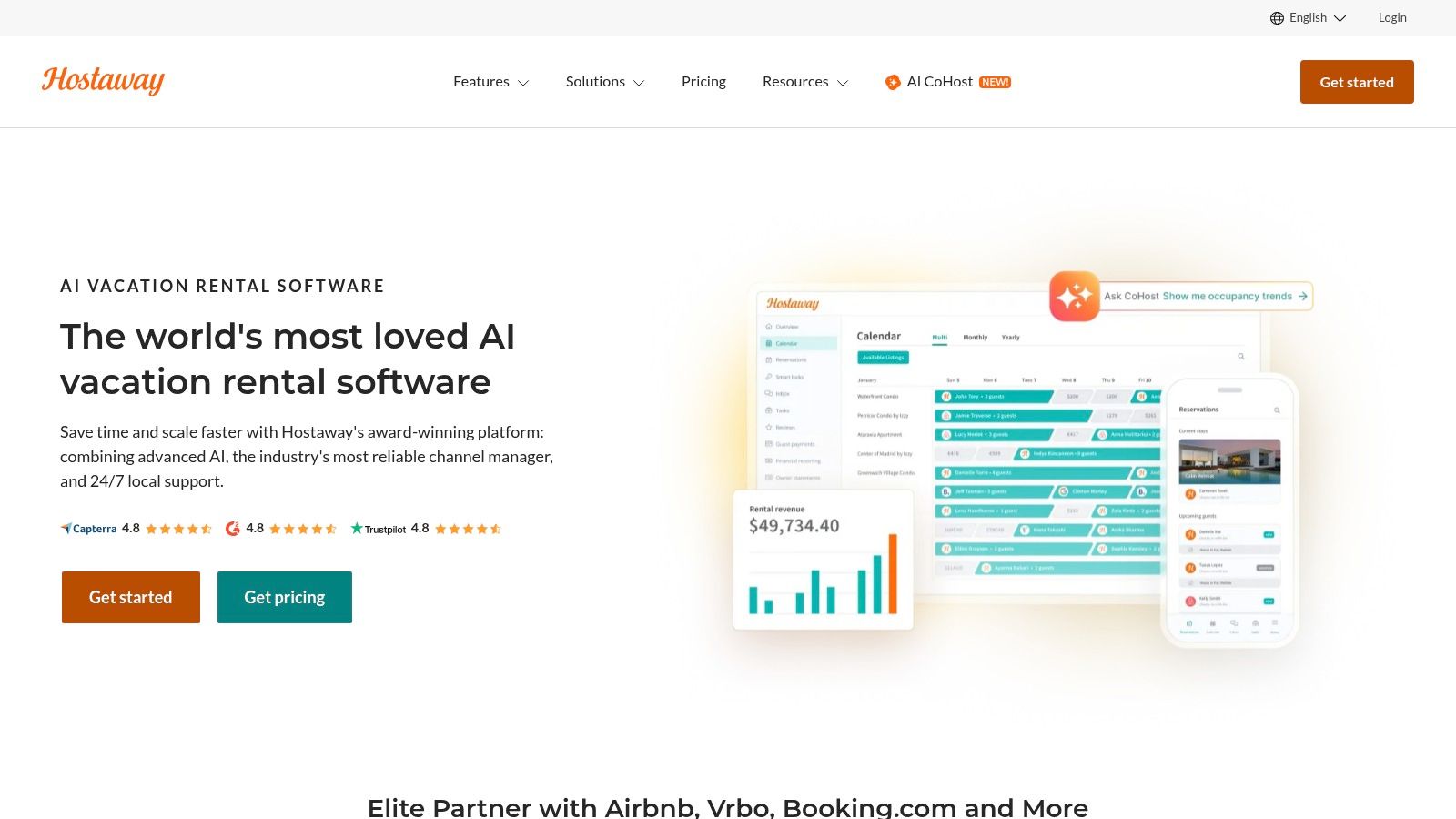
Hostaway belongs on the shortlist when your website purchase is really a PMS decision. Its direct-booking website builder is tightly tied to unified inbox, automations, reporting, and operational workflows.
That usually makes sense for professional managers who care more about system continuity than about front-end originality. The website becomes one intake point into a larger operating machine.
What you're really buying
Hostaway supports hosted direct-booking sites and an embeddable booking engine, plus instant booking and secure payments on your own domain. That combination matters because some managers need a standard hosted site for speed, while others want to keep a separate marketing site and route bookings into Hostaway.
The broader industry direction supports that integrated approach. HomeRunner's 2025 vacation-rental management trends review argues that integrated booking engines and real-time PMS sync had become baseline expectations for serious operators, and that the stronger direct-booking sites are the ones reducing friction, keeping calendars accurate across channels, and converting cautious, late-stage shoppers with transparent pricing and a fast flow.
- Best for: Managers who want bookings, messaging, automations, and reporting inside one ecosystem.
- Operational upside: Strong continuity from guest booking through back-office handling.
- Trade-off: Hosted convenience, but lighter custom design freedom than a fully custom build.
Website: Hostaway
7. Guesty Websites and Guesty for Hosts Website Builder
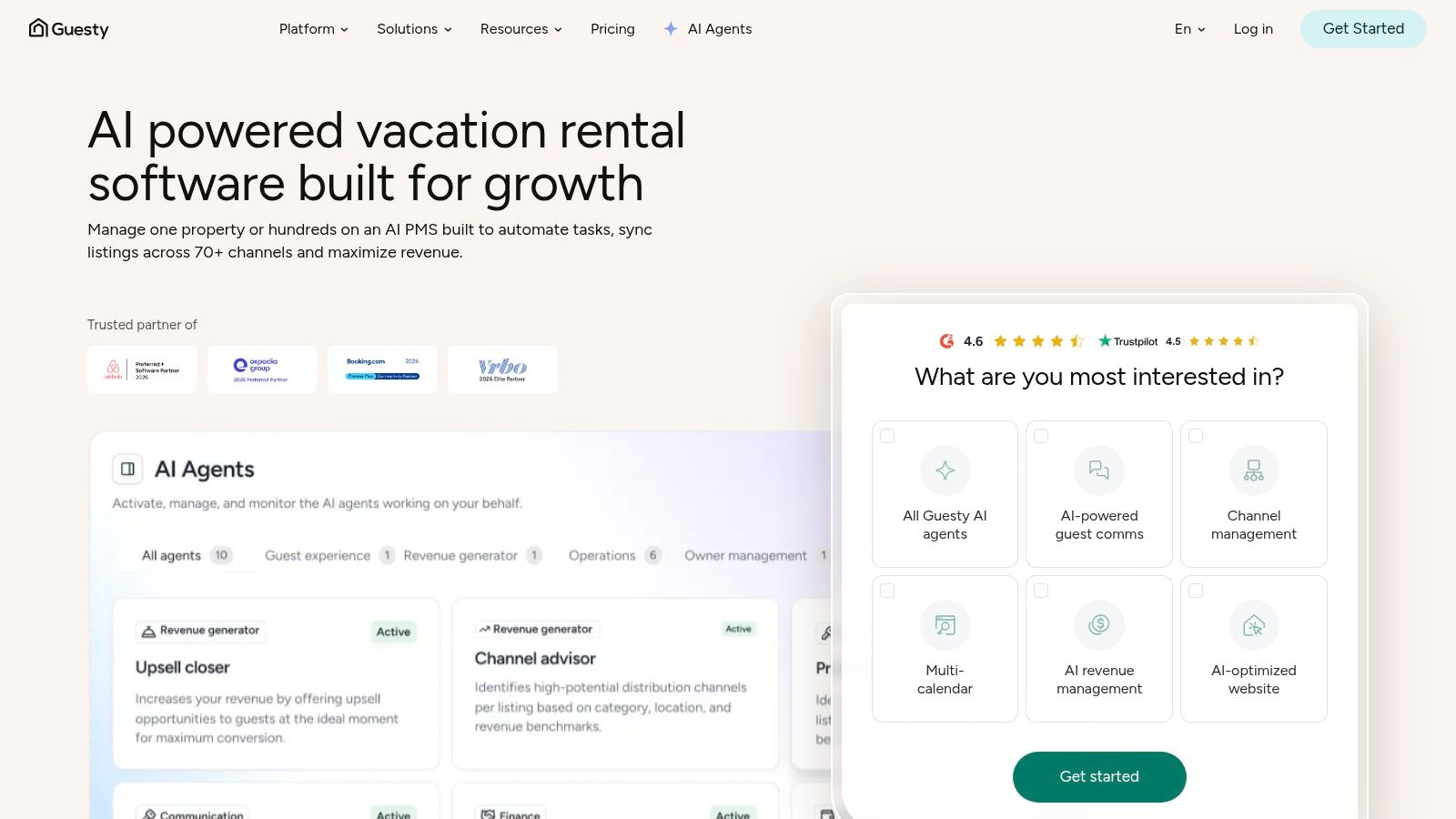
Guesty gives you two ways in. That's the most important thing to know. Smaller operators can approach it through Guesty for Hosts, while larger managers can treat Guesty Websites as part of the Guesty Pro environment.
That split makes Guesty less of a single product than a ladder. If you expect your operating model to change, that's useful.
Fit by portfolio maturity
Guesty offers customizable hosted sites, SEO basics, branded checkout, booking-engine embedding for sites built on platforms like WordPress and Squarespace, and sync across calendar, pricing, and payment systems. If your needs span both content control and operational depth, that breadth is appealing.
The drawback is predictability. Template-guided design is easier to launch, but advanced options and some domain or configuration choices may carry added cost depending on product track and setup.
- Best for: Operators who want a pathway from smaller-scale hosting tools into a broader PMS ecosystem.
- Why it stands out: It supports both hosted deployment and embedded booking-engine use.
- Watch for: Plan boundaries. Guesty's website value depends heavily on which Guesty product line you're entering through.
Website: Guesty
8. Hostfully Direct Booking Site
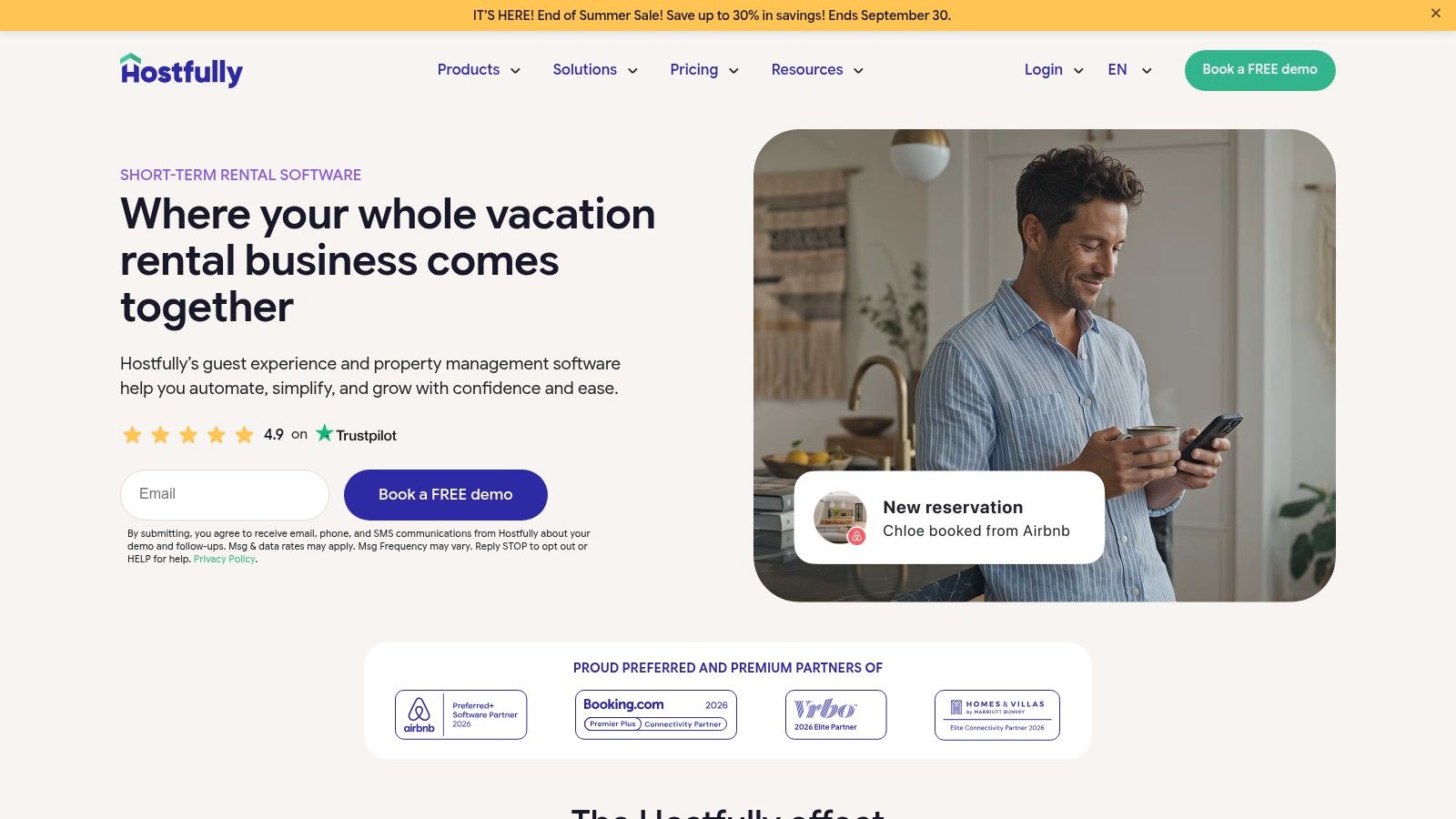
Hostfully is a strong operational pick if you want a direct-booking site attached to a broader ecosystem of integrations, payments, invoicing, and owner-facing management.
It also deserves credit for making an important cost detail visible. Hostfully discloses a 0.85% direct-booking fee on its PMS pricing page. That kind of fee isn't necessarily a deal-breaker, but it changes the economics compared with flat-subscription models.
Why the economics matter
Many owners still assume the biggest hurdle is getting a direct-booking site online. The harder part is getting meaningful channel performance from it. StayFi's 2026 vacation-rental statistics article said 70% of vacation-rental operators had a direct-booking website, yet 62% still generated less than 25% of bookings through direct channels and 18% reported no direct bookings at all.
That has a practical implication for Hostfully buyers. A site connected to a capable PMS can help with operations, but the direct-booking fee only pays for itself if the channel converts and if your traffic strategy is real.
Important lens: Website ownership isn't the same thing as website performance. Ask how the platform helps you reduce friction, not just publish pages.
- Best for: Operators who value PMS depth and third-party integrations more than front-end flexibility.
- Cost trade-off: Percentage-based direct-booking fees can affect margins over time.
- Branding trade-off: Template-based design remains less flexible than custom frameworks.
Website: Hostfully
9. Tokeet Webready
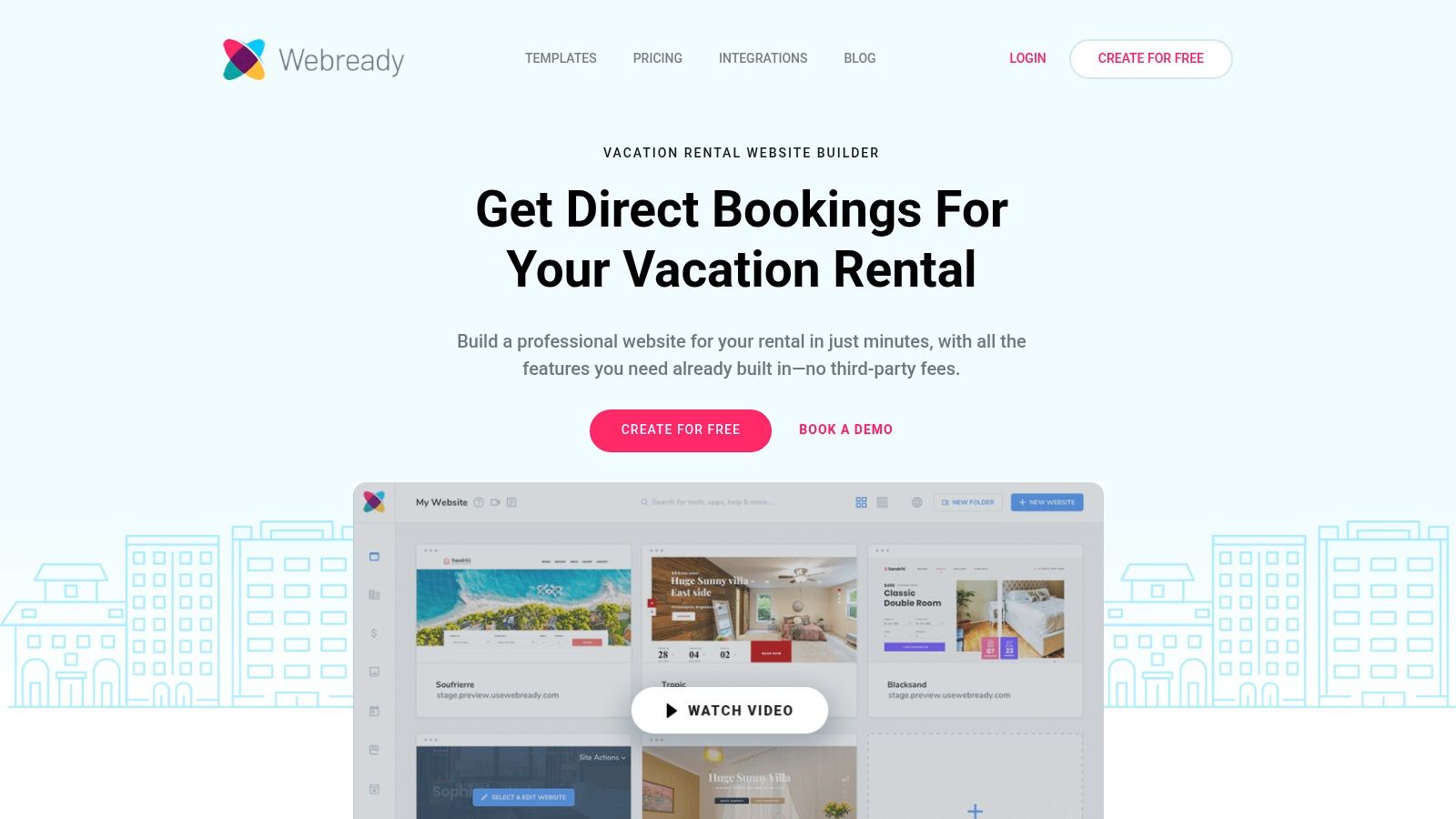
Tokeet Webready is one of the cleaner options for owners who want a true website editor experience without necessarily committing to a large PMS from day one. Its WYSIWYG Live Edit model is the headline. You can build and publish in a way that feels closer to a traditional site builder.
That makes it attractive for non-developers who still want more control over page presentation than many PMS-linked tools allow.
Where it lands in the stack
Webready includes a booking engine, coupons, rate management, SSL, and basic SEO and analytics support. It can run standalone or sync with the broader Tokeet environment, which gives it a hybrid role between independent builder and PMS-connected extension.
That flexibility is the main reason to choose it. You're not forced into the entire Tokeet stack immediately, but you can connect deeper later if you want.
- Best for: Operators who want an easier editor than many PMS websites offer, with the option to integrate later.
- Setup implication: Faster than custom CMS development, but still requires content and booking-flow decisions.
- Cost note: Pricing for advanced or higher-tier configurations isn't always as prominently surfaced as the entry-level message.
Website: Tokeet Webready
10. Bookster
Bookster is the right comparison point when you don't want to replace your website. You want to keep it, then add booking capability through widgets, multi-property search, and an embeddable booking engine.
That makes Bookster more strategic than some hosted-only tools. It's less about "launch me a site" and more about "turn my existing site into a real direct-booking channel."
Best use case
Bookster also adds channel management, market data, direct-booking marketing tools, and built-in dynamic-pricing capabilities. For smaller operators who already have a CMS or designer and don't want to migrate platforms, that's a practical path.
The trade-off is regional orientation and plan complexity. Pricing and documentation skew toward the UK market and GBP expectations, and some advanced capabilities sit higher in the plan structure.
- Best for: Owners who value CMS retention and want booking mechanics embedded into an existing branded site.
- Strongest advantage: Flexible deployment model with practical marketing tools.
- Watch for: Regional pricing assumptions and feature gating on higher tiers.
Website: Bookster
Top 10 Rental Property Website Builders, Feature Comparison
| Product | ✨ Core features | ★ Quality | 💰 Price / Value | 👥 Target audience | ✨ Standout |
|---|---|---|---|---|---|
| 🏆 Rentabble | Branded hosted site, booking-request flow, seasonal rates, 2-way iCal, owner dashboard | ★★★★ | 💰 Basic €9/mo (≤3); Pro €19/mo (≤6); subscription, no commissions | 👥 Independent owners & small operators | ✨ 🏆 Commission-free direct bookings; fast setup; full branding & calendar integrity |
| Lodgify | No-code site builder, native booking engine, channel manager, embeddable widget | ★★★★ | 💰 Tiered plans; add-ons for extras (payments supported) | 👥 Hosts wanting widget + Google Vacation Rentals | ✨ Embeddable booking widget & Google integration |
| Smoobu | Hosted multilingual site, centralized calendar, OTA sync, guest communication | ★★★ | 💰 Subscription; dynamic-pricing add-on | 👥 Small portfolios | ✨ Unified OTA + direct bookings; quick to live |
| OwnerRez (Hosted Websites) | Hosted sites + WordPress plugin, rate display controls, secure checkout | ★★★★ | 💰 Scales with property count; hosted-site add-on pricing | 👥 Owner-operators needing granular PMS controls | ✨ Tight pricing-rule integration; SEO/admin controls |
| Uplisting (Direct Booking) | Hosted site synced to calendars, Request‑to‑Book (Plus), Stripe payments | ★★★ | 💰 Account-level pricing; cost-effective for multi-unit | 👥 Small teams & multi-unit hosts | ✨ Account-level site fee (not per property); simple setup |
| Hostaway (Direct Booking) | Hosted site & embeddable engine, instant booking, payments, PMS sync | ★★★★ | 💰 Builder free to enable; nominal processing fee per direct booking | 👥 Professional managers & agencies | ✨ Deep ops & automation integrations |
| Guesty (Websites) | Customizable hosted site, embeddable engine, calendar & payments sync | ★★★★ | 💰 Enterprise / tiered pricing; some extras may cost more | 👥 Mid → large managers | ✨ Two product tracks (Pro & Hosts); strong onboarding |
| Hostfully (Direct Site) | Hosted direct-booking site, payments/invoicing, broad integrations | ★★★ | 💰 Subscription + 0.85% direct-booking fee | 👥 Small operators focused on operations | ✨ Large integration ecosystem; transparent fee |
| Tokeet Webready | WYSIWYG drag‑and‑drop editor, included booking engine, SEO basics | ★★★ | 💰 Tiered plans; pricing for higher tiers less prominent | 👥 DIY hosts & small teams | ✨ Live inline editing; standalone or PMS-integrated |
| Bookster | Embeddable booking widgets, channel management, market data, dynamic pricing | ★★★ | 💰 GBP-focused tiers; higher features on upper plans | 👥 UK/European operators keeping custom CMS | ✨ Widget-first engine + built-in market/dynamic pricing tools |
Match the Platform to Your Operating Model
The most common mistake in this category is shopping for a rental property website builder as if it's mainly a design purchase. For most owners, it isn't. It's an operating-model purchase that affects how rates are maintained, how calendars sync, how guests submit or confirm reservations, how payments are collected, and how much manual work sits behind every booking.
The market context supports treating it that way. The underlying software category is no longer niche infrastructure. A 2025 market estimate summarized by Dataintelo's vacation rental management software market report valued the global vacation rental management software market at $0.92 billion in 2025 and projected it to reach $2.38 billion by 2034 at an 11.1% CAGR, with cloud-based deployments holding 73.4% of the market in 2025. The same source also cited another market estimate valuing the broader vacation rental software market at $8.6 billion in 2024, projected to reach about $14.1 billion by 2034, with property management software representing 48.3% of software-type share in 2024. The point isn't the forecasts alone. It's that hosted, cloud-based booking, calendar, pricing, and website tools have become core operating infrastructure.
Start with the implementation model. If you need a fast hosted site with minimal setup, narrow the list quickly. If you already have a WordPress, Squarespace, or custom CMS presence, prioritize tools that offer an embeddable booking engine without forcing a rebuild. If operations are already complex, start in the PMS category and treat the website as a connected distribution layer rather than a separate project.
A practical fit looks like this:
- Rentabble: Best for independent owners who want rapid, low-complexity direct booking with predictable subscription pricing.
- Lodgify or Bookster: Best when your existing CMS matters and you want booking functionality layered onto it.
- Smoobu, Uplisting, Tokeet Webready, or OwnerRez: Best when channel management, pricing rules, and day-to-day operations are central to the purchase.
- Hostaway, Guesty, or Hostfully: Best when a broader PMS ecosystem justifies additional setup complexity or direct-booking fees.
Before launch, verify the parts that are hardest to change later. Confirm who owns the domain, what branding elements you can edit, how availability sync works, whether rates update in real time or through iCal windows, how the guest moves from property page to request or checkout, what payment methods are supported, and whether the platform charges flat subscription fees, per-reservation fees, or both.
Then test the booking path yourself. Search dates, trigger a booking, inspect the total price, check calendar updates across channels, review the confirmation flow, and verify what data reaches your dashboard. A rental property website builder isn't finished when it looks right. It's finished when the guest can book cleanly and you understand the full operating cost of every reservation.
If you want the simplest path to an owned direct-booking channel, Rentabble is built for that exact use case. It gives small operators a hosted branded site, live availability, exact pricing, and OTA calendar sync without custom development or per-booking commissions. See how it works at Rentabble.