Vacation Rental Websites a Guide for Savvy Owners
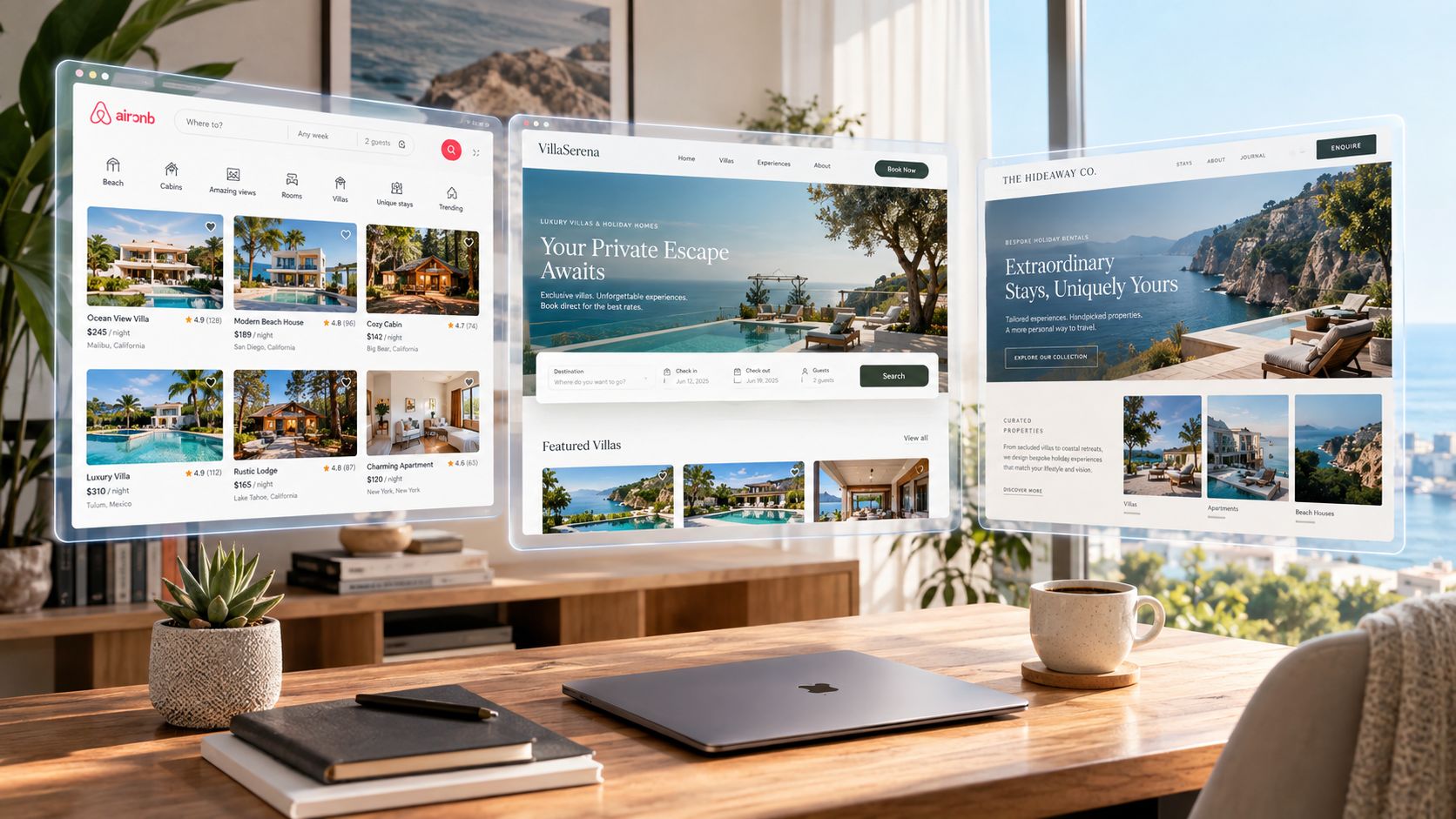
You've furnished the property, photographed every room, and published listings on a major marketplace. Then the first payout arrives. The booking looks healthy until you see how much of the reservation value has gone to commission, while the guest relationship remains tied to someone else's platform.
That trade-off is manageable when you're testing demand. It becomes harder to justify when you're building a lasting rental business. Vacation rental websites now sit inside a global market valued at USD 101.7 billion in 2025, projected to reach USD 121.9 billion by 2033, while online portals continue to grow faster than offline channels, according to Grand View Research's vacation rental market analysis.
The primary decision isn't whether you need a website. It's why you need one. Do you want marketplace reach, lower commission dependence, a recognizable brand, or a direct relationship with guests? The right platform follows from that answer.
Table of Contents
- The Modern Owner's Dilemma Commissions vs Control
- The Three Paths for Your Rental Business
- Comparing Your Website Options Side by Side
- Must-Have Features for a Direct Booking Site
- Marketing Your Website to Attract Direct Bookings
- Choosing the Right Path for Your Business Goals
The Modern Owner's Dilemma Commissions vs Control
A marketplace solves the first hard problem for a new rental: getting seen. Travelers already search there, compare properties, and trust its booking process. You can publish a listing without hiring a designer, building payment tools, or setting up availability displays.
The trade-off reaches beyond commission. The marketplace shapes how guests encounter your property, compare it with competitors, communicate with you, and return to book accommodation. You gain immediate demand, while control over the channel and the guest relationship stays limited.
Practical rule: Use a marketplace to access demand, but don't confuse access to demand with ownership of your business.
The market's scale makes a deliberate channel strategy worthwhile. Airbnb reportedly had more than 9 million active listings, over 5 million hosts, and more than 2.5 billion guest arrivals all-time by 2026, across 150,000 or more cities and towns in 220 or more countries and regions, according to StayFi's vacation-rental statistics overview. Those figures point to the operating standard travelers now expect from online accommodation: searchable inventory, current availability, clear property details, and a booking process that does not require a phone call.
For a new owner, remaining entirely inside that system can feel efficient, and it often is at the start. The business cost appears later. Marketplace reservations give you less control over future contact, repeat bookings, and the way your property's identity is presented.
The margin question
Commission is only part of the decision. A direct booking website may leave more revenue with you per reservation, but it transfers work onto your business. You must attract visitors, answer questions, keep rates and availability accurate, explain policies clearly, and provide a trustworthy payment or inquiry process.
A direct site earns its place when it functions as a sales channel, not an online brochure.
The practical choice for many owners is a gradual shift toward channel ownership. Keep marketplaces that introduce new guests, then build a branded site for repeat visitors, referrals, local search, and travelers who prefer to deal directly with the property owner. This approach preserves reach while creating a path to lower commission dependence and stronger brand recognition.
A website becomes valuable when it changes both the economics and the relationship. It can help retain more revenue per reservation, present your own positioning, and give guests who already know the property a reliable place to book. The purpose is not to abandon demand sources. It is to build an owned channel that supports the business after a marketplace has made the first introduction.
The Three Paths for Your Rental Business
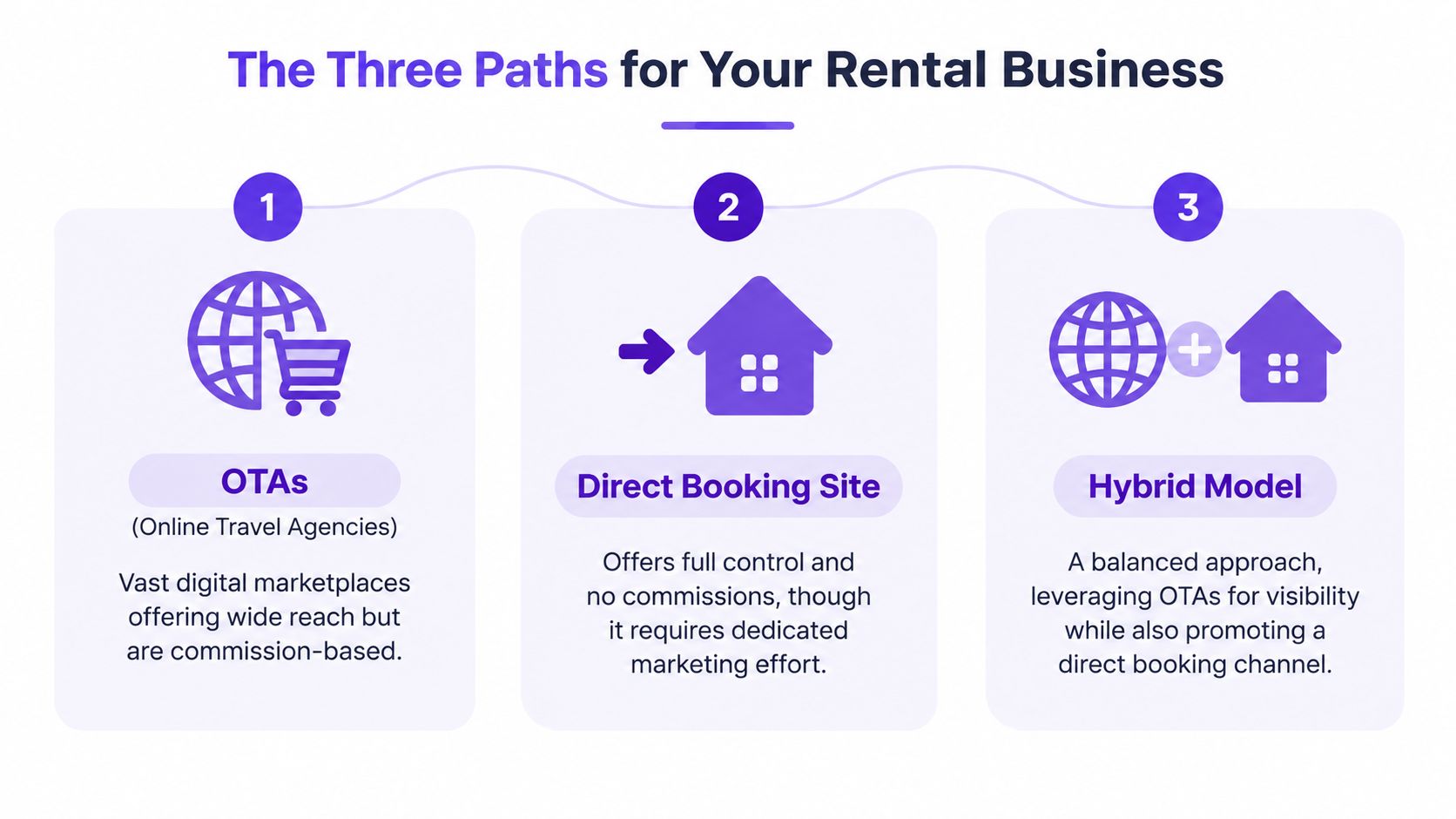
A new owner may start with one marketplace, add a direct booking site after receiving repeat inquiries, and later consider custom technology. These are three different business models, not only three website designs. The right choice depends on whether your priority is immediate reach, lower commission dependence, brand control, or ownership of the guest relationship.
Marketplaces prioritize reach
Online Travel Agencies, or OTAs, place your property in front of an established audience. Airbnb and Vrbo are familiar examples, although their audiences, fees, ranking systems, and operating rules differ. You gain built-in search, reviews, payment tools, customer support structures, and traveler confidence without creating demand from scratch.
The trade-off is reduced control. Your listing appears inside a standardized environment, visibility can change with platform decisions, and guest communication and data access are limited by the channel. Marketplaces suit owners whose immediate goal is filling available dates, testing demand, and learning which amenities or messages attract bookings.
Airbnb's scale shows why this model remains powerful. It has more than 9 million active listings and over 5 million hosts by 2026, creating a global booking environment that has influenced traveler expectations, as noted in StayFi's marketplace statistics reference.
Direct sites prioritize ownership
A direct booking website gives the property its own address, identity, content, and booking path. You can present the accommodation as a distinct product, explain its policies and amenities in your own terms, and share local knowledge that a marketplace template may not accommodate.
The cost is distribution work. A direct site does not bring an audience with it. Visitors must come through search, referrals, social channels, email, signage, or relationships with previous guests. A platform can simplify hosting and booking tools, but you still need accurate availability, clear pricing, useful content, and a reason for travelers to visit.
This model fits owners pursuing lower commission dependence, brand building, and repeat bookings. It also supports a direct relationship with guests, which can make future communication and referrals easier to manage within applicable platform and privacy rules.
Custom builds prioritize control
A custom-built site provides the widest control over design, booking logic, and integrations. A larger operator may need bespoke connections to internal systems, complex property search, unusual booking rules, or workflows that standard platforms cannot support.
That flexibility creates ongoing obligations. Development, maintenance, testing, hosting, security, and technical support all become part of the operating budget. For a single-property owner, custom development may solve problems that do not yet exist. Accurate availability, transparent pricing, strong photography, and a dependable inquiry or booking process may deliver more business value.
The hybrid model balances discovery and ownership
A hybrid model assigns different jobs to different channels. Marketplaces introduce new travelers and support demand discovery. A branded direct site handles referrals, repeat guests, owner-generated marketing, and guests who already know the property.
The model works only with consistent operations. Availability, policies, fees, and cancellation terms must remain accurate across every channel, with a system or routine for preventing double bookings. Each channel should have a defined commercial purpose. Otherwise, the owner pays for duplicated work without gaining meaningful control or reducing dependence on marketplace commissions.
Comparing Your Website Options Side by Side
The best vacation rental websites aren't necessarily the most elaborate. They're the ones whose operating burden matches the owner's resources and whose commercial purpose remains clear.
| Factor | Marketplace, such as Airbnb | Direct booking platform | Custom-built website |
|---|---|---|---|
| Upfront and ongoing costs | Usually low setup effort, with booking-related platform costs | Subscription or platform cost, with lower dependence on booking commissions | Development, hosting, maintenance, and future change costs |
| Brand control | Limited by marketplace templates and rules | Strong control over branding, content, domain, and guest presentation | Maximum design and workflow control |
| Marketing effort | Marketplace supplies built-in discovery | Owner must attract and retain visitors | Owner must attract visitors, while also managing a more complex asset |
| Technical skills | Low to moderate, depending on operational needs | Low, if the platform handles hosting and booking tools | Moderate to high, or dependent on outside specialists |
| Time to go live | Usually fast after listing preparation | Fast when templates and booking tools are ready | Often slower because design, development, testing, and integrations are involved |
| Best strategic role | Demand discovery and occupancy support | Owned channel, brand building, and direct relationships | Differentiated infrastructure for larger or more complex operations |
A marketplace is the simplest starting point if your immediate need is exposure. You're trading control for convenience, and that can be sensible while you learn your seasonality, guest preferences, and operating rhythm.
A hosted direct platform occupies the practical middle. It gives you a public-facing site without requiring you to commission every element from a developer. This is often the strongest fit for a small owner who wants a branded channel but doesn't want website maintenance to become a second business.
Custom development deserves a higher bar. Ask what the custom system will do that a reliable hosted platform cannot. If the answer is mainly visual uniqueness, the expense may not improve bookings. If the answer involves highly complex workflows, multiple operational systems, or a distinctive portfolio experience, custom work may be justified.
The right question isn't “Which platform has the longest feature list?” It's “Which platform removes the business problem I'm trying to solve?”
Evaluate the options against your actual constraints. A single property with limited technical confidence needs simplicity and dependable calendars. A growing portfolio needs repeatable property pages, centralized availability, pricing controls, and a process that doesn't require rebuilding the site whenever the business expands.
Must-Have Features for a Direct Booking Site
A direct site earns bookings by removing doubt at the moment guests decide. They need to see whether the property is available, understand the full price, review the rules, and know what happens after they submit a reservation.
Start with the booking decision
A booking engine should display current availability, calculate the reservation total, and make the next step clear. Guests should not have to send a message just to learn whether their dates are open or whether a cleaning fee changes the total.
Automated pricing reduces repetitive quoting for the owner. Transparent totals reduce uncertainty for the guest. Show the important policies before the reservation request, including minimum stays, check-in restrictions, cancellation terms, and other conditions that affect the booking.
Property presentation carries equal weight. Arrange photos in a practical sequence: sleeping areas first, then entry, kitchen, outdoor space, and proximity to relevant places. Use specific descriptions that answer questions about the stay. Vague phrases about hospitality do little for a guest comparing several properties.
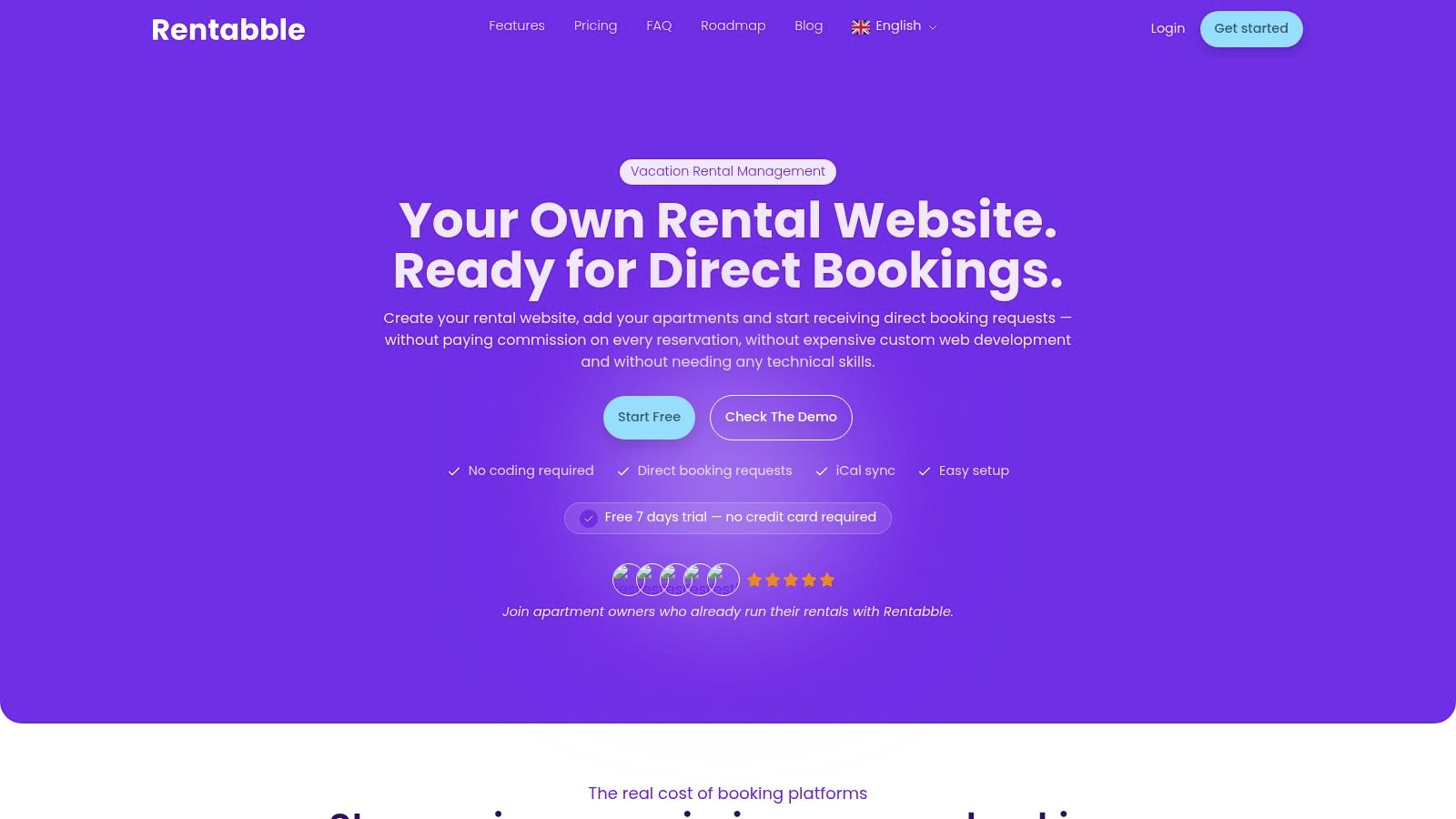
A direct booking platform such as Rentabble's vacation-rental website solution can combine the public website with operational tools. The same standard applies to any provider. The site should help guests make a confident decision while giving the owner a recognizable brand and a direct relationship after the booking.
Treat calendar sync as risk management
Owners who list on Airbnb, Booking.com, Vrbo, Expedia, or other channels need dependable calendar synchronization. iCal is widely used, but it isn't real-time. Platforms commonly retrieve imported calendar files every 2 to 4 hours, and some channels can experience a lag extending to 24 hours. That delay creates a period in which two guests may request the same dates, according to Lodgify's calendar synchronization guidance.
API-based channel managers generally push updates in under 60 seconds, reducing the likelihood of double bookings. If your platform depends on iCal, set procedures around its limits. Check new reservations promptly, avoid promising dates before confirmation, and ensure confirmed bookings block the property automatically.
This video offers a practical example of the website and booking workflow owners should assess before choosing a platform.
Price for the calendar, not just the property
Seasonal pricing tools should support different rate periods, minimum stays, permitted arrival days, and discounts. Without these controls, owners edit rates manually or accept reservations that leave awkward gaps between stays.
A central dashboard should bring together bookings, blocked dates, reviews, revenue snapshots, and property details. Multilingual pages may matter in destinations serving international travelers. An automatically generated sitemap helps search engines find the site's pages.
Security, backups, email notifications, and support protect daily operations. A polished website that loses inquiries, shows stale availability, or requires a developer for every small change can consume more owner attention than it saves in commissions. Choose the platform that supports accurate booking decisions and keeps the guest relationship in your hands.
Marketing Your Website to Attract Direct Bookings
A direct site without a discovery plan is a brochure hidden in a drawer. The marketing job is to reach travelers with a specific intent, such as finding a particular neighborhood, property type, amenity, or travel experience.
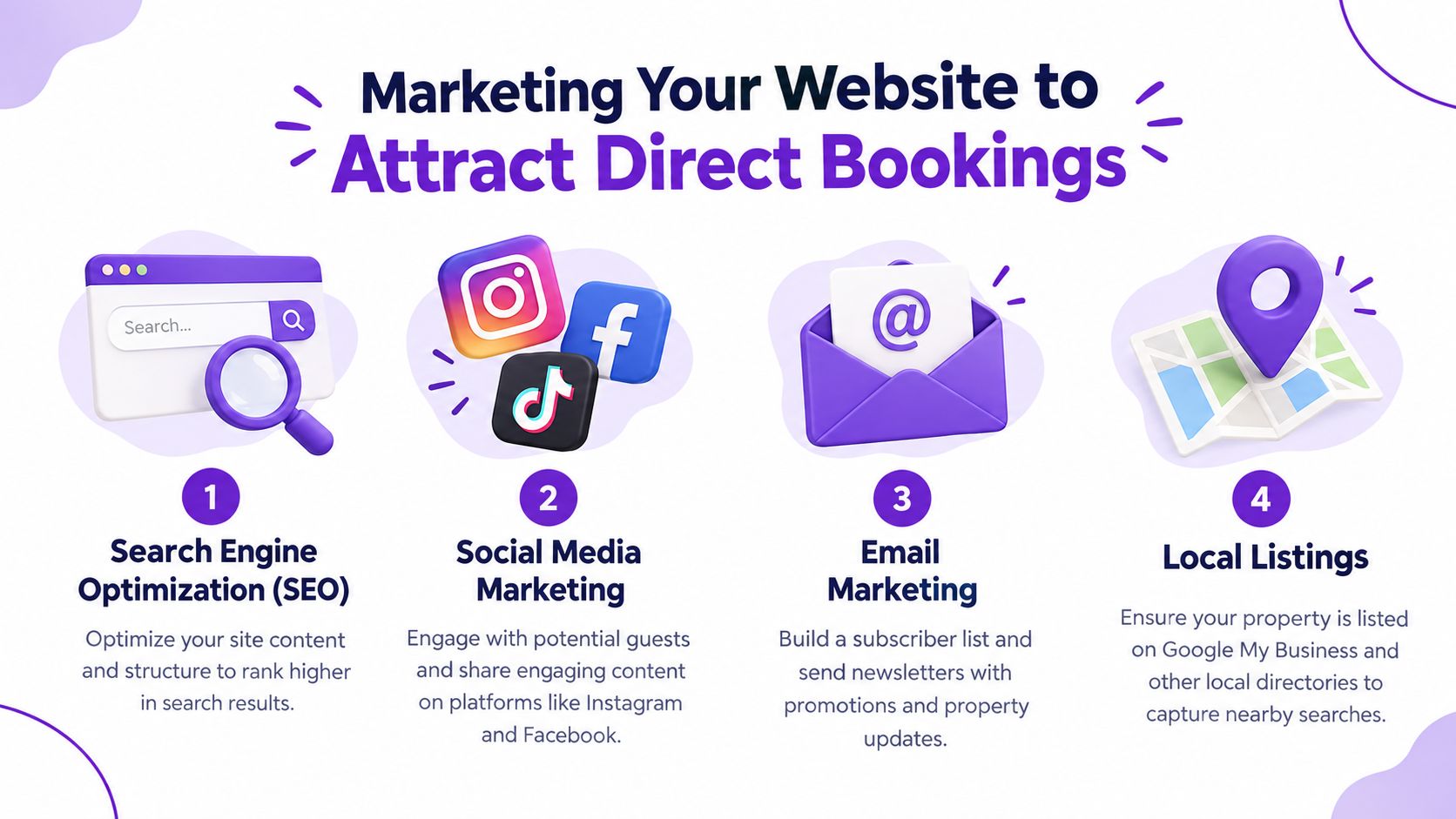
Search Engine Optimization is a practical starting point because it aligns your content with what guests already type into search engines. Use precise location and property terms in page titles, headings, URLs, descriptions, and image alt text. “Apartment near the old town” is more useful than “your perfect escape” when a traveler is actively comparing accommodation.
Build pages around real guest intent
A property page should target the location and accommodation type naturally. Create useful supporting content around arrival information, local attractions, beaches, restaurants, transport, and seasonal activities. The content should answer guest questions, not repeat generic destination copy.
Reviews help in two ways. They provide social proof for visitors already on your site, and they can add natural language describing the location and stay. Ask recent guests for honest feedback and publish it with permission. Keep the wording authentic rather than polishing every sentence into identical marketing language.
Social media works best when it shows the property in context. A short video of the balcony view, a walk to a nearby landmark, or a seasonal change can give potential guests a reason to remember the property. Email is more valuable when it serves a known audience, such as past guests, referral contacts, or people who requested dates but didn't book.
Local listings can capture searches from travelers already researching the destination. Keep the property name, contact details, location, and website consistent wherever the business appears.
Prioritize high-intent traffic
You don't need to beat every global OTA for every search. You need to become visible for searches that indicate a strong match between the traveler and your property.
Direct sites ranking in the top three organic positions for destination-intent searches can convert visitors at 2 to 4 times the rate of OTA referral traffic, while operators with dedicated SEO programs reportedly reduce OTA commission dependence by 30% to 50% within 18 months, according to Authority Specialist's vacation-rental SEO statistics.
Those results shouldn't be treated as a guarantee. Ranking takes sustained work, and a weak booking experience can waste otherwise qualified traffic. Use practical vacation-rental marketing guidance to keep the work focused on pages, messages, and channels that support a direct booking decision.
Choosing the Right Path for Your Business Goals
A marketplace is the practical starting point when immediate exposure matters and the property is still being tested. It provides discovery and access to established traveler demand, but the trade-off is limited control over the guest relationship. Track which guests, dates, and inquiries could eventually shift to a channel you own.
Choose a direct booking platform when the business goal is control. A branded site gives referrals, past guests, local-search visitors, and direct-minded travelers somewhere to book with the property itself. The platform should also keep routine work manageable, including calendar updates, property pages, pricing changes, and booking requests, without requiring a developer.
Custom development belongs in a narrower category. Consider it only when a larger portfolio, distinctive booking process, or complex integration cannot be handled by simpler tools. Building custom software because the site should look different is a weak business case if discoverability, price clarity, and calendar accuracy still need improvement.
Match the channel to the stage
Property count influences the decision, but it does not settle it. A single owner can benefit from direct bookings when the property has a strong local identity and regular referrals. A multi-property operator may need centralized controls so availability, pricing, and content stay consistent across the portfolio.
Your preferred operating model matters too. Owners creating a lifestyle business with fewer administrative tasks should choose a hosted platform with clear controls. Owners building a recognizable accommodation brand should prioritize original content, a controlled domain, guest reviews, repeat-booking paths, and technology that can support additional properties.
Direct guests may behave differently from OTA guests. Data from 2025 reported that direct-booking guests stayed 45.2% longer and booked 51.3% earlier than OTA guests, according to Houfy's direct-booking statistics. That pattern makes direct bookings useful for longer-lead reservations, while marketplaces can continue supplying discovery.
For many owners, a hybrid system is the workable answer. Use OTAs to introduce the property, the direct site to strengthen the brand and guest relationship, and dependable calendar procedures to keep every channel aligned. Assign each channel a job instead of expecting one platform to do everything.
The decision should follow the business outcome. Choose a marketplace if listings and reach are the immediate need. Build a direct channel if lowering commission dependence and owning guest relationships are priorities. Investigate custom development only after simpler tools have failed to support a clearly defined requirement.
Rentabble gives owners a branded direct-booking website with property pages, availability, pricing controls, calendar synchronization, and booking-request tools without custom development. Visit Rentabble to create an owned booking channel that supports the brand and reduces reliance on marketplace commissions.