Airbnb Commission Changes: What Croatian Hosts Should Do

You opened your payout statement for a Split booking and the fee line came back larger than the spreadsheet in your head said it should be. The percentage is the part everyone argues about; the part that matters is what it removes from a year of bookings.
What an Airbnb commission increase costs Croatian hosts is arithmetic, not opinion, and you can run it with your own figures in a few minutes. Below is a worked model for two apartments in Split at three occupancy levels, then three responses in the order that costs you least to try.
Start with the fee on your own payouts
The host service fee is not one number worldwide. It depends on the fee structure attached to your listing and on the market, so any article quoting “the new Croatian rate” is only useful if it matches the line you were actually charged.
Two places tell you the truth: the fees or pricing section of your listing settings, and the breakdown of a recent payout. Write down the percentage deducted from your last three bookings, and the date of the first booking where it changed. That is your starting number, and everything below uses it.
- The fee is charged per booking, so it scales with nights sold, not with your profit.
- What it is calculated on depends on the fee structure — check the payout breakdown to see which lines it touched.
- It is deducted in the month of the stay, which is why a change feels sudden even when it has been visible in the settings for weeks.
The model: two apartments in Split, three occupancy levels
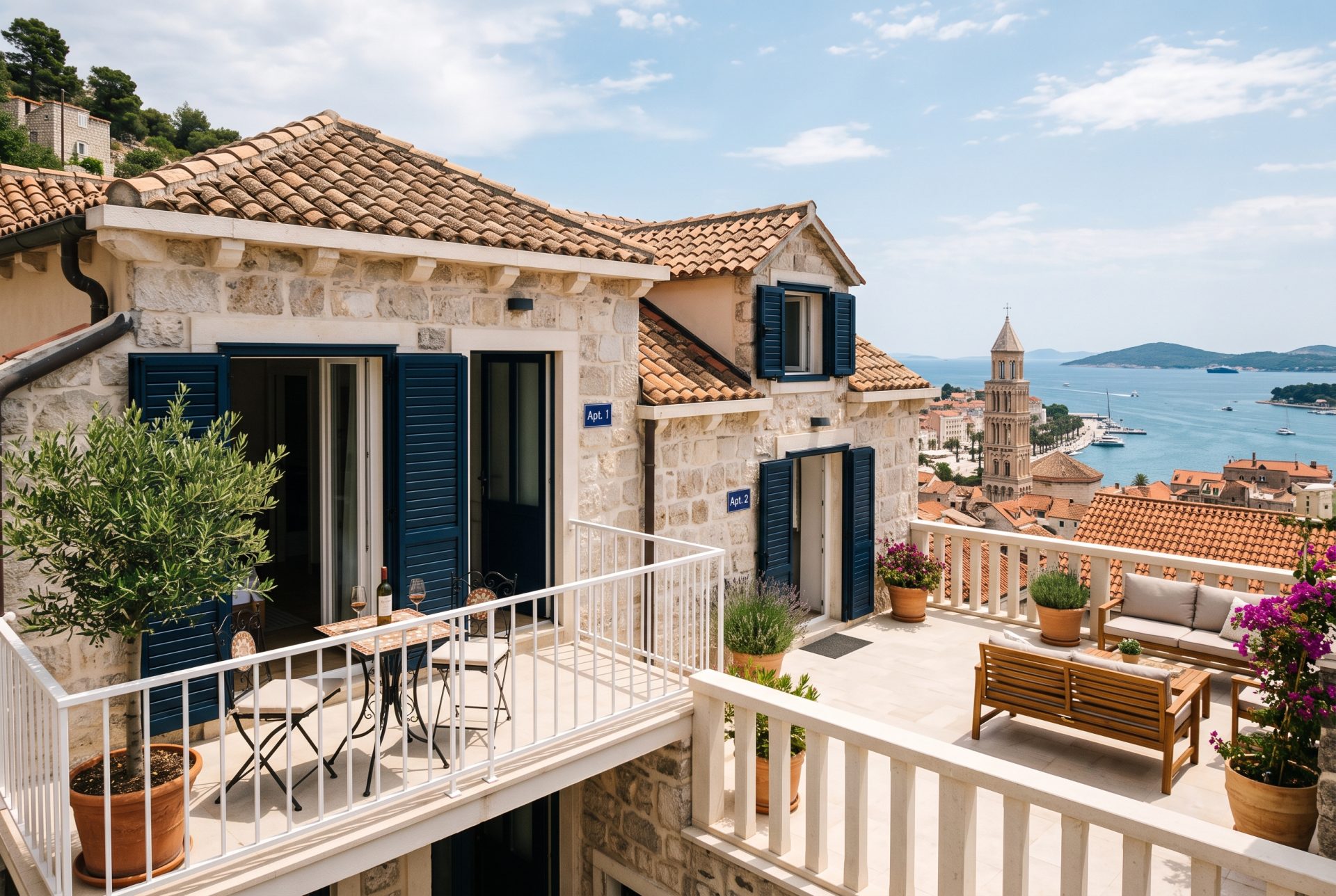
Take a portfolio most Croatian owners would recognise: two one-bedroom apartments in the same building, similar standard, an average nightly rate of €110 across the year before platform fees and tourist tax, and 730 sellable nights (two apartments × 365). Here is what a fee change costs at 45%, 60% and 75% occupancy.
| Occupancy | Nights sold | Gross accommodation revenue | Cost of each 1 percentage point of fee | Cost of a 5-point move |
|---|---|---|---|---|
| 45% | 329 | €36,190 | €362 | €1,810 |
| 60% | 438 | €48,180 | €482 | €2,410 |
| 75% | 548 | €60,280 | €603 | €3,015 |
Read the fourth column as your multiplier. If the fee on your payouts rises by two percentage points, the annual cost at 60% occupancy is about €964; at 75% it is about €1,206. None of this depends on a rate we guessed — it is your revenue multiplied by the change you can see in your own account.
The table also shows why the percentage is a poor way to think about it. At 60% occupancy, a five-point move costs about the same as 22 extra nights at €110. If your average rate is closer to €160, multiply the last two columns by about 1.45 before you decide anything.
The effect on profit, not revenue
The fee is charged on revenue but paid out of profit. If your two apartments keep roughly a third of gross bookings after cleaning, utilities, accounting and local charges, then a €2,410 increase at 60% occupancy is about 15% of that profit. Divide the annual cost by your own pre-change profit: that ratio, not the percentage, is the size of the decision.
First response: re-price on Airbnb, but only where it works
Re-pricing is the fastest response and costs nothing to try. To hold your net revenue per booking constant, the booking value has to rise by the fee increase divided by one minus your new total fee. If, purely as an example, your total fee moves from 15% to 20%, the uplift is 5 ÷ 80 = 6.25%, not 5%.
What we see when owners do this badly: the whole calendar goes up 6% in one evening, the shoulder-season weeks stop booking, and the extra revenue on peak weeks does not cover the empty nights. Test it on a defined set of dates and measure the result.
- Pick the test dates. Six to eight weeks of peak and shoulder dates, not the full year.
- Change one thing. Raise the nightly rate on those dates by the calculated uplift and leave everything else alone.
- Give it two booking cycles. A booking cycle is the typical gap between a guest reserving and arriving on those dates; you can read it from your own reservation history.
- Apply the pass mark. Pass: net revenue per available night on those dates is higher than before. Fail: booked nights fell by more than the price rose — revert the test dates and keep only the peak-week increase.
Rises usually stick on weekends, school holidays and dates around major events in Split. They usually fail on dates more than a few months out, when guests are still comparing everything on the platform. The full set of levers is in our guide to vacation rental pricing strategy.
Second response: turn past guests into direct bookings

The cheapest booking you will ever take is from someone who has already stayed. They know the apartment, they know the stairs, and they are not comparing forty listings. What is usually missing is not a discount — it is a reason to come back and a way to book that takes one message.
- Collect consent, not just email addresses. Ask at check-out whether you may send one message a year about dates. Keep a record of the answer; EU rules require it and it protects you.
- Send three messages, not a newsletter. One before arrival with practical details, one a few days after departure alongside the review request, one in late autumn when guests plan the next summer.
- Offer what the platform cannot. Flexible check-in, first refusal on the same week next year, or a direct rate slightly below the platform price. Do not hand back more than the fee you are saving.
The list mechanics and timing are covered in vacation rental email marketing. Expect the first repeat bookings to be occasional rather than a channel; the point is that they compound and are not exposed to the next fee change.
Third response: a booking page you own
Past-guest messages and your own website are the same asset: a booking route you control. A direct booking page needs four things to function — a live availability calendar, a rate for each date, a way to take payment, and terms the guest accepts at the moment of booking. The photos and the description you already have.
- Decide what the site sells. One page per apartment, plus a page answering what guests ask before booking: parking, stairs, check-in time, distance to the ferry.
- Connect the calendars. If a direct booking does not block the same dates on Airbnb, you will double-book, and that mistake costs more than the fee. How the sync works and where it fails is set out in vacation rental calendar sync.
- Set payment and cancellation terms. A deposit at booking and the balance before arrival is standard; the terms belong on the page, not in a message after the guest asks.
- Send a proper confirmation. The confirmation email is where the guest decides whether to trust the booking: address, check-in arrangement, what happens next, who to call.
Most owners stop at step one because the rest looks technical. It is mostly configuration: Rentabble builds direct-booking websites for holiday rentals, so owners can take bookings on their own site instead of paying commission to a platform. The wider build-or-buy question is set out in direct booking website explained.
The Croatian part: eVisitor, tourist tax and VAT
Some of the administrative work disappears when you leave the platform, and some of it simply moves to you. Direct bookings are the second kind.
Guest registration and tourist tax
- Register every guest in eVisitor. Croatian rules require each guest to be registered and the tourist tax reported per night; deadlines and rates vary by municipality and season, so confirm the current figures with your local tourist board rather than a blog.
- Check what the platform actually did. How much of the registration and tax reporting a platform handles varies by platform and by the arrangement on your listing. The legal obligation stays with you either way, so verify each stay appears in eVisitor and that any tax was collected and remitted.
- Build it into check-in. Ask for names, document numbers and dates at the time of booking. The eVisitor entry then takes two minutes instead of reconstructing a stay from a message thread a week later.
VAT, invoices and fiscalisation
- Know your VAT position this year. Whether short-term letting is VATable for you depends on your registration and turnover, and thresholds have moved in recent years. Ask your accountant for your position now rather than relying on what was true when you started.
- Invoice in euro, from your own business. A direct booking produces an invoice you issue: your details, the dates, the accommodation, the tourist tax shown separately.
- Keep the fiscalisation trail. Payments taken directly fall under Croatian fiscalisation rules, and card payments through a provider still have to be reconciled to the invoices you issued. A monthly reconciliation of bookings, invoices and payouts saves a day at year end.
Which of the three to do first
| Response | What it costs | What it depends on | Main risk |
|---|---|---|---|
| Re-price on Airbnb | Attention, no cash | Occupancy data for your own dates | Losing shoulder-season bookings |
| Past guests direct | One message per guest | A consented list and a reason to return | Little — worst case, silence |
| Your own booking page | Setup work and a monthly cost | Calendars, payments, written terms | Double bookings if sync is wrong |
Order: re-price this week, because it is free and reversible. Start the guest list at the next check-out, because it takes one message. Build the booking page once the first two are running, because it is the only one of the three that keeps working without you.
Absorbing the increase is also a legitimate answer — when the annual cost is small against your profit and the alternatives would cost more in time than they return. Run the table before deciding; the figures, not the percentage, tell you which case you are in.
Common mistakes
- Absorbing the increase without repricing anything. Doing nothing is a decision to accept a lower net rate on every future booking.
- Applying the uplift to the whole calendar at once. The dates that go quiet are usually the shoulder weeks you needed.
- Undercutting the platform by the full fee. A direct rate at or slightly below the platform price is enough of a reason; matching the fee saving exactly leaves you nothing for the extra admin.
- Launching the site before calendar sync works. One double booking costs more in refunds and reviews than several months of fee.
- Forgetting eVisitor for direct guests. The platform prompt is gone; the obligation is not.
- Treating tourist tax as your own money. Keep it as a separate line from the day you take the booking, not from the day you file.
What to do with the numbers
Run your own version of the model: nights sold, average nightly rate, and the actual change on your payout statement. That gives an annual cost in euros, and dividing it by your profit gives the size of the problem — which is usually smaller than the headline percentage suggests and larger than most owners assume.
Then act in the order that costs least. Re-price a defined set of dates and measure them against a pass mark you set in advance. Collect the guests you have already hosted. And build a booking route you control before the next fee change arrives, because the only durable answer to a platform fee is a guest who books with you directly.